Easy Two-step Word Problems Worksheets for Ages 3-4
5 filtered results
Difficulty Level
Grade
Age
-
From - To
Subject
Activity
Standards
Introducing our Easy Two-Step Word Problems worksheets, perfectly tailored for 3-4-year-olds! These engaging Homeschool online printables are designed to develop early math skills in a fun and interactive way. Each worksheet presents simple, age-appropriate problems that encourage young learners to apply basic arithmetic in real-world scenarios. With clear instructions and colorful illustrations, these printables make learning enjoyable and accessible for preschoolers. Ideal for home education, our worksheets help build a strong foundation in problem-solving and critical thinking. Start your child's educational journey with confidence by choosing our Easy Two-Step Word Problems worksheets today!
Favorites
With answer key
Interactive
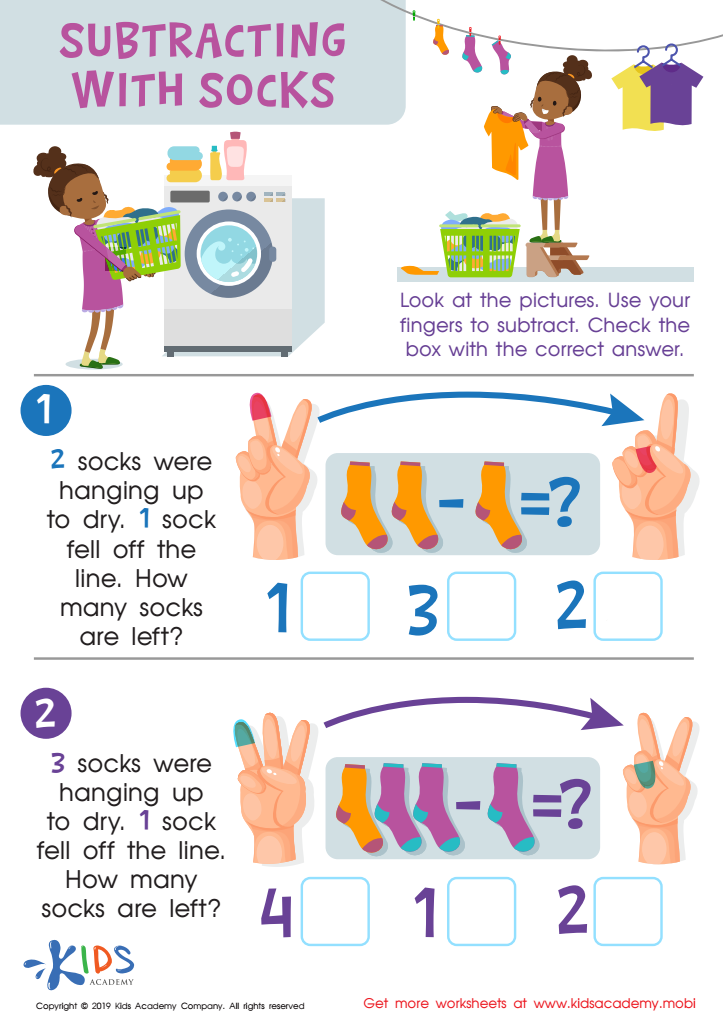
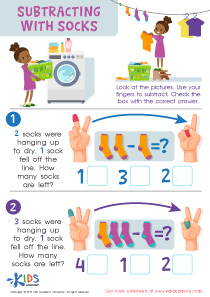
Subtracting Socks Worksheet
Before beginning this exercise with your children, warm them up with a counting game. If math is not their favorite subject, use this worksheet. Help them read the two word problems, then use their fingers to count and subtract. Ask them to select the correct answer and check the box.
 Assign to My Students
Subtracting Socks Worksheet
Worksheet
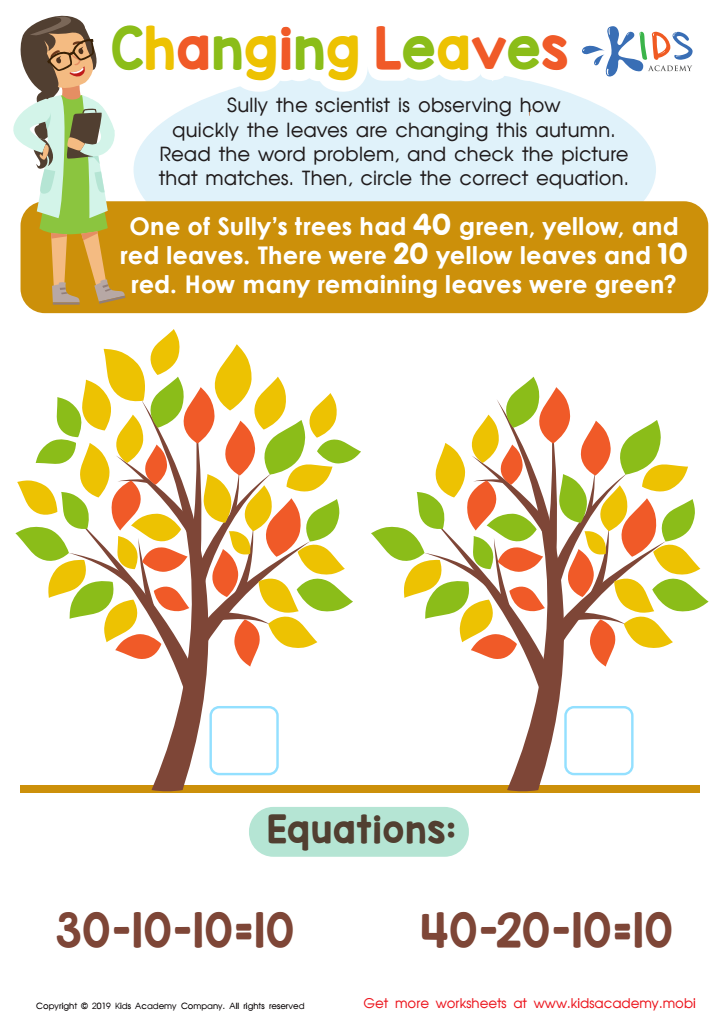
Changing Leaves Worksheet
Fall is the perfect time for kids to help Sully the scientist observe the changing leaves! Download the free worksheet with a subtraction word problem and bolded info to find the matching equation and picture. It's a fun way for your tots to learn while they admire the reddening, yellowing, and orange leaves.
Changing Leaves Worksheet
Worksheet
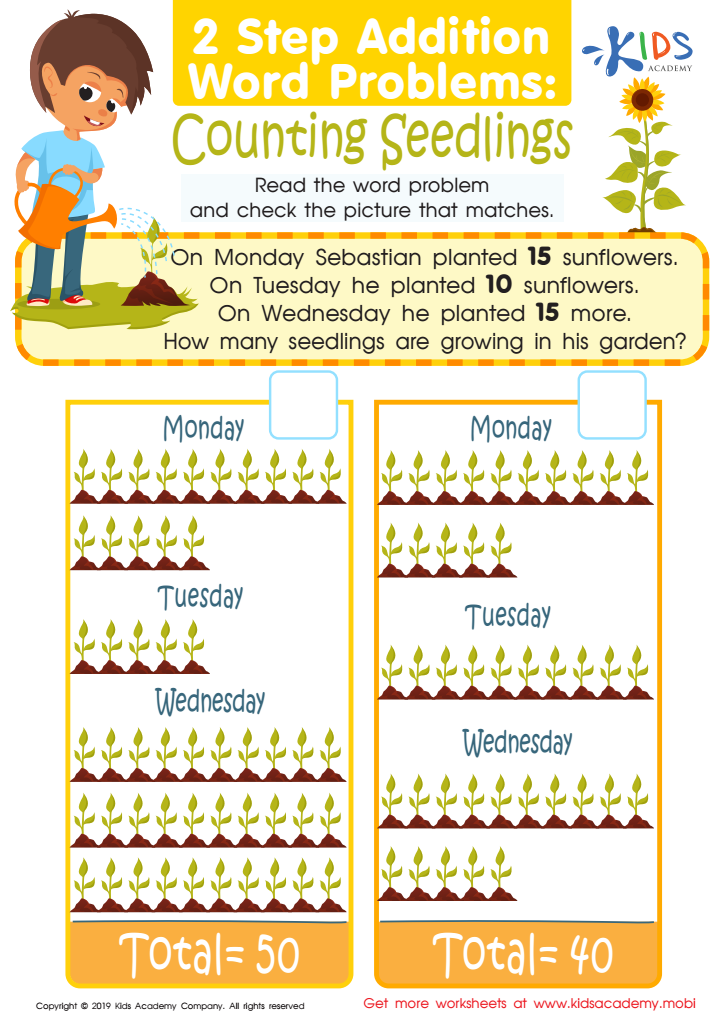
Counting Seedlings Worksheet
Understanding math word problems is key. Multiple steps can prove challenging - this free worksheet provides one-to-one picture representation to help kids solve multi-step addition word problems. Strengthen addition skills by choosing the matching picture to the answer.
Counting Seedlings Worksheet
Worksheet
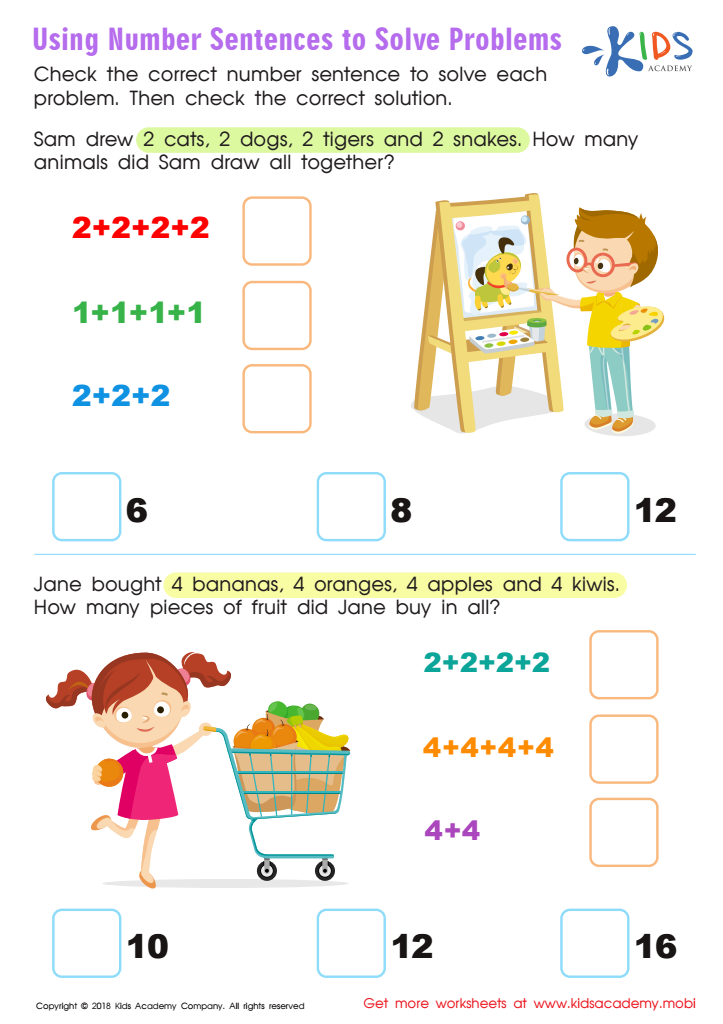
Using Number Sentences to Solve Problems Worksheet
Solving math problems requires an efficient strategy. Picture representation can help young mathematicians with basic addition problems, especially when it involves repeated addends. As they gain confidence, they'll be able to apply their number sentence solving abilities to more complex equations.
Using Number Sentences to Solve Problems Worksheet
Worksheet
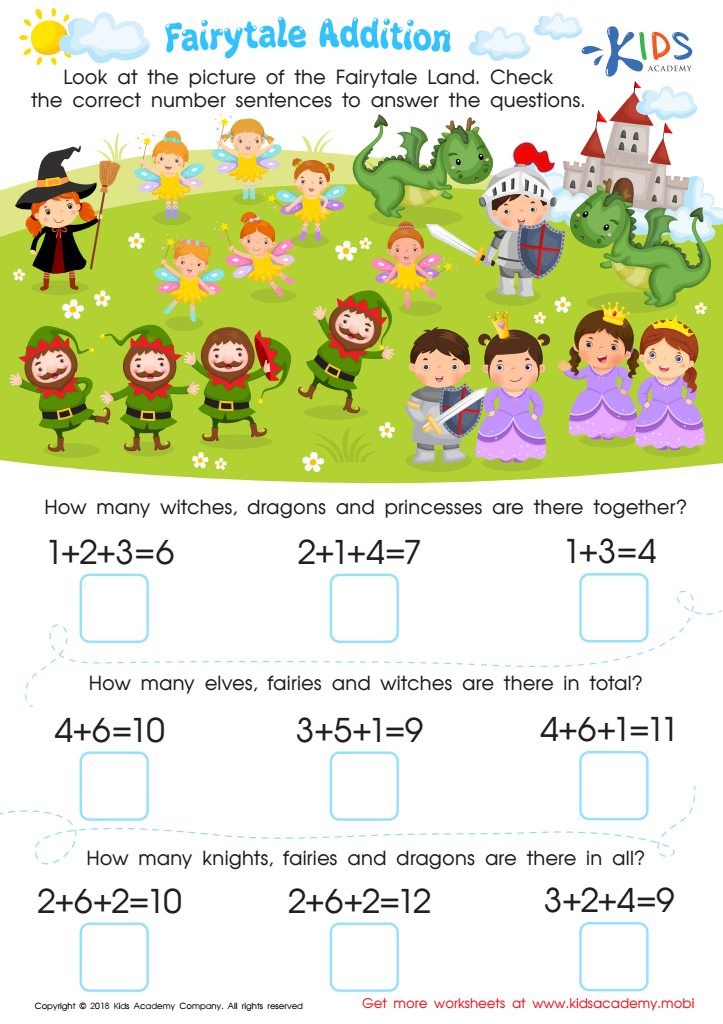
Fairytale Addition Worksheet
Take your kids to Fairytale Land! They'll meet witches, dragons, fairies, elves, knights, and princesses. This free worksheet adds up the fun, letting kids use three addends to solve addition equations and find the right answers. With friends like these, math won't even seem like math!
Fairytale Addition Worksheet
Worksheet
Join Kids Academy for Free
Who is primarily going to use this learning content?



The Value of Easy Worksheets on Two-Step Word Problems for Young Learners
In the foundational stages of learning, particularly for children aged 3-4 years, engaging and interactive educational tools are crucial. Among these tools, homeschool interactive worksheets focused on two-step word problems play a pivotal role. These worksheets not only blend learning and fun but also lay down the early tracks for critical thinking and problem-solving skills.
Building Blocks of Learning
For young children, every new experience or piece of knowledge serves as a building block for their future education. Easy worksheets on two-step word problems are uniquely designed to cater to the developmental needs of 3 to 4-year-olds. At this age, children are just beginning to comprehend the world around them through more complex interactions. These worksheets simplify what might initially seem like a challenging concept, breaking it down into manageable, solvable parts that make sense to young minds.
Engagement Through Interaction
Homeschool interactive worksheets are particularly beneficial because they promote active learning. Unlike passive video or auditory lessons, these worksheets require direct engagement from children, prompting them to think, analyze, and write. This hands-on approach ensures that children are not mere spectators of their learning process but active participants. This engagement is crucial at a young age as it sets the groundwork for educational habits and the love for learning.
Stepping Stones in Cognitive Development
Two-step word problems are an excellent exercise for cognitive development. Initially, solving these problems helps children understand sequence and order—fundamental concepts in both math and everyday life. By engaging with these problems, children learn to follow steps, a skill that is transferable to many other areas, including reading comprehension and scientific thinking.
For instance, a typical problem in such a worksheet might involve a scenario like: "Sara has 2 red apples. Her mother gives her 3 more. How many apples does Sara have now?" This problem teaches counting and addition in two segments, making the child pause, process, and then proceed—a vital skill in logical thinking and reasoning.
Customized Learning
Another significant advantage of homeschool interactive worksheets is their adaptability. Parents and educators can tailor these worksheets to the specific learning pace and interest of each child. This personalized approach ensures that no child feels left behind or unchallenged, fostering a positive learning experience. It also allows for the integration of colorful, engaging visuals and themes that align with the child's interests, further enhancing the learning process.
Parent-Child Interaction
Interactive worksheets designed for homeschool environments encourage not just child engagement, but also parent involvement. This is particularly beneficial in the developmental stages of children aged 3 to 4 years, as parental support is crucial in reinforcing new concepts. By working through two-step word problems together, parents can observe their child’s problem-solving process and provide immediate feedback or assistance where needed. This not only strengthens the child's understanding but also deepens the bond between parent and child, making learning a shared, enjoyable experience.
Preparation for Future Academic Challenges
Starting with two-step word problems at a young age prepares children for the more complex academic tasks they will encounter in school. These early experiences with problem-solving lay a strong foundation for subjects like mathematics, science, and critical reading. By mastering the skill of breaking down problems into manageable steps early on, children equip themselves with the tools necessary for tackling multi-step problems that are common in higher educational settings.
Confidence and Independence
Working through two-step word problems can significantly boost a young child's confidence in their abilities. As they successfully solve each problem, their self-esteem grows, and they are encouraged to take on more challenges. This sense of achievement helps cultivate an attitude of independence and a willingness to explore new topics and areas of learning. Given that confidence plays a critical role in a child’s overall academic performance, starting with these manageable challenges can make a significant difference.
Conclusion
Easy worksheets on two-step word problems are more than just simple tools for teaching mathematics; they are gateways to developing essential life skills in young learners. Homeschool interactive worksheets provide a structured yet flexible approach to early education, allowing young children to thrive in a nurturing, engaging, and intellectually stimulating environment. By incorporating such resources into the educational journey of children aged 3 to 4, we pave the way for a brighter, more confident generation of thinkers and problem solvers. These worksheets are not just about learning numbers; they are about setting the stage for lifelong learning and success.