Easy Two-step Word Problems Worksheets for Ages 7-8
5 filtered results
Difficulty Level
Grade
Age
-
From - To
Subject
Activity
Standards
Introduce your 7 to 8-year-olds to the engaging world of math with our Easy Two-step Word Problems worksheets! Designed to build critical thinking and problem-solving skills, these school worksheets offer a fun and interactive way to deepen their understanding of basic arithmetic operations. Each sheet is carefully crafted to challenge young minds while reinforcing their math fundamentals. With clear instructions and a variety of scenarios, children will enjoy unraveling each problem across every engaging page. Perfect for classroom use or home practice, these worksheets are essential tools for developing young learners' mathematical abilities. Equip your child for success today!
Favorites
With answer key
Interactive
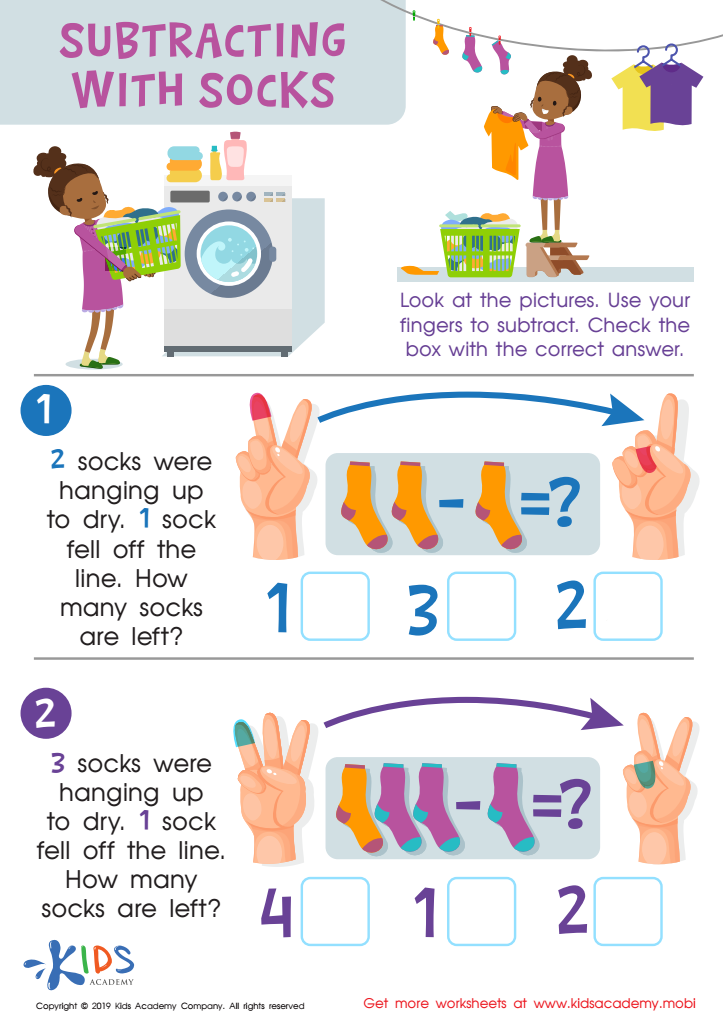
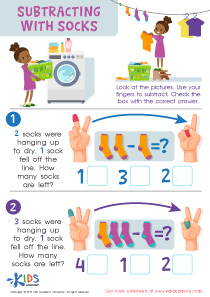
Subtracting Socks Worksheet
Before beginning this exercise with your children, warm them up with a counting game. If math is not their favorite subject, use this worksheet. Help them read the two word problems, then use their fingers to count and subtract. Ask them to select the correct answer and check the box.
 Assign to My Students
Subtracting Socks Worksheet
Worksheet
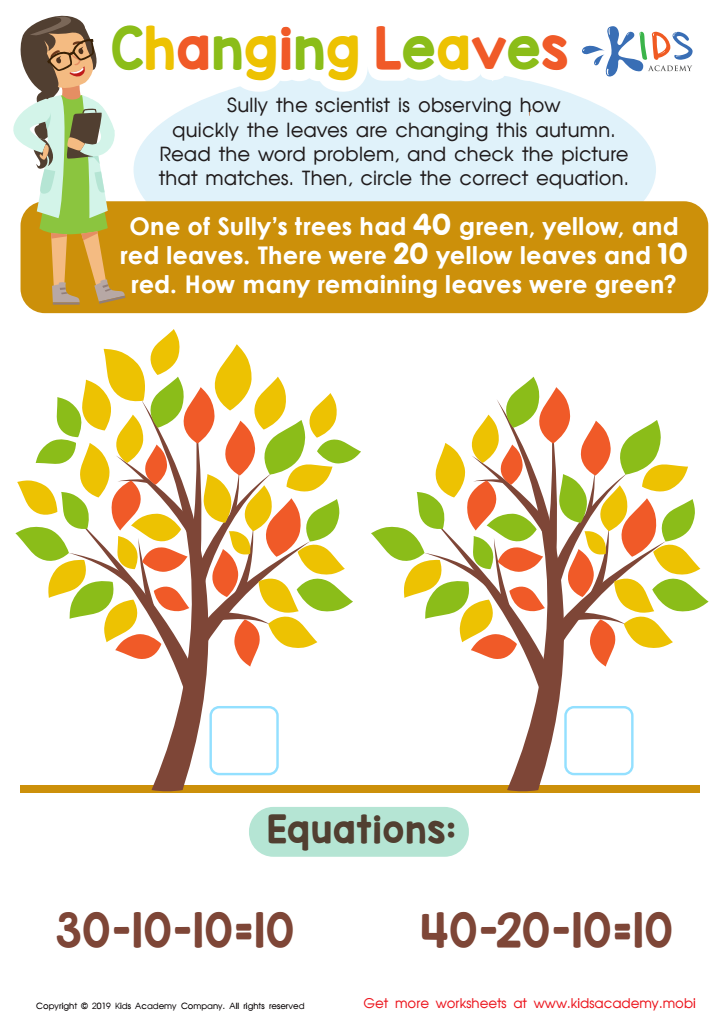
Changing Leaves Worksheet
Fall is the perfect time for kids to help Sully the scientist observe the changing leaves! Download the free worksheet with a subtraction word problem and bolded info to find the matching equation and picture. It's a fun way for your tots to learn while they admire the reddening, yellowing, and orange leaves.
Changing Leaves Worksheet
Worksheet
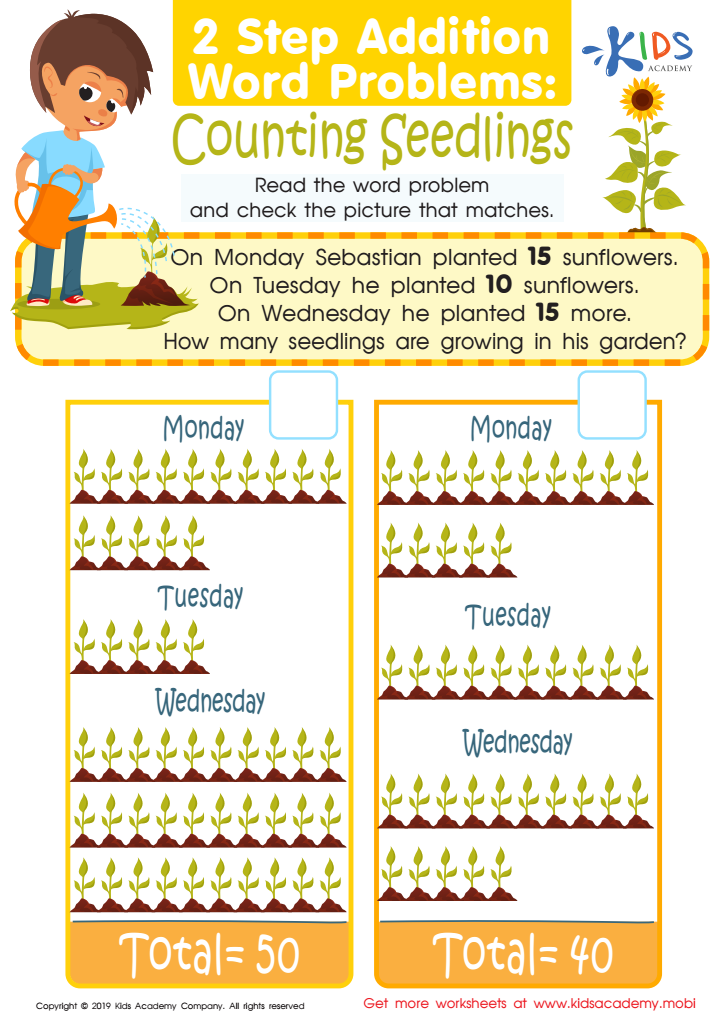
Counting Seedlings Worksheet
Understanding math word problems is key. Multiple steps can prove challenging - this free worksheet provides one-to-one picture representation to help kids solve multi-step addition word problems. Strengthen addition skills by choosing the matching picture to the answer.
Counting Seedlings Worksheet
Worksheet
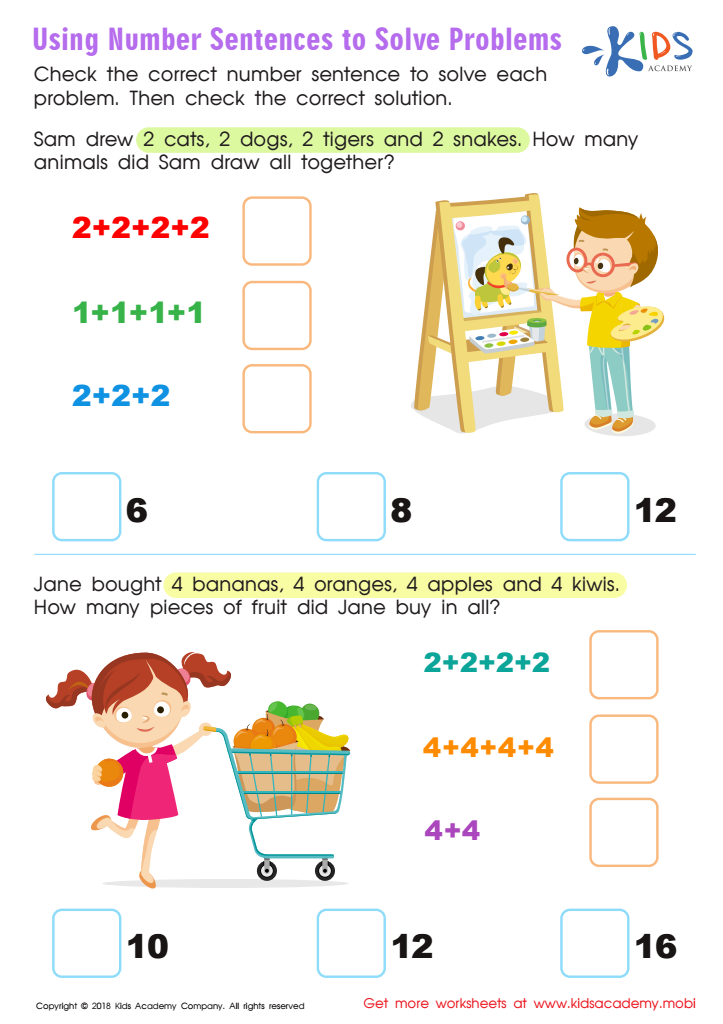
Using Number Sentences to Solve Problems Worksheet
Solving math problems requires an efficient strategy. Picture representation can help young mathematicians with basic addition problems, especially when it involves repeated addends. As they gain confidence, they'll be able to apply their number sentence solving abilities to more complex equations.
Using Number Sentences to Solve Problems Worksheet
Worksheet
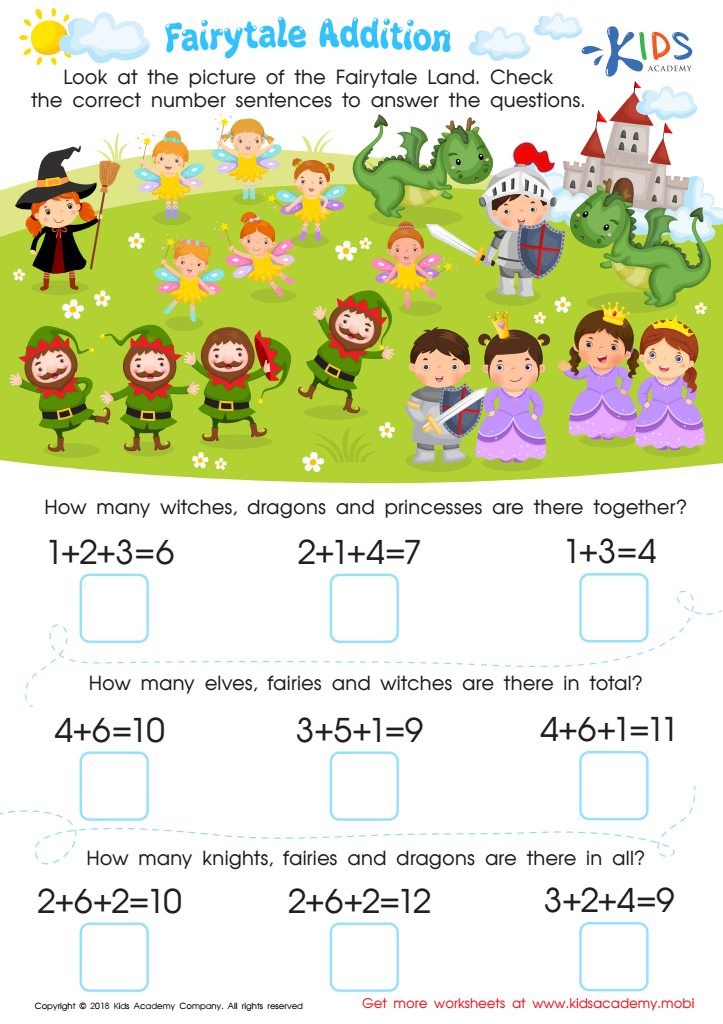
Fairytale Addition Worksheet
Take your kids to Fairytale Land! They'll meet witches, dragons, fairies, elves, knights, and princesses. This free worksheet adds up the fun, letting kids use three addends to solve addition equations and find the right answers. With friends like these, math won't even seem like math!
Fairytale Addition Worksheet
Worksheet
Join Kids Academy for Free
Who is primarily going to use this learning content?



The Value of Easy Worksheets on Two-Step Word Problems for Children Aged 7-8
In the dynamic world of elementary education, fostering strong problem-solving skills in young learners is essential. One effective tool for developing these skills are easy worksheets on two-step word problems, which can be integral components of school printables catering to children aged 7-8 years. Such resources not only enhance mathematical understanding but also encourage critical thinking and application of concepts in various situations.
Building a Foundation in Mathematics
At ages 7 to 8, children are at a critical stage in their educational journey. They have moved beyond basic counting and are now exploring more complex mathematical concepts. Two-step word problems are an excellent bridge in this developmental phase. These problems require students to perform two sequential operations to arrive at a solution. Typically, these operations involve fundamental arithmetic such as addition, subtraction, multiplication, or division.
The use of easy worksheets on two-step word problems helps in several ways. Firstly, they reinforce the arithmetic skills that are taught in class. Regular practice through these worksheets ensures that children become fluent in performing basic calculations, an essential skill that supports higher-level math and everyday problem-solving.
Enhancing Reading Comprehension and Logical Thinking
Two-step word problems combine mathematical computation with reading comprehension. Children must first understand the problem presented to them, discern what is being asked, and identify the relevant data before they can solve it. This process enhances their reading skills and boosts their ability to comprehend and follow multi-step directions.
Moreover, these problems require logical thinking. Children learn to connect different pieces of information and reason out the steps needed to find a solution. This practice in logical sequencing is valuable not only in mathematics but across all subjects and in everyday decision making.
Application in Real-Life Situations
The practical application of school printables featuring easy two-step word problems cannot be overstated. These worksheets often use scenarios that children might encounter in real life, such as shopping, cooking, or planning events. By solving problems set in familiar contexts, children can see the relevance of mathematics in their daily lives. This not only keeps them engaged but also helps them understand how they can use math to solve problems outside the classroom.
Developing Confidence and Perseverance
Working through two-step problems can also significantly boost a child’s confidence. Initially, many children find it challenging to solve these problems. However, with practice, they learn to break down complex questions into manageable parts, a skill that instills a sense of accomplishment. As children successfully solve these problems, their self-efficacy in handling mathematical challenges grows. This confidence is crucial as they progress to more advanced topics and face new academic challenges.
Moreover, two-step word problems teach perseverance. Not every problem is straightforward, and some require repeated attempts and strategies before arriving at the correct solution. By engaging with these worksheets, children learn the valuable lesson that persistence is key to overcoming difficulties, a lesson they can carry into other areas of their lives and future learning.
Supporting Diverse Learning Styles
Easy worksheets on two-step word problems are also versatile tools that cater to various learning styles. Visual learners can benefit from worksheets that include charts or pictures, auditory learners might discuss the problems with peers or teachers, while kinesthetic learners could use physical objects to visualize the problems. This adaptability helps ensure that all children, regardless of their preferred learning mode, can benefit from these exercises.
Integration with Technology and Collaboration
In today's digital age, these school printables can easily be integrated with technology, enhancing their accessibility and appeal. Interactive versions of these worksheets can be used on tablets or computers, providing immediate feedback and hints, which further supports independent learning. Additionally, two-step word problems can foster collaboration among peers. Children can work in pairs or small groups to solve problems, discuss their thinking processes, and explain their reasoning. This collaborative aspect encourages communication skills and helps students learn from each other.
Conclusion
Easy worksheets on two-step word problems are invaluable tools in the toolkit of elementary educators. They not only bolster mathematical skills and logical thinking but also enhance reading comprehension and real-life application. Furthermore, they build confidence, teach perseverance, and cater to diverse learning styles while promoting collaboration and integration with technology. For children aged 7-8, these school printables are not just about learning math; they are about developing a comprehensive set of skills that are crucial both in academics and in life. By incorporating these worksheets into their curriculum, educators can provide a well-rounded educational experience that prepares young learners for future successes.