Understanding number sequences Grade 2 Worksheets
4 filtered results
Difficulty Level
Grade
Age
-
From - To
Subject
Activity
Standards
Our Grade 2 "Understanding Number Sequences" worksheets are designed to help young learners build a strong foundation in recognizing and applying numerical patterns. These engaging activities challenge students to identify, continue, and create number sequences, enhancing their problem-solving and critical thinking skills. Aligned with educational standards, each worksheet provides clear instructions and a variety of fun exercises that cater to different learning styles. Perfect for classroom or home use, these resources make mastering number sequences both enjoyable and attainable for second graders. Equip your students with the tools they need to succeed in math and beyond!
Favorites
With answer key
Interactive
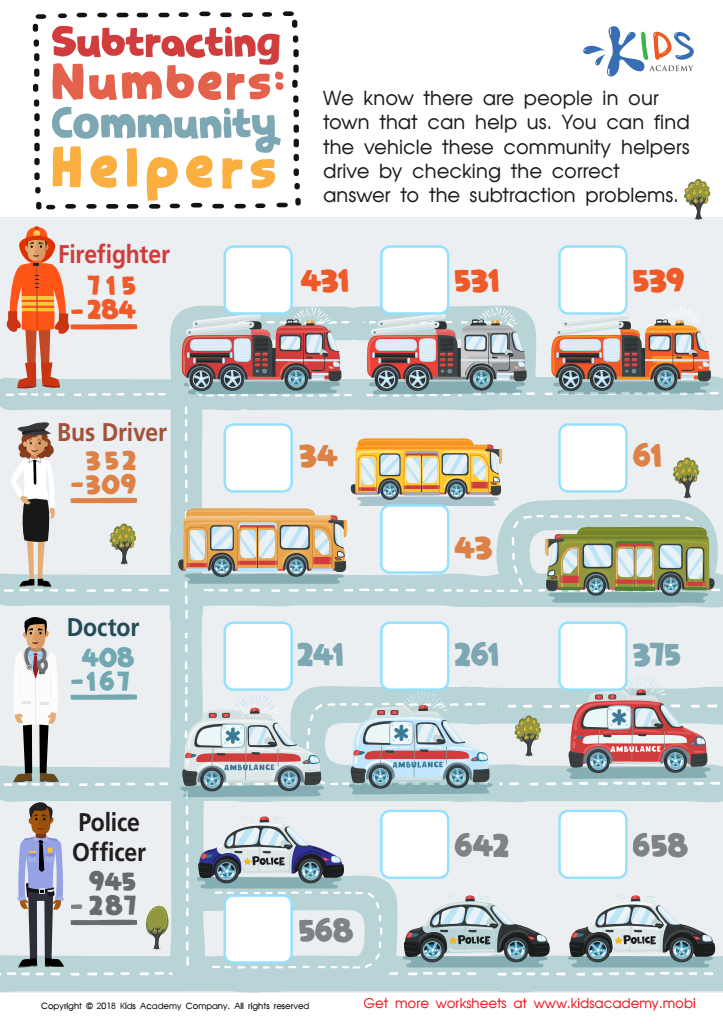
Subtracting Numbers: Community Helpers Worksheet
A community is an area of different people, buildings and other elements. People in a community have varied roles and work together to make it thrive. Ask your child what community helpers they know and how they help. Match the helpers to their vehicles by solving subtraction problems!
 Assign to My Students
Subtracting Numbers: Community Helpers Worksheet
Worksheet
Join Kids Academy for Free
Who is primarily going to use this learning content?







Understanding number sequences is a foundational mathematical skill for second graders, and it's crucial for various reasons that parents and teachers should recognize. Firstly, number sequences lay the groundwork for arithmetic operations—addition, subtraction, multiplication, and division. When children grasp the patterns and regularities in sequences, they develop a better sense of numeracy, which helps them excel in more complex mathematical tasks later on.
Secondly, understanding number patterns nurtures critical thinking and problem-solving abilities. It encourages children to identify relationships, make predictions, and apply logical reasoning. This cognitive development is not restricted to mathematics; it translates to other subjects and day-to-day activities, improving overall academic performance and life skills.
Moreover, mastery of number sequences supports early algebraic thinking. Recognizing patterns and sequences can lead to a deeper understanding of mathematical relationships and functions, easing the future learning curve in algebra and higher-level math.
Lastly, achieving proficiency in number sequences builds student's confidence. Success in understanding and completing sequential tasks bolsters self-esteem, making children more enthusiastic and open to tackling challenging problems.
In essence, investing time in understanding number sequences in Grade 2 provides a robust scaffold for mathematical learning. Parents and teachers should actively support and encourage this learning to ensure that foundational concepts are solidified, paving the way for future academic success.