Critical Thinking Grade 2 Adding up to 100 Without Regrouping Worksheets
3 filtered results
-
From - To
Enhance your second-grade students' math skills with our "Critical Thinking Grade 2: Adding Up to 100 Without Regrouping Worksheets." These engaging worksheets are designed to strengthen students' addition skills while fostering critical thinking. Using fun and interactive problems, children will learn to combine numbers effectively, ensuring a deep understanding of math concepts without the need for regrouping. Perfect for independent practice or guided learning, these worksheets encourage students to visualize addition through various strategies, promoting mental math and analytical thinking. Explore our collection to provide your students with valuable practice that builds confidence and skills in adding up to 100 effortlessly!
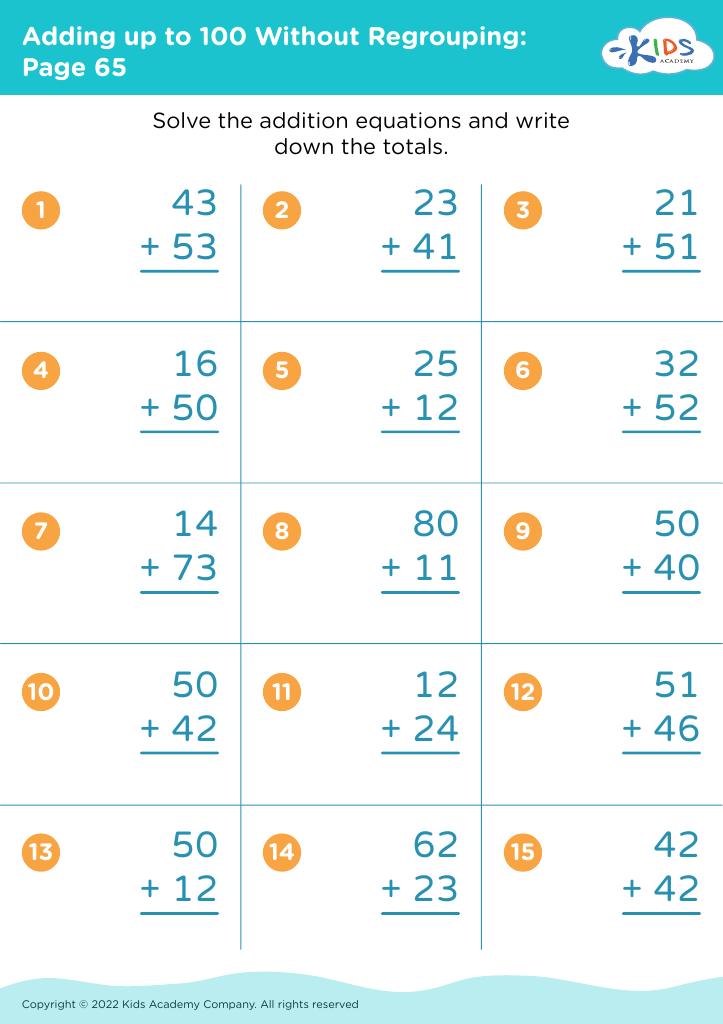
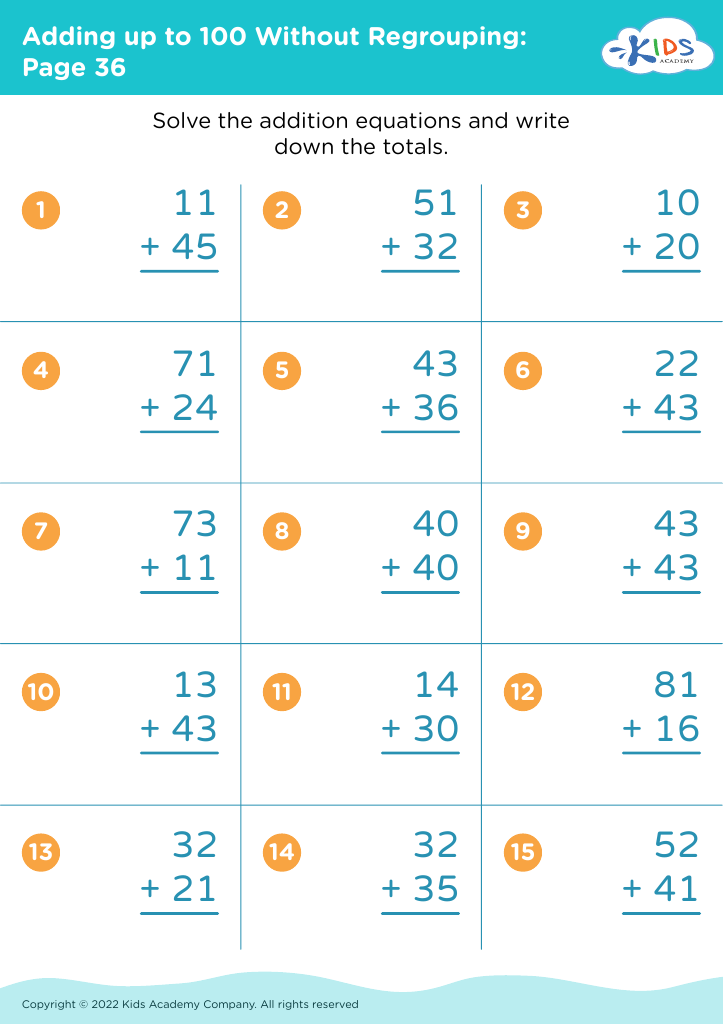
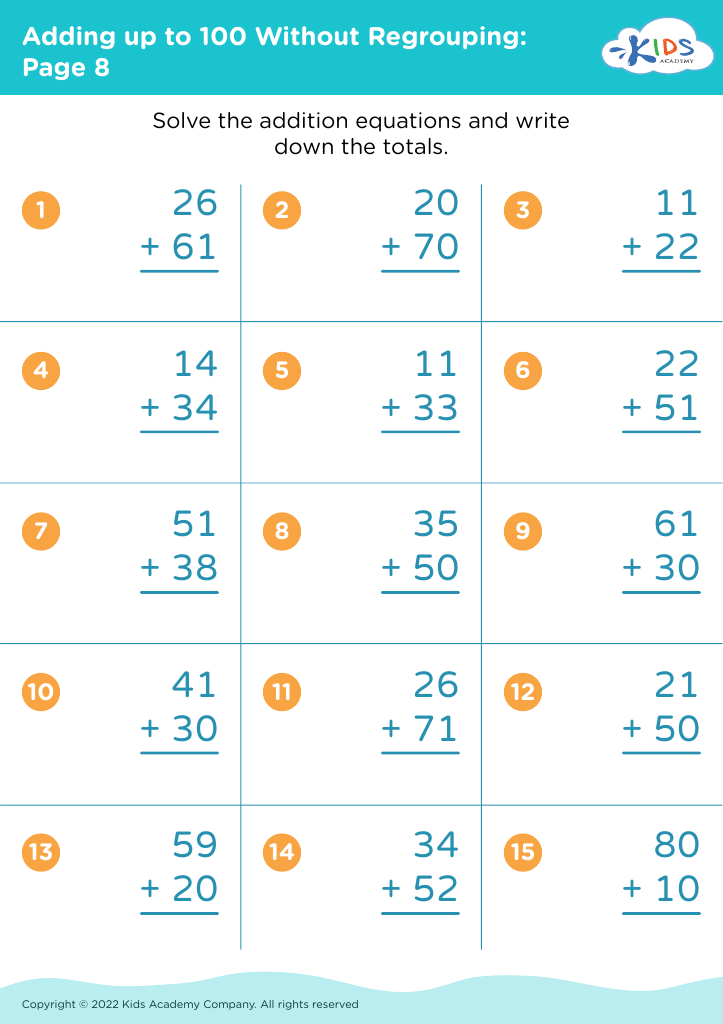




Critical thinking in grade 2 is essential for fostering a strong mathematical foundation, especially when teaching concepts like adding up to 100 without regrouping. This skill involves not only performing basic arithmetic but also understanding and applying problem-solving strategies.
When parents or teachers emphasize critical thinking skills, they encourage students to explore math beyond rote memorization. For example, when a child learns to add numbers such as 57 + 32, they should consider various approaches, such as breaking numbers into parts (50+30 and 7+2) to make calculations more manageable.
These critical thinking skills promote deeper understanding, enabling students to apply mathematical concepts in real-world situations. Moreover, this practice cultivates flexibility in thinking, allowing students to navigate challenges later in their academic journey.
Additionally, fostering critical thinking helps build confidence and resilience, as children learn to tackle problems independently and believe in their capabilities. Engaging parents and teachers in this process ensures a collaborative environment where students can grow and thrive, ultimately leading to better educational outcomes and a greater appreciation for mathematics. Encouraging such skills in second graders lays the groundwork for thoughtful, adept learners in the future.