Understand fractions Grade 2 Adding up to 100 Worksheets
5 filtered results
-
From - To
Explore our "Understand Fractions Grade 2 Adding up to 100 Worksheets" designed to simplify fractions and addition for your second grader. These engaging worksheets provide step-by-step guidance on understanding basic fractions while boosting addition skills up to 100. Kids will enjoy fun, colorful activities that invite hands-on learning and practical application, enhancing their fraction knowledge through visual representations and problems. Perfect for classroom or home practice, these worksheets ensure students grasp key math concepts with confidence. Empower your child's learning journey with tailored exercises that make fractions and addition approachable and enjoyable. Start enhancing math skills skill today!
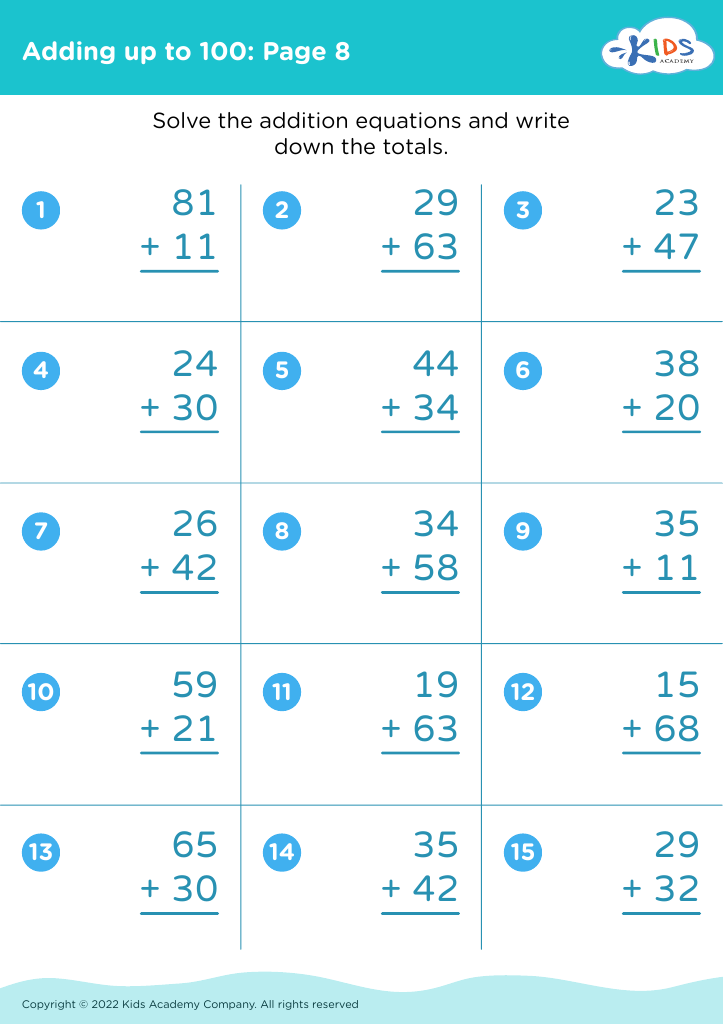
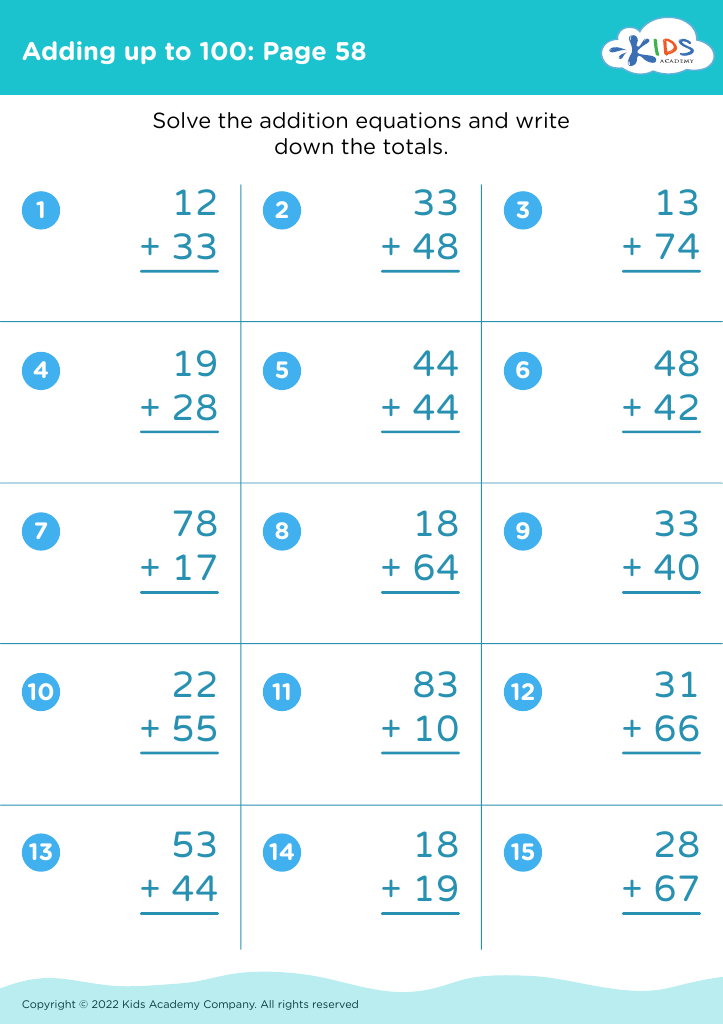





Understanding fractions and adding up to 100 by Grade 2 is crucial for young learners as it lays a solid foundation for their future mathematical learning. Firstly, grasping the basics of fractions helps children comprehend that numbers can represent parts of a whole, which is essential for all advanced arithmetic and real-life scenarios. For example, knowing that ¾ of a pizza is more than ⅔ assists not just in math but in everyday decision-making.
Secondly, the ability to add numbers up to 100 develops computational fluency, enhancing students’ confidence in working with numbers. This capability serves as a stepping stone for more complex mathematical concepts such as multiplication, division, and problem-solving techniques, which are fundamental skills in both academics and practical life.
Additionally, math often appears in various subjects and everyday activities, including science experiments, following recipes, measuring objects, and even budgeting. Encouraging proficiency in these foundational skills during early grades fosters a positive learning attitude, enthusiasm for math, and a greater likelihood of academic success.
Therefore, parents and teachers should prioritize and support young students in mastering fractions and addition up to 100, as these skills are not just about numbers but a key to broader cognitive development and lifelong problem-solving abilities.