Understanding seasons Grade 2 Addition & Subtraction Worksheets
4 filtered results
Difficulty Level
Grade
Age
-
From - To
Subject
Activity
Standards
Explore the exciting world of seasons with our Grade 2 Addition and Subtraction Worksheets! Designed specifically for young learners, these engaging resources encourage students to practice essential math skills while discovering the unique characteristics of each season. With a focus on problem-solving and critical thinking, our worksheets incorporate real-life scenarios related to spring, summer, autumn, and winter. Students will enhance their addition and subtraction abilities through seasonal themes, making math both fun and relevant. Perfect for classroom activities or at-home practice, these worksheets promote a deeper understanding of mathematics and the natural world. Get started today and make learning enjoyable!
Favorites
With answer key
Interactive
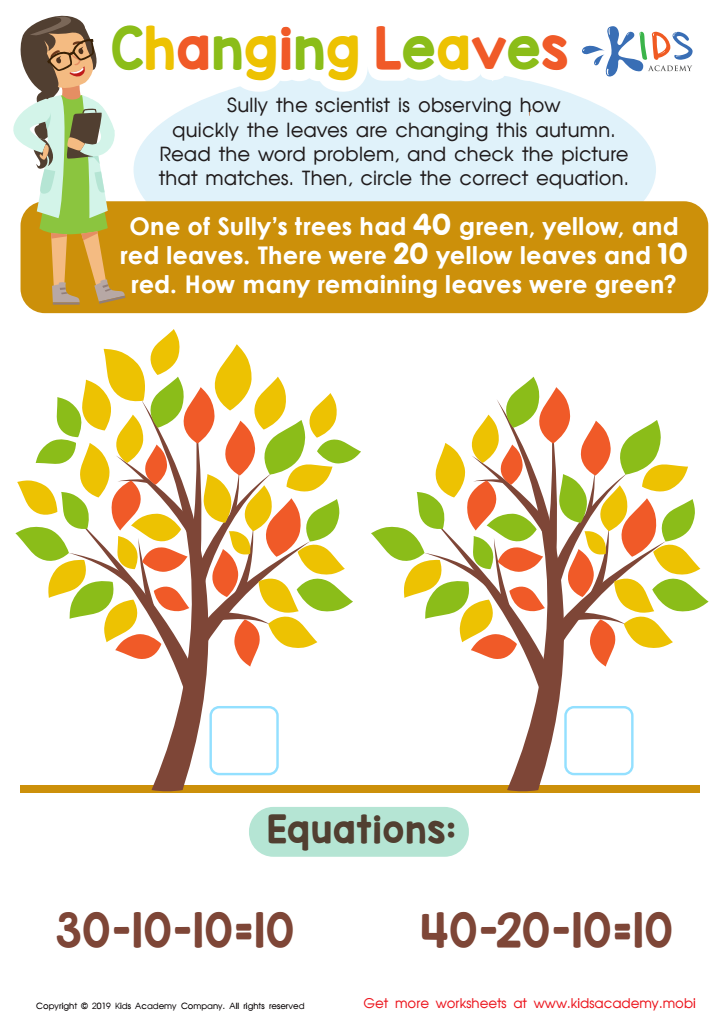
Changing Leaves Worksheet
Fall is the perfect time for kids to help Sully the scientist observe the changing leaves! Download the free worksheet with a subtraction word problem and bolded info to find the matching equation and picture. It's a fun way for your tots to learn while they admire the reddening, yellowing, and orange leaves.
 Assign to My Students
Changing Leaves Worksheet
Worksheet
Join Kids Academy for Free
Who is primarily going to use this learning content?








Understanding seasons is crucial for second graders as it connects math with real-world experiences, especially in addition and subtraction. When students learn about seasons, they encounter various contexts—such as counting days until a holiday or calculating how many weeks until summer vacation. This effectively integrates mathematical concepts, making arithmetic more relevant and engaging.
Parents and teachers should recognize that learning about seasons encourages observational skills and critical thinking. For example, creating addition and subtraction problems related to seasonal events helps children grasp these math concepts in relatable ways. "If winter lasts three months and spring lasts four months, how many months do we have in both seasons?" Such questions foster a deeper understanding of time and measurement.
Moreover, seasonal themes offer opportunities for hands-on activities, from counting snowflakes in winter to measuring rainfall in spring. These interactive experiences not only develop math skills but also enhance scientific understanding of our environment. Finally, discussing seasons strengthens students’ ability to categorize information, essential for later learning. By caring about this integration, parents and teachers can aid students' mathematical growth and enrich their overall educational journey.