Counting skills Grade 2 Arrays Worksheets
3 filtered results
-
From - To
Boost your second-grader’s counting skills with our engaging Grade 2 Arrays Worksheets! Designed to make learning fun, these expertly crafted worksheets help children understand arrays and improve their counting abilities through visual and hands-on exercises. By exploring rows and columns, students will effortlessly enhance their mathematical skills, paving the way for future success in multiplication and division. Perfect for classroom or home use, our printable worksheets cater to different learning styles and reinforce key concepts. Give your child the tools they need to excel in math with our colorful and educational counting skills arrays worksheets!
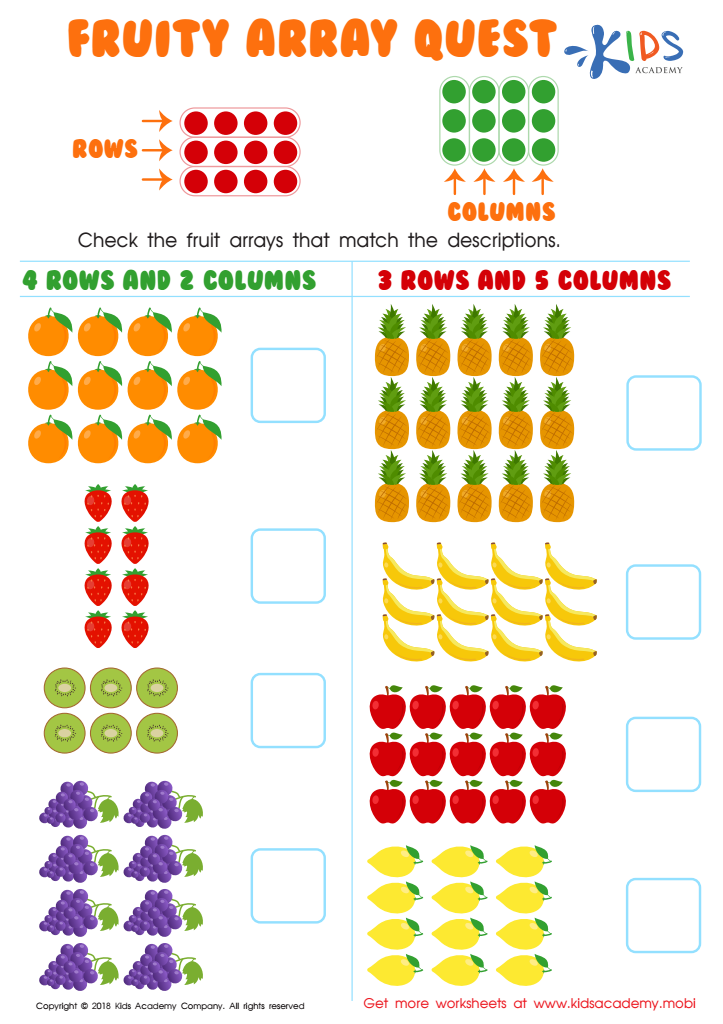
Fruity Array Quest Worksheet
 Assign to My Students
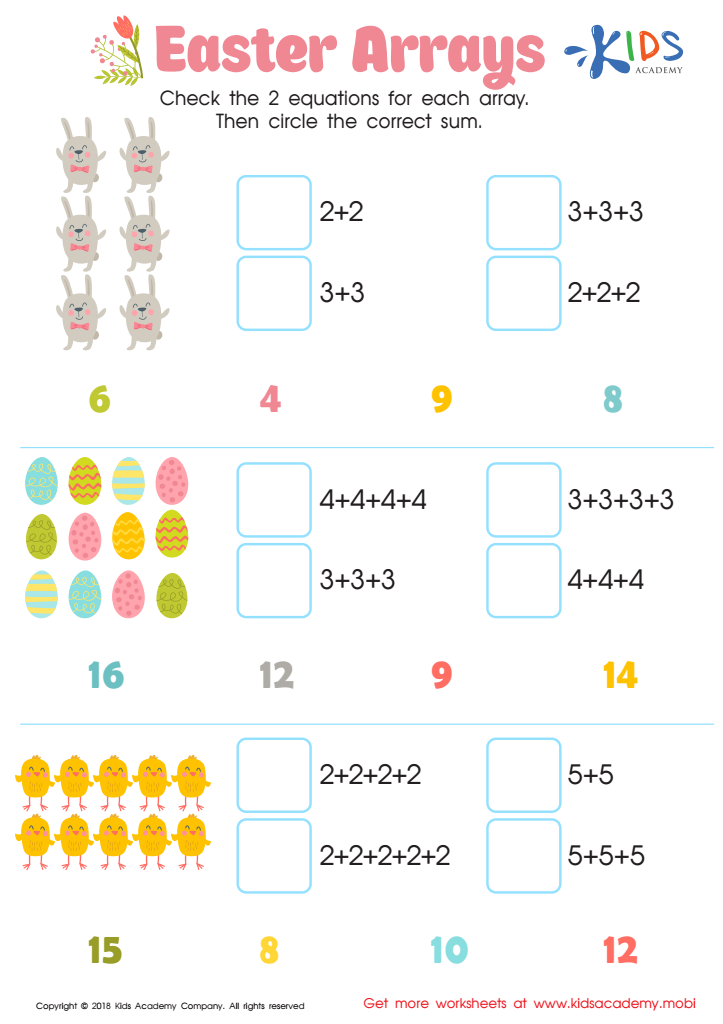
Easter Arrays Worksheet
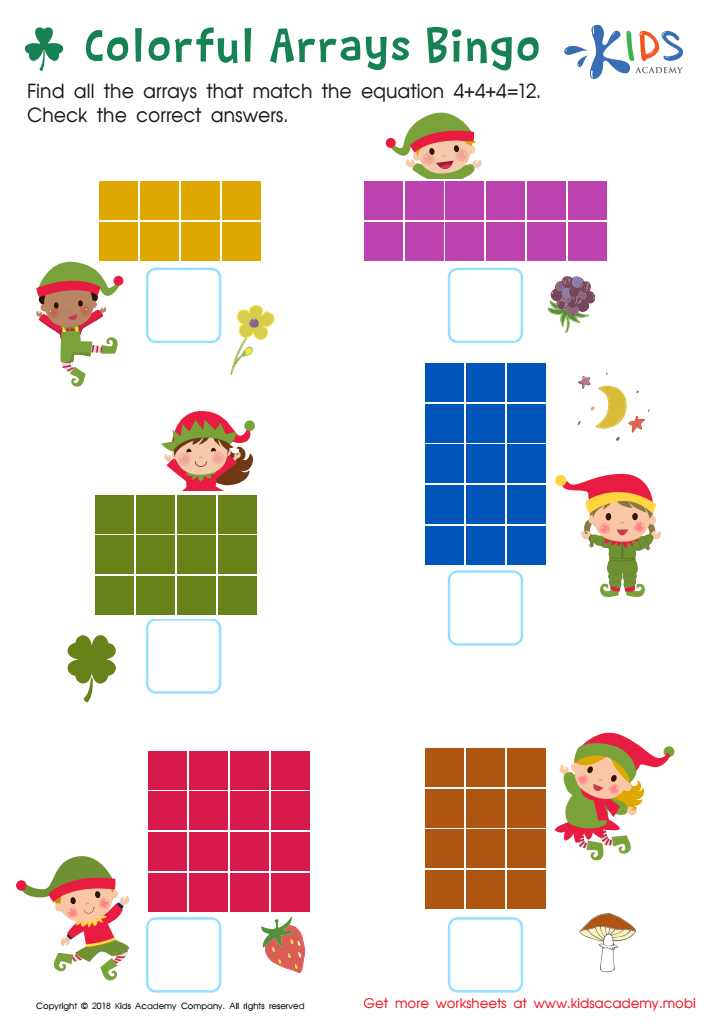
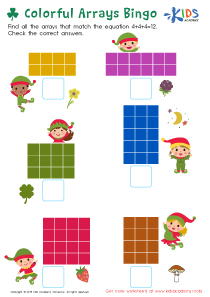
Colorful Arrays Bingo Worksheet






Counting skills in Grade 2 are fundamental for children's mathematical development, and arrays play a crucial role in this learning process. Arrays—organized rows and columns of objects—help children visualize and understand basic mathematical concepts such as multiplication, addition, and the organization of numbers.
For parents and teachers, focusing on counting skills through arrays is important because it lays the groundwork for more complex mathematical operations. When children interact with arrays, they learn to group numbers efficiently, which enhances their ability to solve multiplication problems and later, division. This visualization helps them see patterns and relationships between numbers, making the transition to higher-level math smoother.
Furthermore, proficiency with arrays fosters problem-solving skills. Children begin to develop logical thinking as they manipulate and organize numbers within arrays. They learn to identify how numbers can split into groups, reinforcing their understanding of numerical value and quantity. Arrays make abstract concepts more concrete, and this hands-on learning can boost a child’s confidence and interest in math.
Finally, strong counting skills augmented by the use of arrays support not just math-specific learning but overall cognitive development. Patterns, organization, and systematic thinking are transferable skills that benefit reading comprehension, scientific reasoning, and even everyday problem-solving. Therefore, investing in this aspect of early education can yield long-term educational benefits.