Number Recognition Grade 2 Arrays Worksheets
3 filtered results
-
From - To
Enhance your second grader’s math skills with our Number Recognition Grade 2 Arrays Worksheets. Designed specifically for early learners, these worksheets offer engaging activities to bolster number recognition and counting. Children practice organizing objects into rows and columns, making math both visual and interactive. Each sheet introduces arrays in a fun, approachable way, helping young minds grasp the basics of multiplication and division concepts. Perfect for both classroom and home use, these worksheets support the development of foundational math skills, ensuring your child builds confidence and competence in number recognition. Explore our collection for an educational edge!
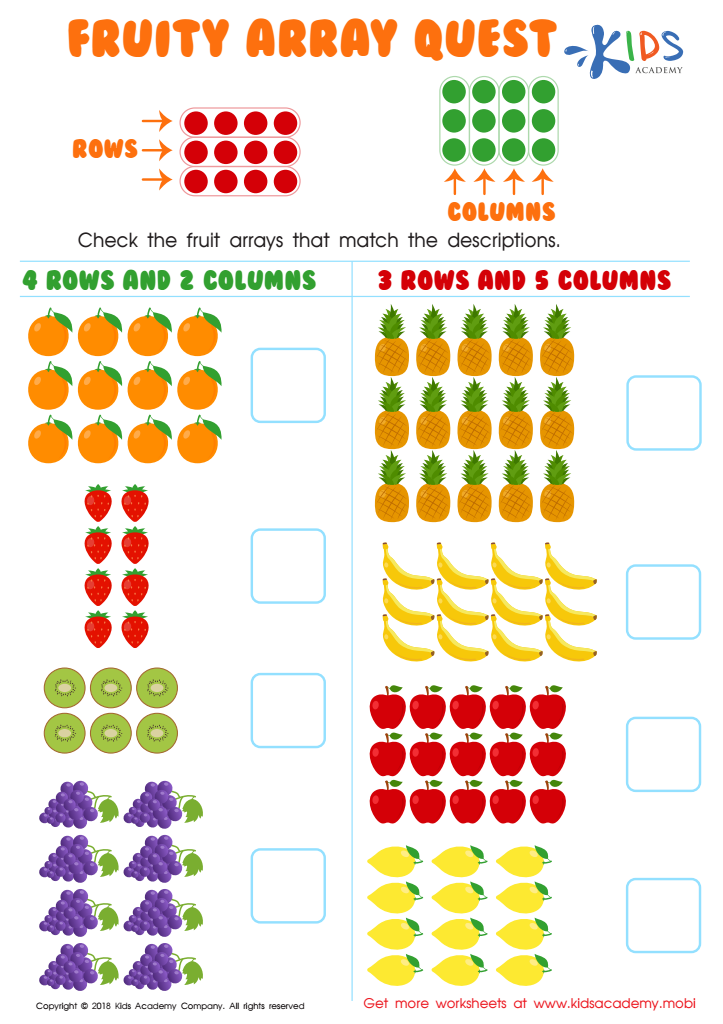
Fruity Array Quest Worksheet
 Assign to My Students
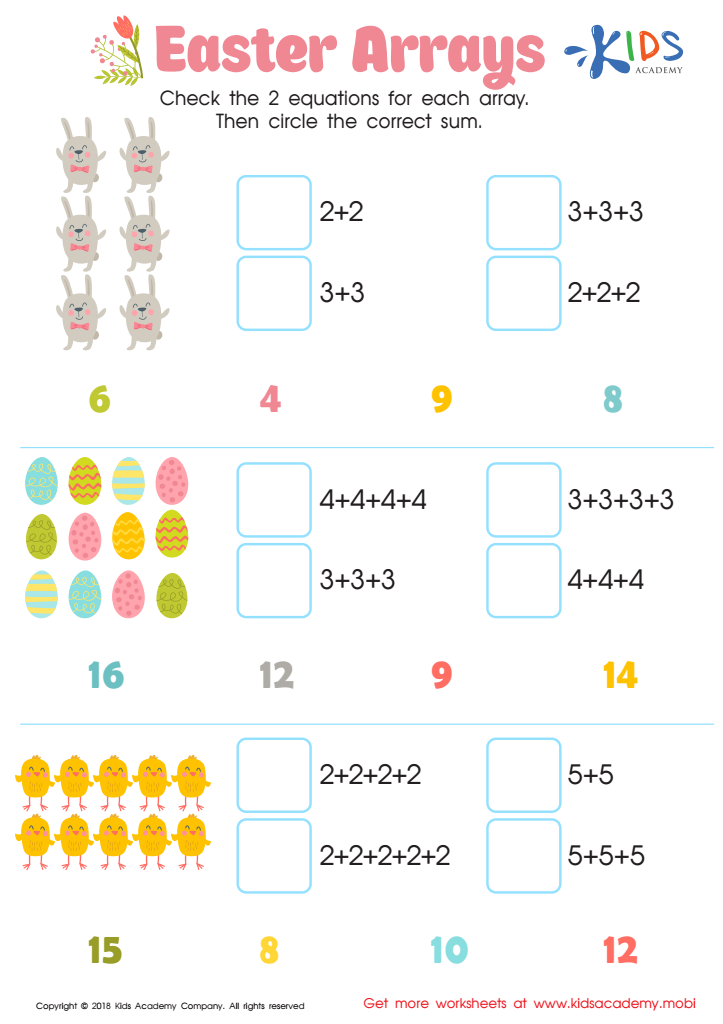
Easter Arrays Worksheet
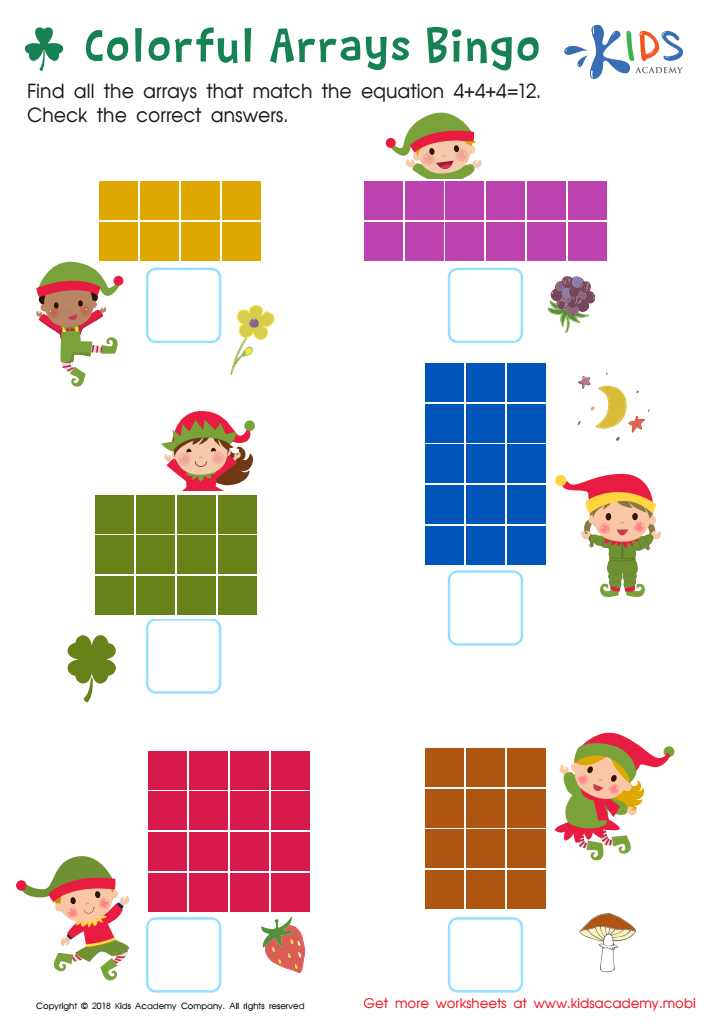
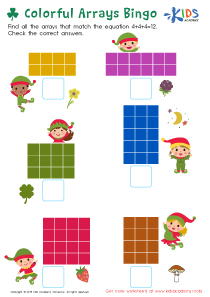
Colorful Arrays Bingo Worksheet





Number recognition in Grade 2, especially through the use of arrays, is fundamental for children's mathematical development. Arrays, which are orderly arrangements of objects, play a critical role because they make abstract concepts more tangible. For parents and teachers, fostering skills in number recognition is not just about identifying numbers, but understanding their real-world applications.
Arrays introduce children to important mathematical concepts such as multiplication and division. For instance, an array of 3 rows with 4 objects in each row visually demonstrates 3 times 4 equals 12. This visual representation helps children grasp multiplication as repeated addition, setting a solid foundation for future math topics.
Furthermore, the ability to recognize and interpret numbers using arrays aids in developing problem-solving skills and logical thinking. When children understand how to break down numbers into arrays, they learn to approach math problems methodically, enhancing their analytical abilities.
Parents and teachers should also focus on arrays because they encourage interactive and engaging learning. Using tangible objects for creating arrays allows children to experience kinesthetic learning, catering to various learning styles and ensuring a thorough understanding of mathematical principles. By prioritizing number recognition and arrays in early education, parents and teachers set the stage for a child’s long-term success in mathematics.