Comparing quantities Grade 2 Math Worksheets
8 filtered results
Difficulty Level
Grade
Age
-
From - To
Subject
Activity
Standards
Enhance your child's math skills with our specially designed Comparing Quantities Grade 2 Math Worksheets. These engaging and educational worksheets help second graders develop essential skills in comparing numbers, quantities, and understanding numerical relationships. Each worksheet provides a range of fun exercises and colorful illustrations to keep young learners interested and motivated. Kids will practice comparing greater than, less than, and equal to concepts, as well as ordering numbers and quantities. Ideal for both classroom and home learning, these printable worksheets support the Grade 2 math curriculum, ensuring your child builds a strong mathematical foundation. Download today to boost your child's confidence and abilities!
Favorites
With answer key
Interactive
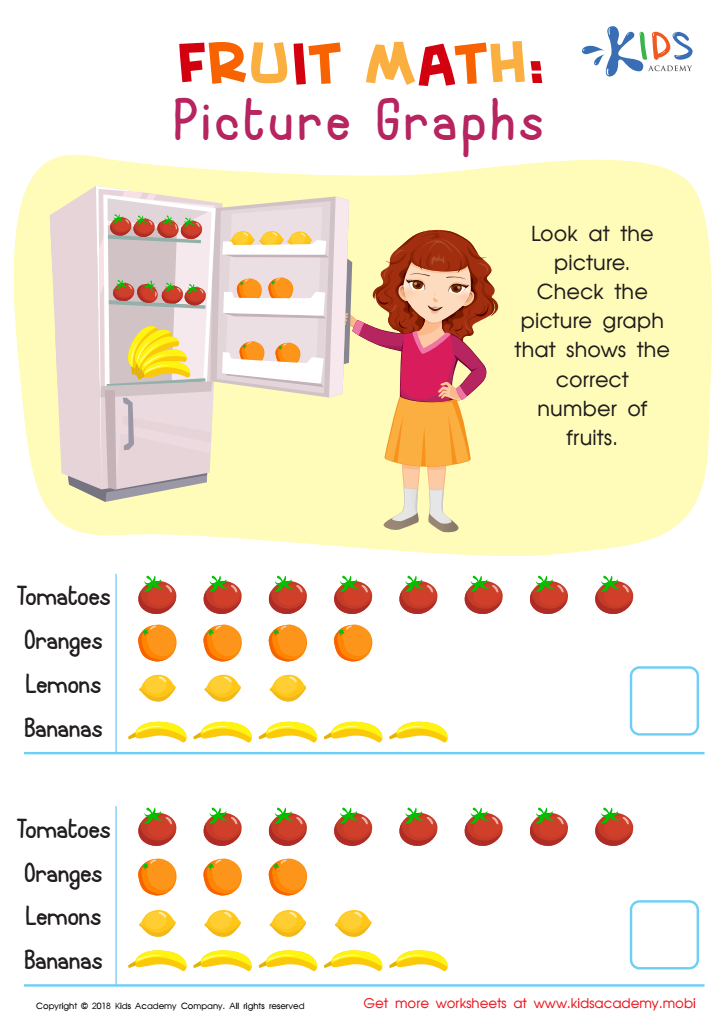
Fruit Math: Picture Graphs Worksheet
Help your child learn to draw graphs by having them look at pictures. Ask them to identify a graph that accurately portrays the data and have them explain why. This will prepare them to easily draw more complex graphs in the future. For example, have them look at the picture with the number of fruits in the colorful worksheet and explain why the graph is accurate.
 Assign to My Students
Fruit Math: Picture Graphs Worksheet
Worksheet
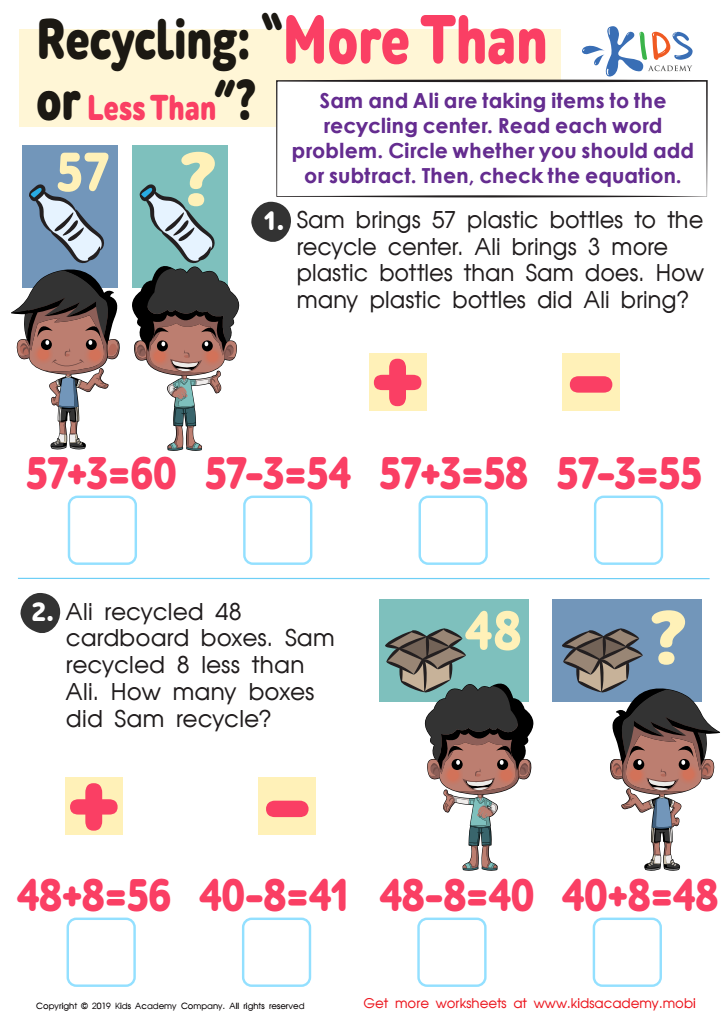
Recycling - More or Less Worksheet
Your child can compare numbers and solve word problems with this free worksheet. Help them understand what's being asked as Sam and Ali take items to the recycling center. They can choose the correct equation to match the word problem and apply their skills in reading and pulling out the appropriate information.
Recycling - More or Less Worksheet
Worksheet
Join Kids Academy for Free
Who is primarily going to use this learning content?







Teaching Grade 2 students to compare quantities is fundamental for several reasons. First, it lays the groundwork for more advanced math concepts such as addition, subtraction, multiplication, and division. Understanding how to compare quantities fosters number sense, helping children develop an intuitive grasp of how numbers and amounts relate to each other. This is crucial for problem solving in everyday life, like determining if they have enough money to buy an item or comparing weights when baking.
Moreover, it builds critical thinking and analytical skills. When students compare quantities, they not only determine which quantities are larger, smaller, or equal but also understand the reasoning behind their conclusions. This nurtures logical reasoning and decision-making abilities, skills that are valuable beyond the math classroom.
For parents and teachers, focusing on comparing quantities also encourages active learning and engagement. Activities like grouping objects, using number lines, or playing educational games make learning interactive and fun. Additionally, mastering this skill boosts confidence. As students successfully compare quantities, they gain the assurance needed to tackle more challenging tasks.
Overall, proficiency in comparing quantities is a pillar of early math education, influencing both academic success and practical life skills. By caring about this skill, parents and teachers set children up for future excellence in a variety of fields.