Develop inference skills Grade 2 Math Worksheets
3 filtered results
-
From - To
Enhance your child’s critical thinking with our engaging Grade 2 Math Worksheets focused on developing inference skills. Designed by educational experts, these worksheets provide fun and interactive activities that teach young learners to make logical conclusions based on given information. Perfectly aligned with Common Core standards, they help build foundational math skills while igniting a love for problem-solving. Ideal for classroom or at-home practice, our worksheets use step-by-step processes and real-world scenarios to make learning enjoyable and effective. Explore our range at Kids Academy to boost your second grader's confidence and mathematical prowess today!
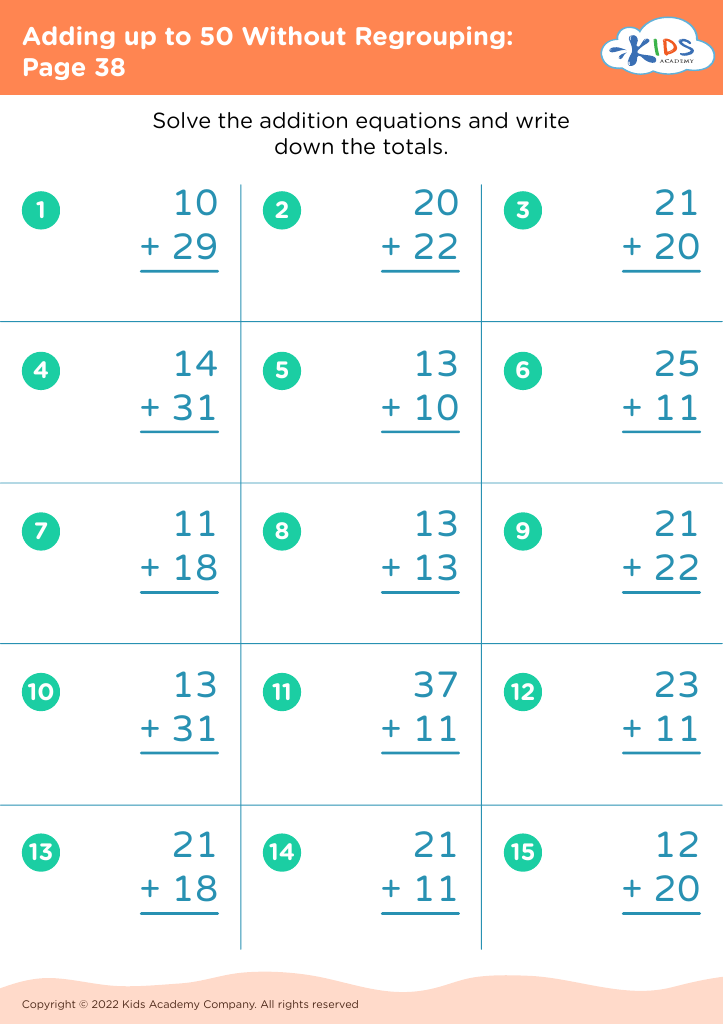








Developing inference skills in Grade 2 Math is crucial for young students as it lays a foundational understanding for more complex problem-solving and critical thinking required in higher grades and everyday life. Inference skills help students make educated guesses or logical deductions based on given data. For instance, when students encounter a word problem, their ability to infer the necessary steps to solve it or to identify what's being asked is vital.
This openness to analytical thinking can foster a deeper understanding of mathematical concepts and operations. Instead of merely performing rote calculations, students learn how to apply math practically, sharpening their problem-solving skills. These skills are not just confined to math; they transfer across subjects and into life skills too. For example, understanding patterns and making predictions based on those patterns are inference skills beneficial not only in mathematics but also in reading comprehension, science, and even social interactions.
For parents and teachers, prioritizing the development of inference skills encourages a holistic educational approach, promoting intellectual curiosity and perseverance. This focus can contribute to higher academic achievement and boost students' confidence in tackling various challenges, nurturing well-rounded, resilient learners equipped to navigate an increasingly complex world.