Fine motor skills (writing numbers) Grade 2 Math Worksheets
4 filtered results
Difficulty Level
Grade
Age
-
From - To
Subject
Activity
Standards
Our Grade 2 Math Worksheets focus on enhancing fine motor skills through writing numbers. Carefully designed by educational experts, these worksheets help children practice precise number formation, ensuring they master both numerical comprehension and handwriting proficiency. By engaging in these fun and interactive exercises, students will boost their grip strength, hand-eye coordination, and overall confidence in writing. Perfect for classroom activities or homeschooling, these worksheets are an invaluable resource for fostering essential motor skills that support broader academic success. Prepare your second grader for a bright mathematical future with our expertly crafted worksheets today!
Favorites
With answer key
Interactive
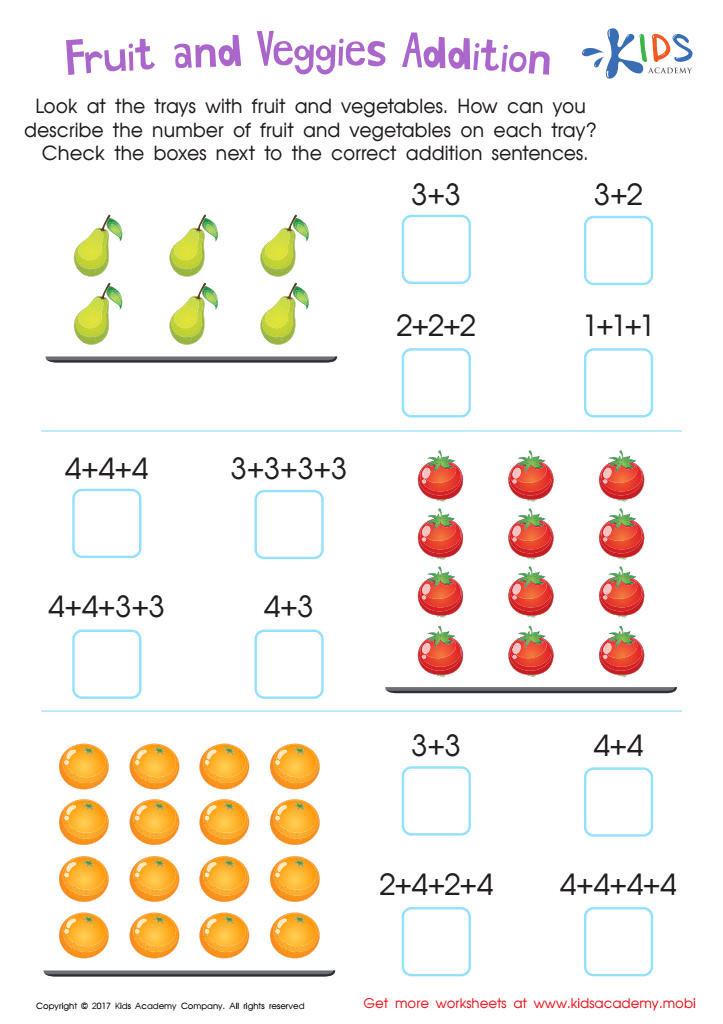
Fruit and Veggies Worksheet
It promotes problem-solving and analytical skills as kids match pictures to correct addition sentences. Help your child go beyond simple addition with this PDF worksheet!
 Assign to My Students
Fruit and Veggies Worksheet
Worksheet

A Hundred Pineapples Worksheet
Can your child count in tens? Show them how to count 100 boxes in stacks of tens. A worksheet can help them understand the concept. Ask them to count boxes of pineapples in stacks of tens and circle the truck with 100 pineapples.
A Hundred Pineapples Worksheet
Worksheet
Join Kids Academy for Free
Who is primarily going to use this learning content?








Fine motor skills are crucial for second graders as they develop their writing abilities, which include writing numbers. These skills involve the coordinated movements of the small muscles in the hands and fingers, enabling children to write legibly and with ease. For parents and teachers, nurturing fine motor skills goes beyond just improving penmanship—it fundamentally impacts a child’s overall learning experience and future academic success.
When children have well-developed fine motor skills, they can focus more on mathematical concepts rather than struggling with writing numbers. This reduces frustration and builds confidence, making math lessons more effective and enjoyable. Quality number writing facilitates clearer homework, tests, and classwork, reducing errors that stem from illegibility. Additionally, good fine motor skills are linked with improved hand-eye coordination and cognitive development, both crucial for a wide range of activities and learning processes.
Encouraging activities that enhance fine motor skills, such as drawing, tracing, or molding clay, supports motor development in a fun and engaging way. Investing time and attention in boosting these skills early on prepares children for greater classroom participation, precision in their task execution, and fosters a positive self-concept in their academic abilities. Consequently, addressing fine motor skill development in Grade 2 strongly influences children’s long-term success and wellbeing.