Mathematical reasoning Grade 2 Word Problems Worksheets
7 filtered results
Difficulty Level
Grade
Age
-
From - To
Subject
Activity
Standards
Our "Mathematical Reasoning Grade 2 Word Problems Worksheets" are expertly designed to enhance your child's critical thinking and problem-solving skills. Perfect for young learners, these engaging worksheets feature a variety of word problems that encourage the application of basic math concepts in real-life scenarios. Aligned with common core standards, these activities not only strengthen mathematical reasoning but also provide a solid foundation for future academic success. Each problem is crafted to develop your child's ability to interpret, analyze, and solve challenges, making math fun and engaging. Boost your second grader's confidence and proficiency in math with our comprehensive word problems worksheets.
Favorites
With answer key
Interactive
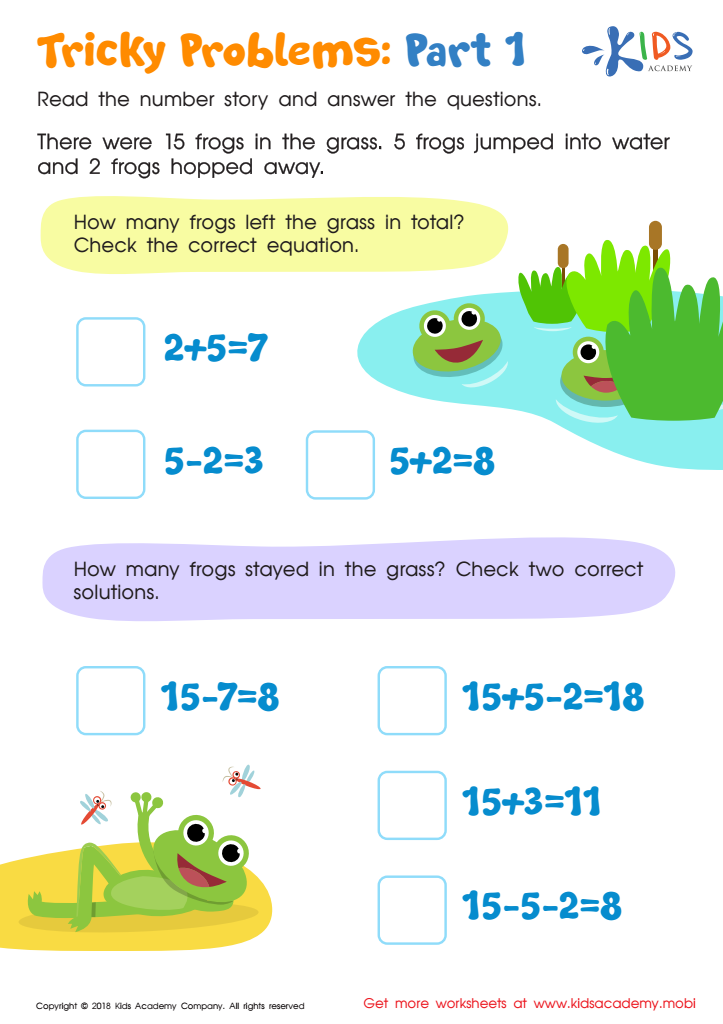
Tricky Problems Worksheet: Part 1
Visualizing word problems can help students solve them. This fun PDF worksheet encourages students to create mental images using math facts, then check boxes to match the equations for basic addition problems. It's a great way to build confidence in solving math.
 Assign to My Students
Tricky Problems Worksheet: Part 1
Worksheet
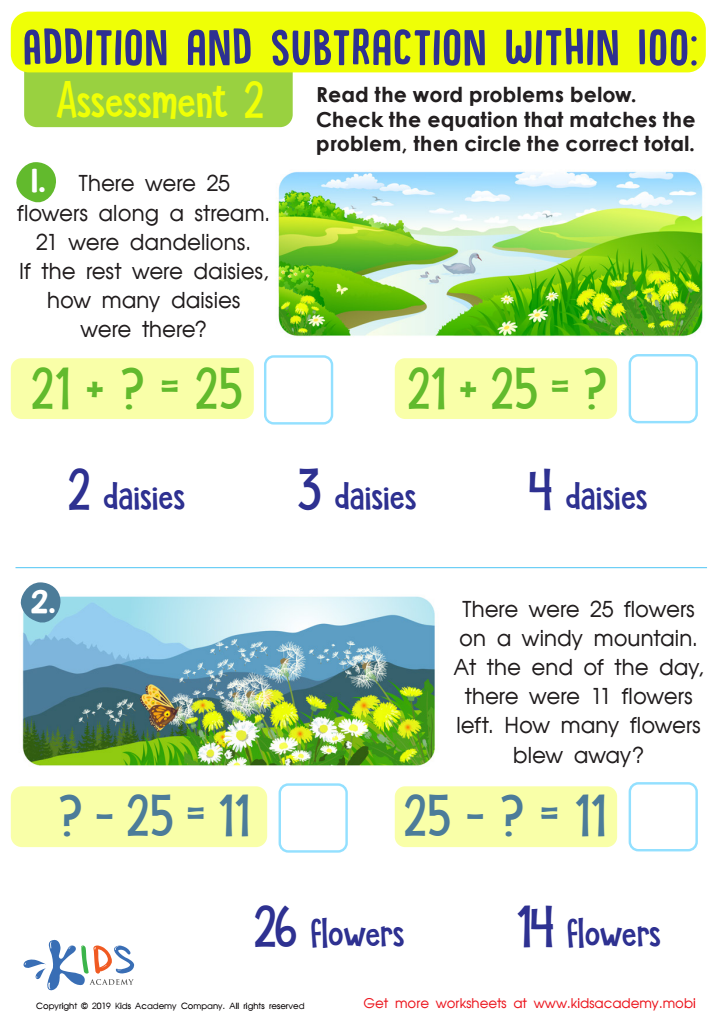
Assessment 2 Math Worksheet
Using fun exercises and pictures, you can get kids excited about math. With practice and reminders of what they've learnt, they'll be solving simple addition and subtraction equations with ease. Read the word problems in the picture to them, then help them check the equation and choose the correct answer.
Assessment 2 Math Worksheet
Worksheet
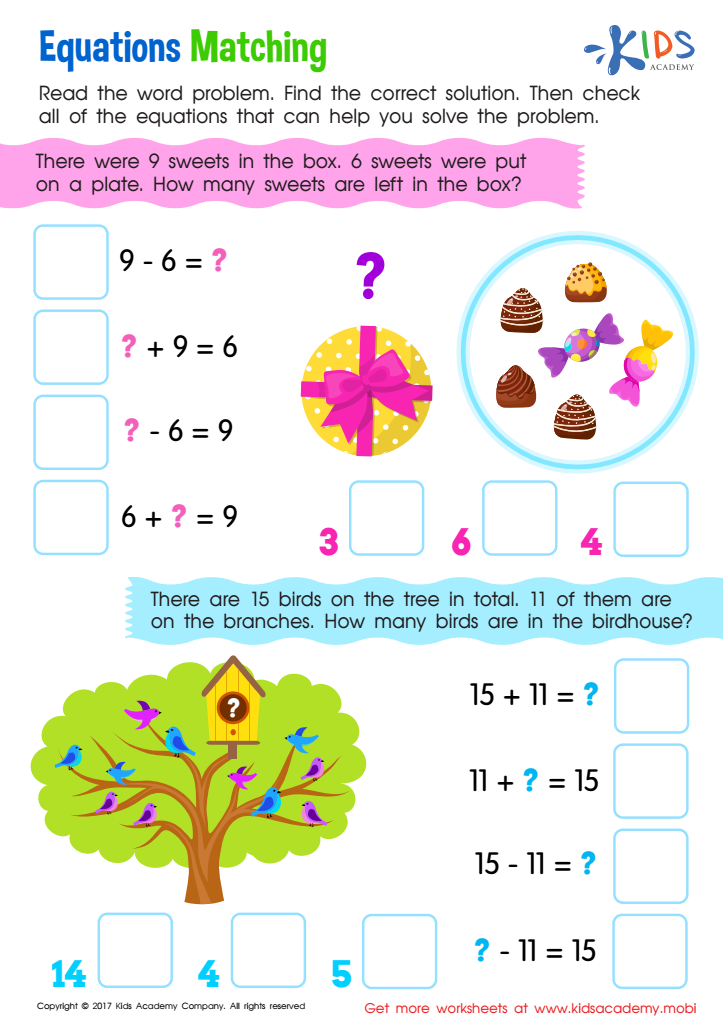
Equations Matching Word Problems Worksheet
Download this worksheet and give your young mathematician practice in solving equations using matching numbers and number family facts. They'll solve word problems, develop critical thinking and algebraic reasoning, and gain success with addition and subtraction.
Equations Matching Word Problems Worksheet
Worksheet
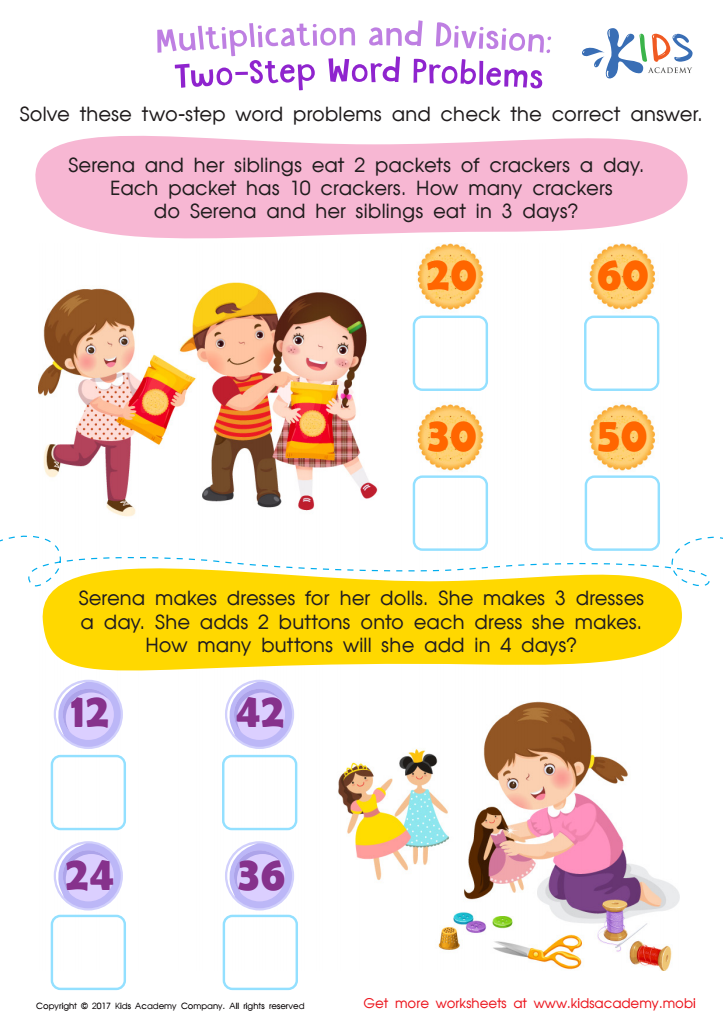
Two Step Word Problems Worksheet
Boost your child's math skills with this fun and realistic two-step word problems worksheet! Kids will learn to break down complex multiplication word problems into easier steps to solve. Download this free PDF worksheet and help them reach the next level.
Two Step Word Problems Worksheet
Worksheet
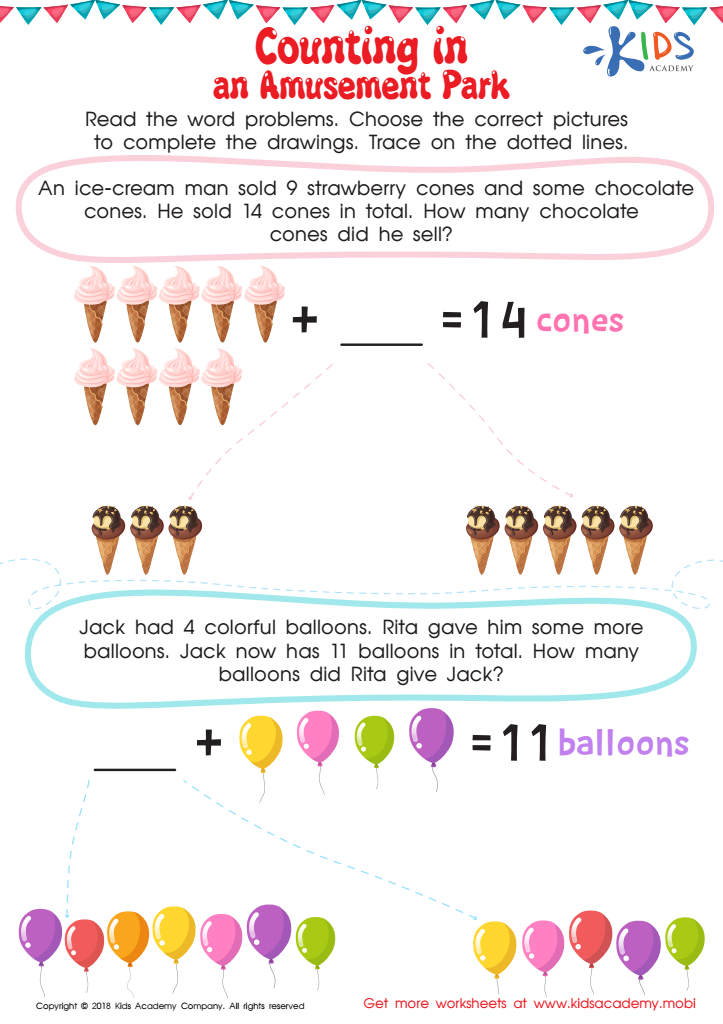
Counting in an Amusement Park Worksheet
Love amusement parks? This colorful worksheet is sure to delight your child as they solve basic addition problems with missing addends. Picture representations help them solve the math equations, while traceable lines help them accurately complete the drawings. No roller coaster ride here, but still loads of fun!
Counting in an Amusement Park Worksheet
Worksheet
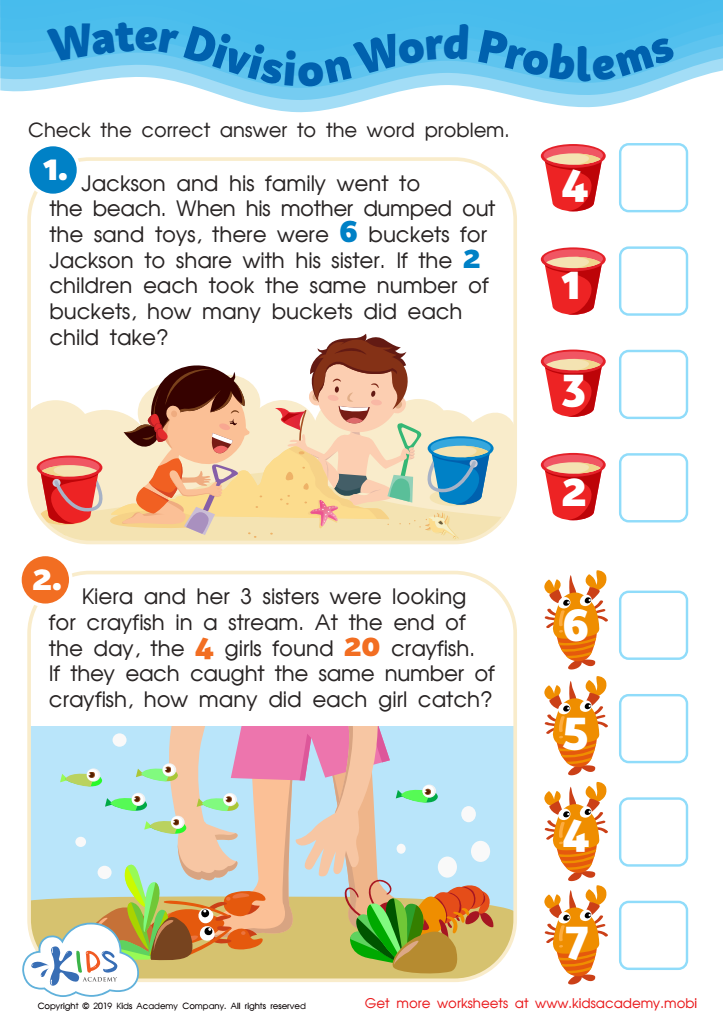
Water Division Word Problems Worksheet
Kids can sharpen their math skills with this fun PDF! They'll see pictures of friends at the beach, plus bold numbers and colorful pictures. All they need to do is read and understand the problem to find the answer - without even realizing they're doing division. A great way to make math enjoyable!
Water Division Word Problems Worksheet
Worksheet
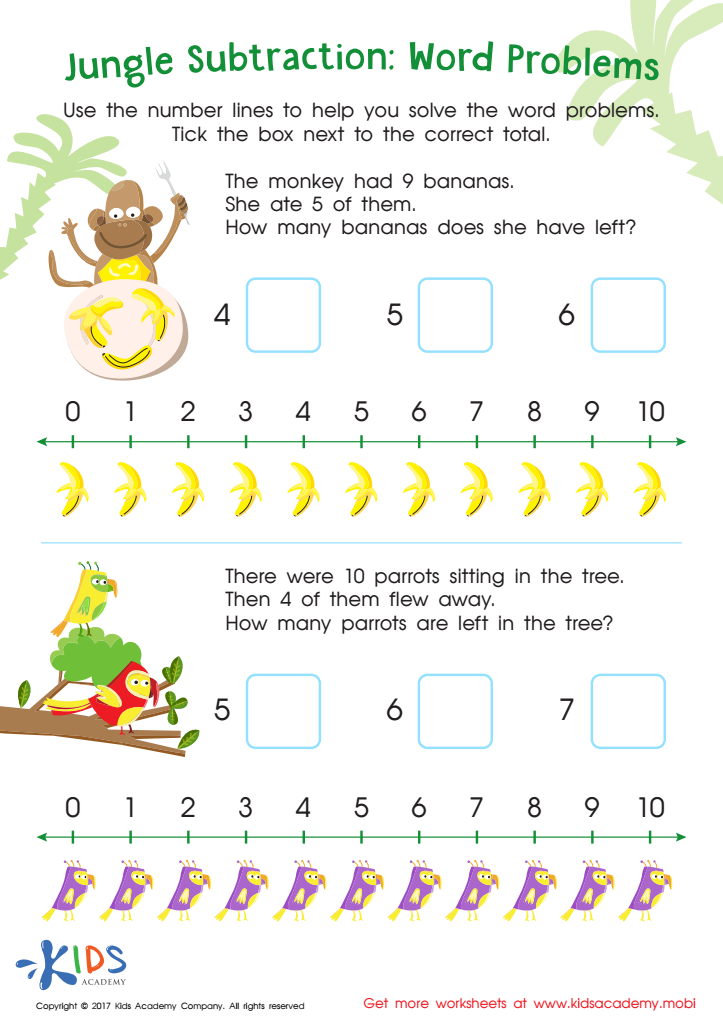
Jungle Subtraction Word Problems Substraction Worksheet
Kids will love this jungle-themed worksheet: subtraction word problems! Help the monkey work out how many bananas he has, using the number line. Encourage your child to use colorful parrots to subtract with ease and make calculations fun!
Jungle Subtraction Word Problems Substraction Worksheet
Worksheet
Join Kids Academy for Free
Who is primarily going to use this learning content?








Mathematical reasoning in Grade 2 word problems is fundamental for children's cognitive and academic development. At this stage, students are transitioning from concrete to more abstract thinking, and word problems introduce them to real-world applications of math skills, ensuring that they grasp both the practical and theoretical aspects of mathematics.
Firstly, solving word problems enhances critical thinking and problem-solving abilities. Children learn to analyze the text, identify relevant information, and determine the appropriate mathematical operations needed to find a solution. This process nurtures logical reasoning, which is a valuable skill across all subjects and in everyday life.
Secondly, mathematical reasoning promotes a deeper understanding of math concepts beyond rote memorization. When students solve word problems, they must comprehend the relationships between numbers and operations, fostering a robust foundation for future math learning.
Thirdly, word problems encourage linguistic and reading comprehension skills. Students must read and interpret the problem statement, enhancing their capacity to understand complex texts and improving their ability to follow multi-step instructions.
Involving parents and teachers in this process supports a collaborative learning environment, reinforcing the importance of mathematics and demonstrating real-life applications. This active engagement helps build students' confidence, setting them on a path to academic success and a lifelong appreciation for mathematics.