Improves counting skills Grade 3 Worksheets
3 filtered results
Difficulty Level
Grade
Age
-
From - To
Subject
Activity
Standards
Boost your child's counting proficiency with our Grade 3 Counting Skills Worksheets! Specially designed to align with educational standards, these engaging and effective worksheets will help third graders reinforce their numerical abilities and build a solid mathematical foundation. Each worksheet combines fun activities with crucial learning, ensuring kids remain motivated and confidence in their skills surges. From skip counting to number patterns, your child will master essential counting concepts through a variety of practice questions and creative exercises. Perfect for classroom enrichment or additional practice at home, our Grade 3 counting worksheets guarantee improved math skills and a brighter academic future.
Favorites
With answer key
Interactive
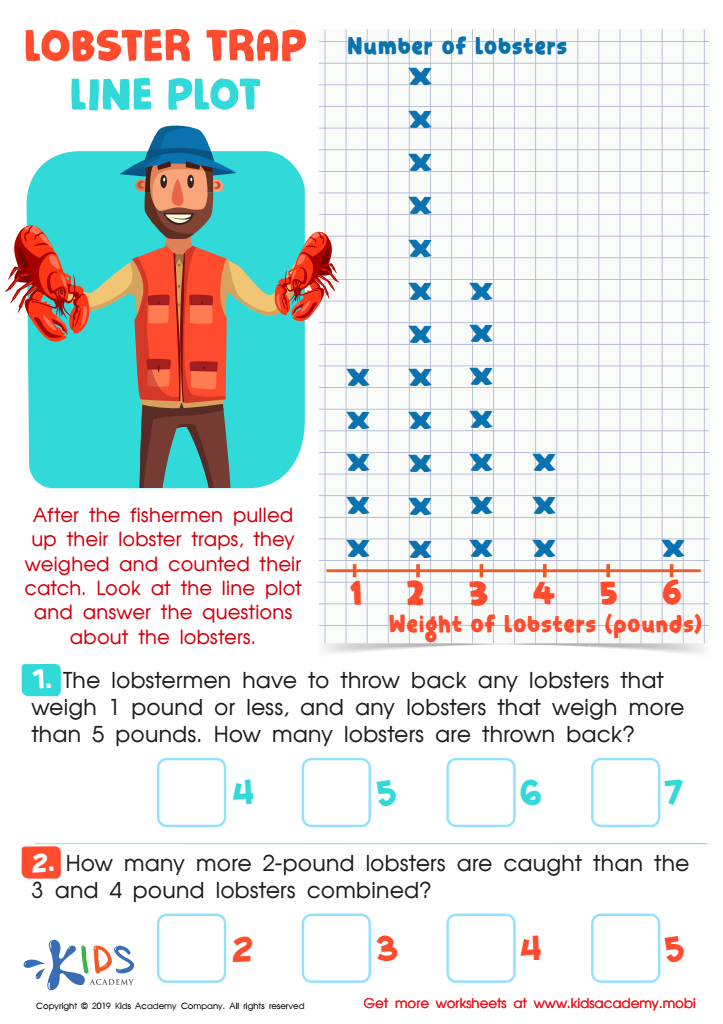
Lobster Trap Line Plot Worksheet
If your kids are working on line plots, this worksheet is perfect for them! Show them the picture and read the instructions. Help them look at the line plot and answer the questions at the bottom. Learning math can be fun, so make it enjoyable together!
 Assign to My Students
Lobster Trap Line Plot Worksheet
Worksheet
Join Kids Academy for Free
Who is primarily going to use this learning content?








Improving counting skills in Grade 3 is essential for both parents and teachers to support, as it lays a fundamental groundwork for more advanced mathematical concepts. At this stage, students transition from basic counting to manipulating numbers through addition, subtraction, multiplication, and division. A solid proficiency in counting is crucial for understanding place value—a key component in grasping large numbers and performing arithmetic operations.
Counting skills also enhance problem-solving abilities. When children can count accurately and confidently, they find it easier to tackle word problems, identify patterns, and engage in logical reasoning. These skills are not only pivotal for math but also for everyday decision-making and other subjects like science and economics.
Furthermore, strong counting skills foster a positive attitude toward mathematics. Early competence in counting can build children’s confidence and reduce anxiety about math, leading to a more enthusiastic approach toward learning. This enthusiasm is often contagious, benefiting classroom dynamics and encouraging a life-long appreciation for STEM (Science, Technology, Engineering, and Mathematics) subjects.
Lastly, proficiency in counting and related mathematical skills contributes to future academic success and is a predictor of overall academic achievement. By emphasizing these skills in third grade, parents and teachers can ensure a strong educational foundation that supports future learning and personal development.