Practice multiplication Grade 3 Worksheets
3 filtered results
Difficulty Level
Grade
Age
-
From - To
Subject
Activity
Standards
Welcome to our Practice Multiplication Grade 3 Worksheets page! Designed for young learners, these engaging worksheets help students build strong multiplication skills through fun and interactive exercises. Tailored to align with third-grade curriculum standards, our resources include a variety of multiplication problems, visual aids, and games to make learning enjoyable. Encourage your child to practice multiplication daily to boost their confidence and academic performance. With a diverse selection of worksheets, from simple equations to word problems, you'll easily find materials suited to your child's learning pace. Start exploring our multiplication worksheets today and watch your child's math skills flourish!
Favorites
With answer key
Interactive
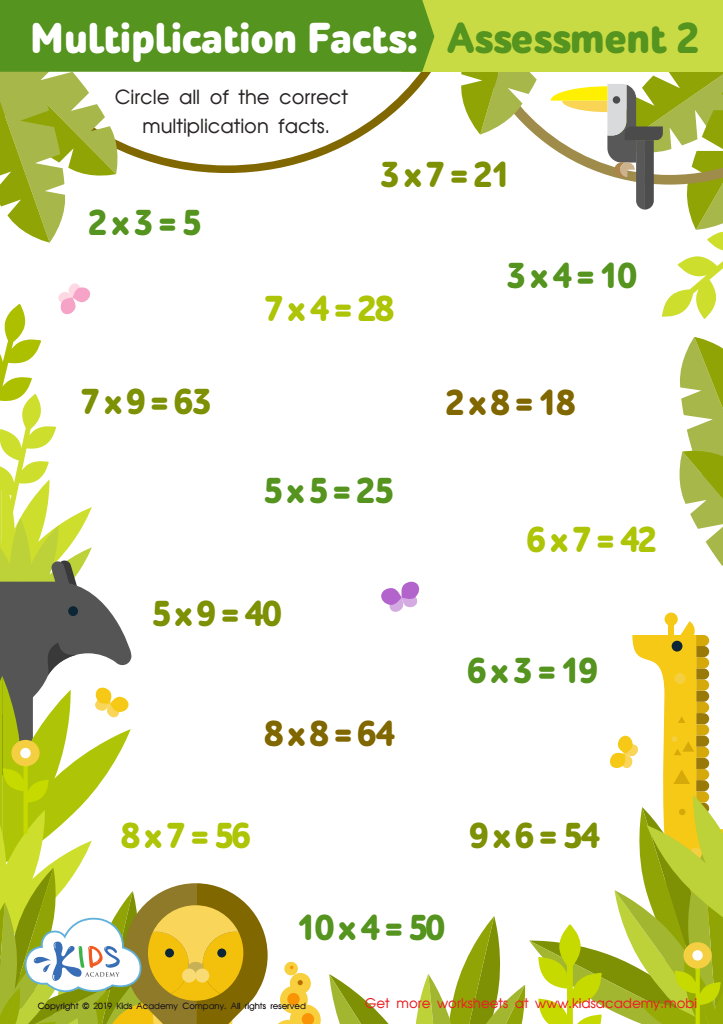
Multiplication Facts: Assessment 2 Worksheet
Engage your students with this fun and simple multiplication worksheet! It will help them practice and get better at solving figures correctly. Look at the problems in the picture and have them circle all the correct multiplication facts. It's a great way to introduce new rules and formats and make multiplication more enjoyable.
 Assign to My Students
Multiplication Facts: Assessment 2 Worksheet
Worksheet
Join Kids Academy for Free
Who is primarily going to use this learning content?








Practicing multiplication in Grade 3 is essential for several reasons that both parents and teachers should recognize. First, multiplication is a foundational math skill that supports students' understanding of more advanced concepts, such as division, fractions, and algebra in later grades. By mastering multiplication tables, students develop confidence and build a solid mathematical base.
Additionally, regular practice improves a child's fluency with numbers, enabling them to solve calculations more quickly and accurately. This fluency is crucial, as math often requires quick thinking and instant recall of facts, especially in higher levels where problem-solving speed can significantly impact performance.
Moreover, understanding multiplication is relevant in daily life. From calculating prices while shopping to estimating distances, multiplication skills play a vital role in fostering practical applications of math beyond the classroom.
Finally, a supportive and engaged learning environment between parents and teachers amplifies this practice. Parents can reinforce lessons at home, and teachers can design interactive and differentiated activities that cater to diverse learning styles. Collaborative efforts help children grasp these essential skills, setting them on a path towards success in mathematics and overall academic achievement.