Basic multiplication Grade 3 Area and Perimeter Worksheets
3 filtered results
Difficulty Level
Grade
Age
-
From - To
Subject
Activity
Standards
Unlock the potential of young minds with our engaging Basic Multiplication Grade 3 Area and Perimeter Worksheets! Our expertly designed worksheets align with common core standards to reinforce essential multiplication skills while integrating area and perimeter concepts. Perfect for third graders, these activities blend math practice with real-world problem-solving to enhance critical thinking. With colorful visuals and interactive problems, children will enjoy mastering foundational math concepts. Ideal for classroom reinforcement or extra practice at home, our worksheets support various learning styles and pacing. Build a strong math foundation and help your kids achieve academic success with ease and fun!
Favorites
With answer key
Interactive
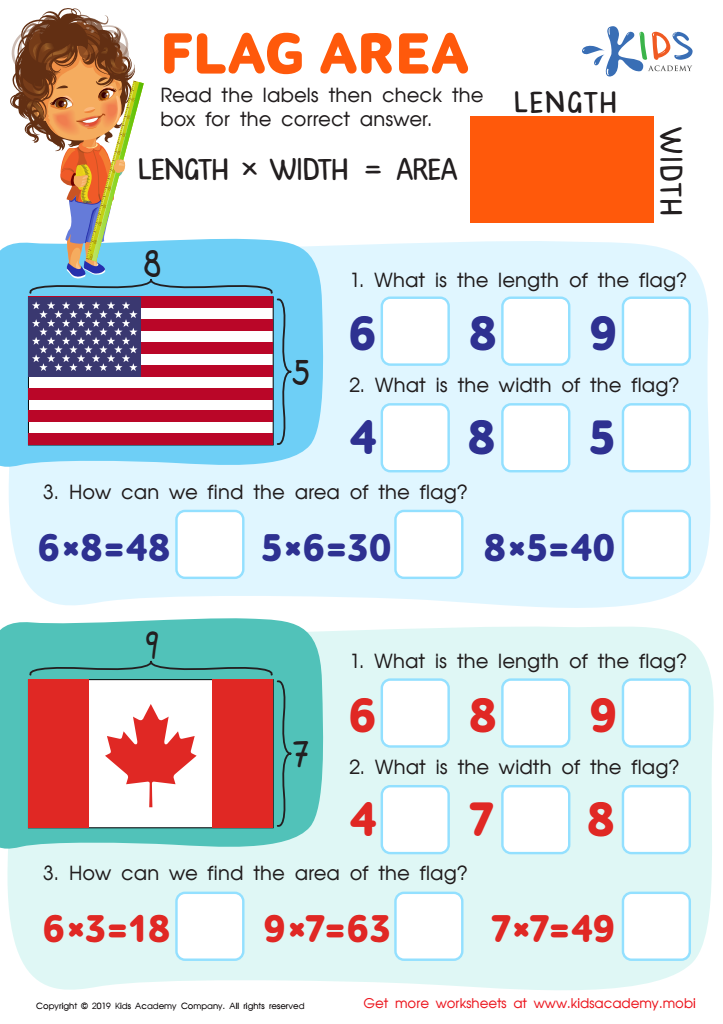
Flag Area Worksheet
Test your child's knowledge of flags by asking which ones they can identify in the image. Then, study the worksheet together. There are 6 questions with labels. Have them read each label and check the box for the correct answer.
 Assign to My Students
Flag Area Worksheet
Worksheet
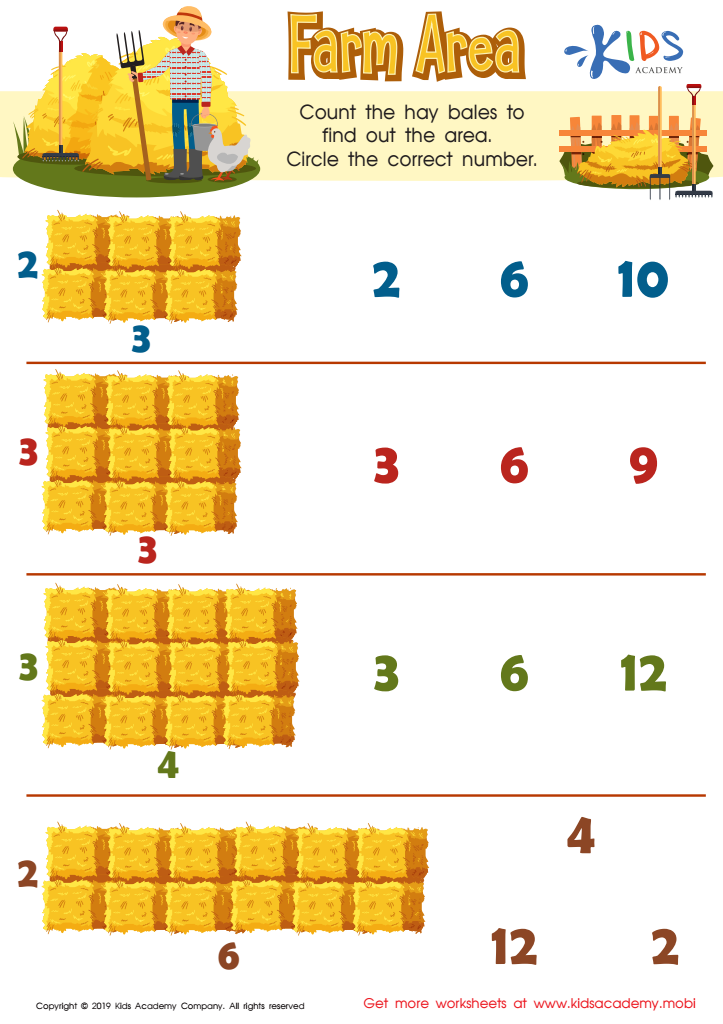
Farm Area Worksheet
Take your kids to a farm and ask them what their favorite part was! Show them this picture with hay bales and have them count them. Find the area then circle the correct number. It's a fun way to learn math and experience a farm!
Farm Area Worksheet
Worksheet
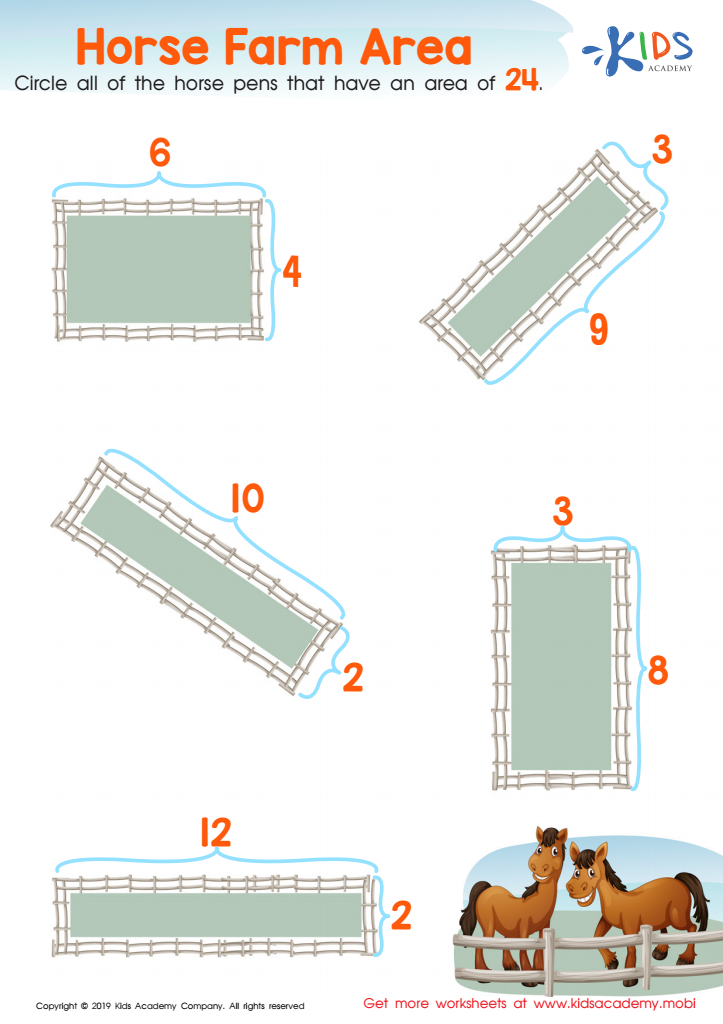
Horse Farm Area Worksheet
Take your kids to a horse farm! They'll love it – there's lots to explore, plus they can ride horses. Then challenge them with a geometry worksheet: help them calculate the area of all the horse pens, then circle the ones with an area of 24.
Horse Farm Area Worksheet
Worksheet
Join Kids Academy for Free
Who is primarily going to use this learning content?



Basic multiplication, area, and perimeter are fundamental concepts in the Grade 3 curriculum that serve as building blocks for more advanced mathematical concepts. Understanding multiplication aids in daily problem-solving, including tasks involving repeated addition, making it essential for real-life scenarios such as shopping or cooking.
Focusing on these concepts helps develop a child’s numerical literacy and critical thinking skills. For example, learning to multiply quickly and accurately makes tackling a variety of math problems simpler, thereby building a foundation for more complex operations such as division, fractions, and eventually algebra.
Teaching area and perimeter opens a window to spatial understanding and geometry. It equips students with the ability to measure and understand the world around them—skills applicable in fields as diverse as architecture, engineering, and interior design. Knowing how to calculate area and perimeter encourages logical reasoning and analytical thinking, which further aids in understanding symmetry, patterns, and properties of shapes.
Moreover, instilling strong math skills at an early age boosts a child’s confidence and academic performance, fostering a positive attitude towards mathematics. Teachers and parents play a crucial role in reinforcing these concepts, through practice, encouragement, and real-world application, ensuring students have a solid math foundation that promotes lifelong learning and success.