Historical Knowledge Grade 3 Arrays Worksheets
3 filtered results
Difficulty Level
Grade
Age
-
From - To
Subject
Activity
Standards
Explore our engaging "Historical Knowledge Grade 3 Arrays Worksheets" designed to enhance students' understanding of arrays while connecting math to historical concepts. These worksheets encourage children to visualize mathematical arrays within historical contexts, bridging their learning across subjects. With appealing visuals and age-appropriate content, students will operate with array patterns that reflect significant historical events or figures. Ideal for classroom or homeschool settings, these resources promote both critical thinking and problem-solving skills. Empower your third graders to dive into math with exciting historical knowledge and enrich their studies with our thoughtfully created worksheet collection. Start today for a fun learning experience!
Favorites
With answer key
Interactive
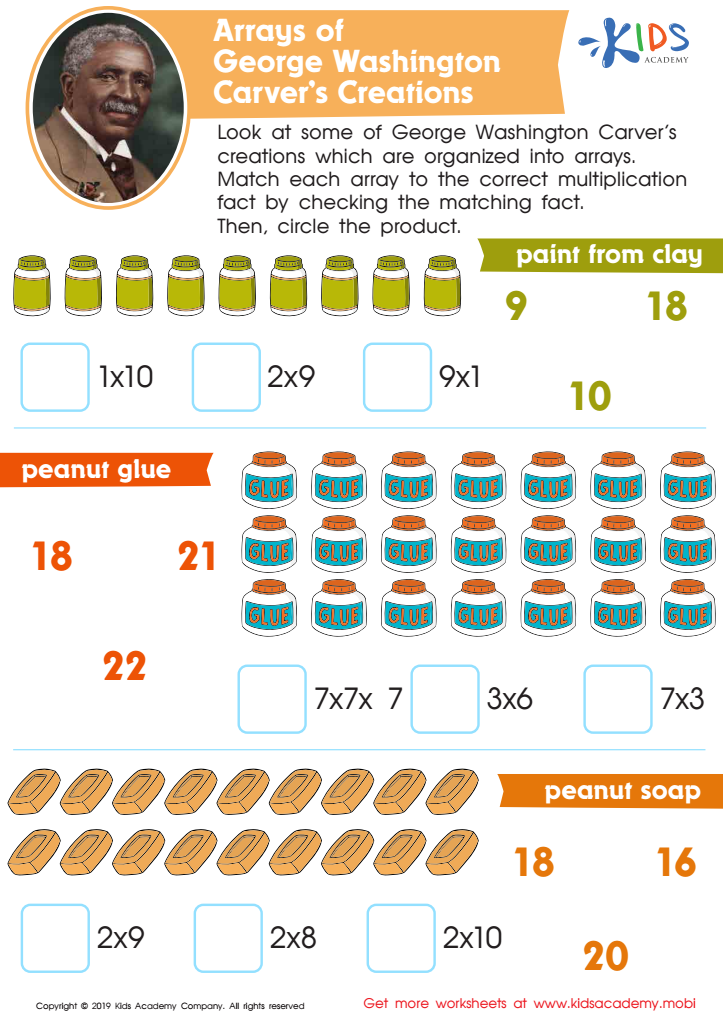
Arrays of George Washington Carver’s Creations Worksheet
Remind your child of what George Washington Carver created. Can they tell you? This worksheet has arrays with his creations. Match the array to the multiplication fact and help your child to circle the product.
 Assign to My Students
Arrays of George Washington Carver’s Creations Worksheet
Worksheet
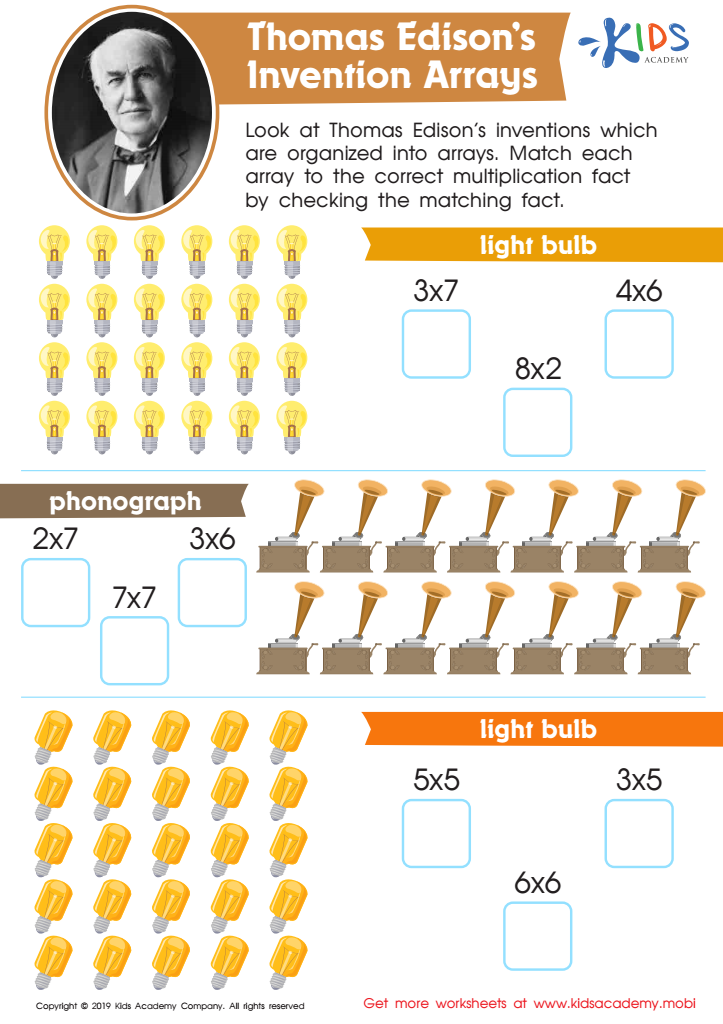
Thomas Edison’s Invention Arrays Worksheet
Test your students' knowledge on history by asking them what Thomas Edison invented. If they get the right answer, provide more information on other inventors. Check out this printout of Edison's light bulb inventions laid out in arrays. Get them to match each array to the correct multiplication fact.
Thomas Edison’s Invention Arrays Worksheet
Worksheet
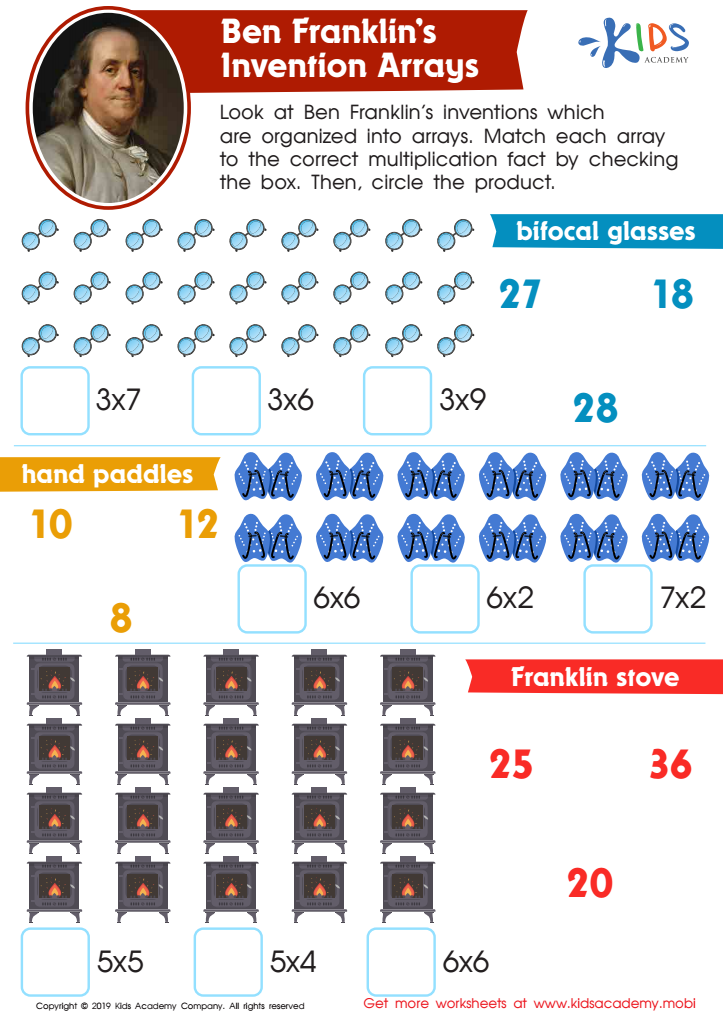
Ben Franklin’s Invention Arrays Worksheet
Have your child guess some of the inventors of the popular items we use today. For instance, the light bulb was invented by Thomas Edison. Look at Ben Franklin's inventions and help your kids match the arrays to the correct multiplication fact. Check the box and circle the product.
Ben Franklin’s Invention Arrays Worksheet
Worksheet
Join Kids Academy for Free
Who is primarily going to use this learning content?





Understanding historical knowledge, particularly in the context of Grade 3 arrays, is crucial for both parents and teachers for several reasons. First, arrays introduce young learners to foundational concepts in mathematics, such as multiplication and problem-solving. By using arrays, students visualize and organize information, which enhances comprehension and retention.
Second, learning through arrays fosters critical thinking and logical reasoning. Students develop the ability to approach mathematical problems systematically, which is essential for their future academic endeavors. This skill not only applies to math but also to other subjects, encouraging a well-rounded educational experience.
Moreover, historical knowledge aids in connecting mathematics to real-world situations. By integrating stories or projects reflecting historical contexts, students see the relevance of arrays in history, such as organizing items in trade or understanding population data.
Furthermore, parental involvement and teacher support in promoting historical knowledge enrich the learning environment, strengthening the child's educational foundation. Knowledge of arrays and their historical applications can inspire a passion for learning beyond textbooks, cultivating curiosity and creativity. As educators and parents collaborate to emphasize these concepts, they empower children with the skills and knowledge to thrive academically and personally throughout their lives.