Basic Math Skills Grade 3 Comparing Numbers Worksheets
3 filtered results
Difficulty Level
Grade
Age
-
From - To
Subject
Activity
Standards
Enhance your third grader's math proficiency with our engaging Comparing Numbers Worksheets! Designed to support essential basic math skills, these worksheets help students master the art of comparing numbers through fun and interactive exercises. Children will learn to identify greater than, less than, and equal to relationships, fostering analytical thinking and boosting confidence in their mathematics abilities. Each worksheet is tailored to align with grade-level standards, making learning effective and enjoyable. Perfect for classroom use or at-home practice, these resources are a great way to reinforce your child's understanding of number comparison. Equip your young learners with the skills for mathematical success today!
Favorites
With answer key
Interactive
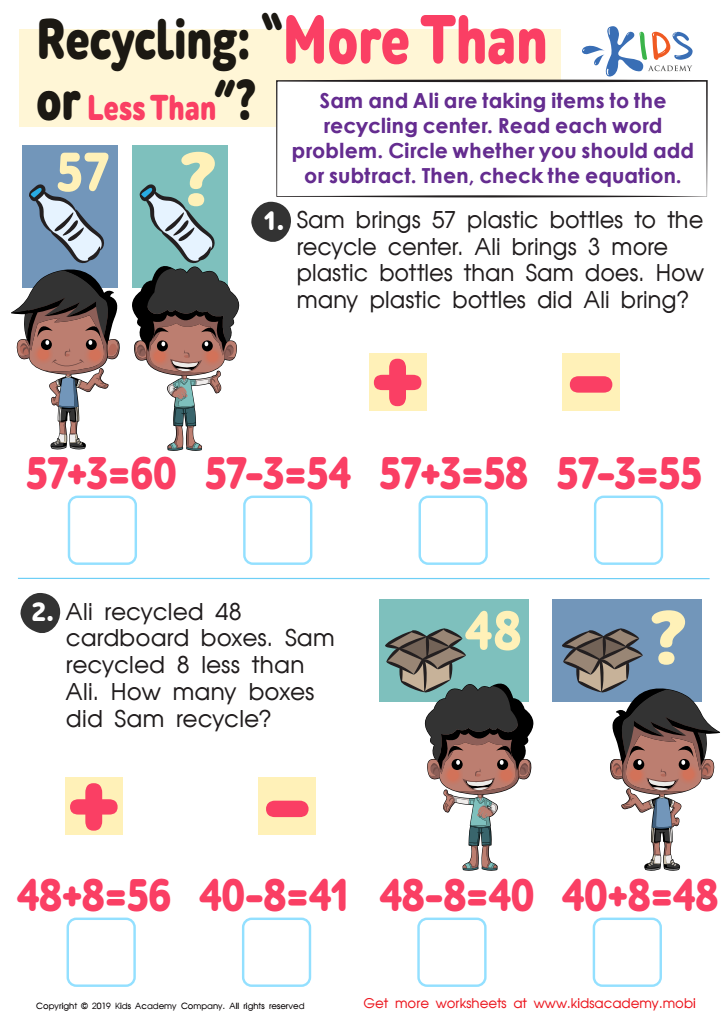
Recycling - More or Less Worksheet
Your child can compare numbers and solve word problems with this free worksheet. Help them understand what's being asked as Sam and Ali take items to the recycling center. They can choose the correct equation to match the word problem and apply their skills in reading and pulling out the appropriate information.
 Assign to My Students
Recycling - More or Less Worksheet
Worksheet
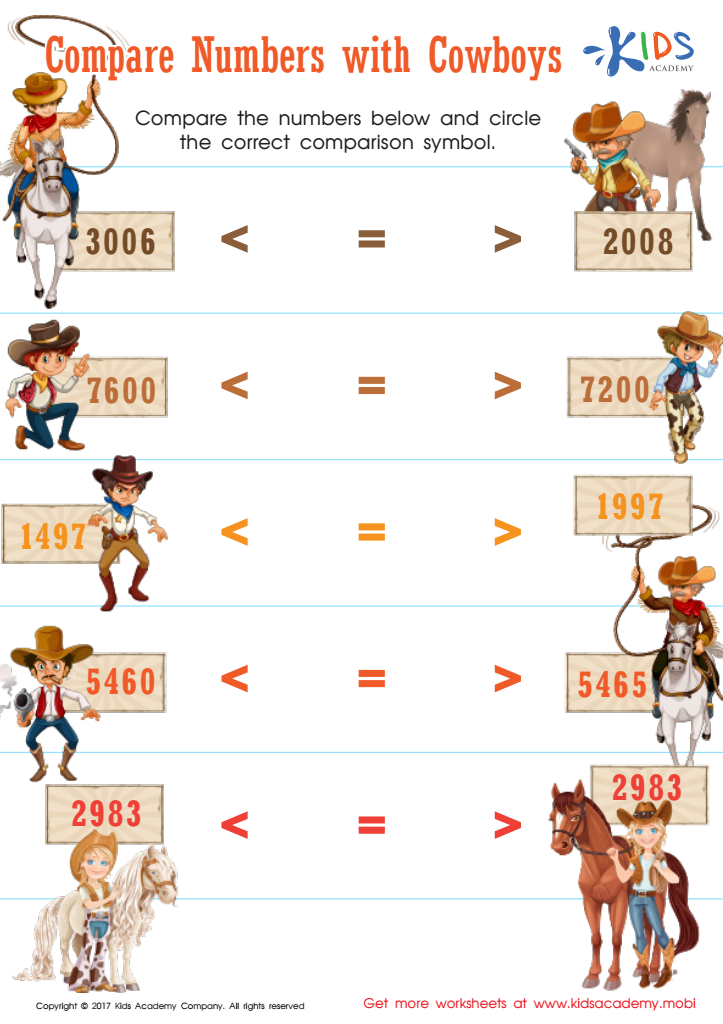
Compare Numbers Worksheet for 3rd Grade
Time to get a roundup on big numbers! Help your 3rd grader practice comparing thousands with this compare numbers worksheet. They'll use >, <, and = symbols for tricky numbers. Jump in and join the cowboys!
Compare Numbers Worksheet for 3rd Grade
Worksheet
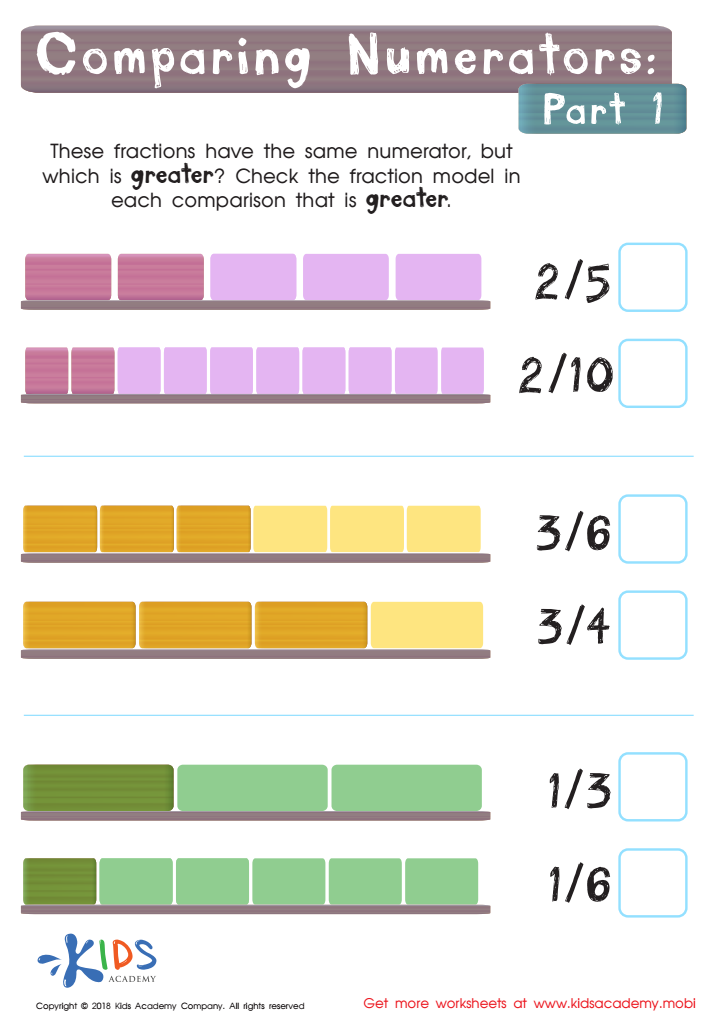
Comparing Numerators Part 1 Worksheet
This worksheet has 3 fractions groups with the same numerator. Your child must determine which fraction is greater in each comparison. Check the fraction model to see the greater one.
Comparing Numerators Part 1 Worksheet
Worksheet
Join Kids Academy for Free
Who is primarily going to use this learning content?








Basic math skills, including comparing numbers, are crucial for a child's overall cognitive development, particularly by third grade. Understanding how to compare numbers helps students grasp foundational concepts of order, magnitude, and difference, laying the groundwork for more advanced mathematical operations. When children can readily identify which numbers are larger or smaller, they are better equipped to solve problems involving addition, subtraction, and eventually multiplication and division.
Parents and teachers should care about this skill because it directly impacts a child's confidence in math. Mastery in comparing numbers not only fosters a positive attitude toward mathematics but also enhances critical thinking abilities, as children learn to Analyze and draw conclusions based on numerical relationships. Furthermore, built-in factors like everyday scenarios—such as budgeting, shopping, or measuring ingredients—rely on these basic skills.
Moreover, a strong foundation in math during early education correlates with academic success later on. As children encounter higher-level math concepts in subsequent grades, their ability to compare numbers will be crucial in solving complex problems. Engaging in activities that promote these skills encourages a lifelong appreciation for mathematics, preparing students for both academic challenges and real-world situations. Thus, investing time and resources now can pay off significantly in the future.