Motor skills development Grade 3 Math Worksheets
3 filtered results
Difficulty Level
Grade
Age
-
From - To
Subject
Activity
Standards
Enhance your Grade 3 students' motor skills with our engaging math worksheets! Designed to combine learning and physical activity, these worksheets help children practice essential math concepts while developing their fine motor skills. Children can enjoy various fun activities, from tracing numbers and shapes to solving math problems that require writing and drawing. Our carefully crafted resources cater to different learning styles and skill levels, ensuring a comprehensive approach to both math and motor skill development. Ideal for classroom or home use, these worksheets will foster a love for learning while improving dexterity and coordination. Explore the fun of math today!
Favorites
With answer key
Interactive
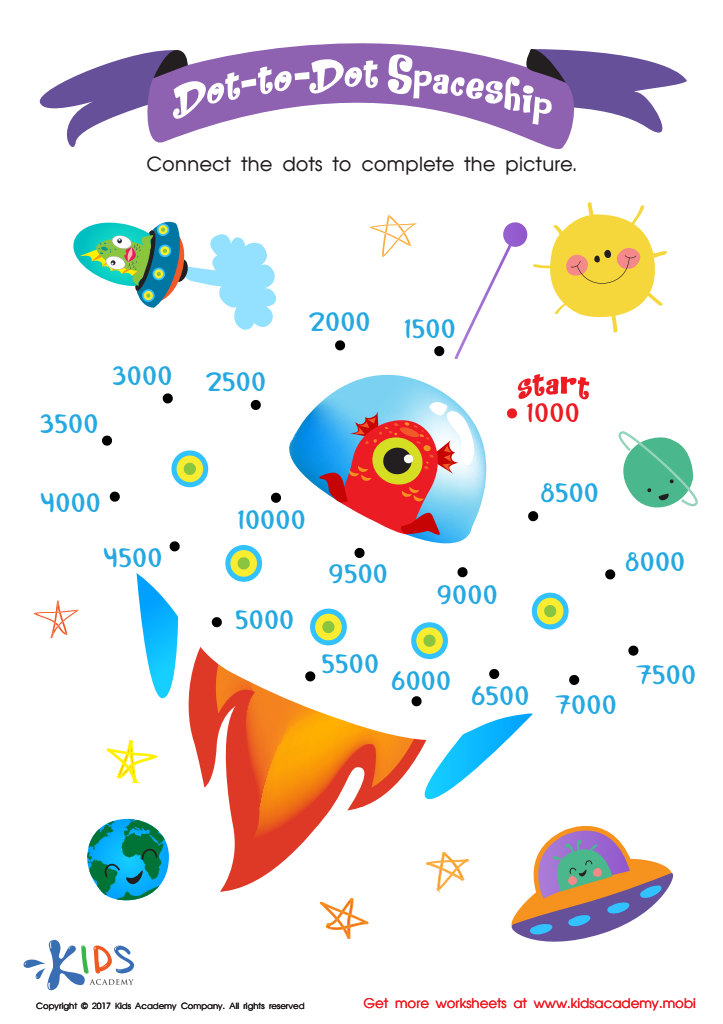
Dot to Dot Worksheet for 3rd Grade
Let your 3rd grader develop better number skills with this dot-to-dot worksheet! They can have fun outlining a spaceship as they skip count by 500 up to 10,000. It's a great way to boost their number sense and make learning more exciting.
 Assign to My Students
Dot to Dot Worksheet for 3rd Grade
Worksheet
Join Kids Academy for Free
Who is primarily going to use this learning content?








Motor skills development is crucial for Grade 3 students as it profoundly influences their overall learning, including math skills. At this stage, children transition from being primarily kinesthetic learners to integrating more abstract concepts, so fine and gross motor skills significantly facilitate this process.
Firstly, proficient motor skills enhance children's ability to engage with hands-on learning activities that reinforce math concepts, such as using manipulatives to understand addition, subtraction, and shapes. These activities not only make learning more engaging but also improve spatial awareness and problem-solving abilities.
Furthermore, motor skills correlate strongly with academic success. Children who struggle with writing, for instance, may find it challenging to express their math solutions clearly, leading to frustration and disengagement. On the contrary, those with well-developed motor skills are often more confident and willing to participate in classroom activities.
Finally, every skill in math, from writing numbers to drawing graphs, requires a certain level of motor coordination. Parents and teachers should prioritize motor skills development to foster a holistic learning environment, paving the way for a child’s confidence and success in math and beyond. By supporting this essential aspect of development, they contribute to a child's academic journey and self-esteem.