Understanding patterns Grade 3 Times Tables Worksheets
3 filtered results
-
From - To
Boost your Grade 3 students' math skills with our "Understanding Patterns" Times Tables Worksheets! These engaging resources make learning multiplication enjoyable by helping children discover the patterns behind times tables. From recognizing sequences to mastering essential multiplication facts, our worksheets support students in developing confidence and fluency in math. Designed for classrooms and home learning, they provide opportunities for hands-on practice, making math fun and effective. Help your young learners uncover the relationships among numbers and build a strong foundation in mathematics that will serve them throughout their academic journey. Download the worksheets today and transform math learning into an exciting adventure!
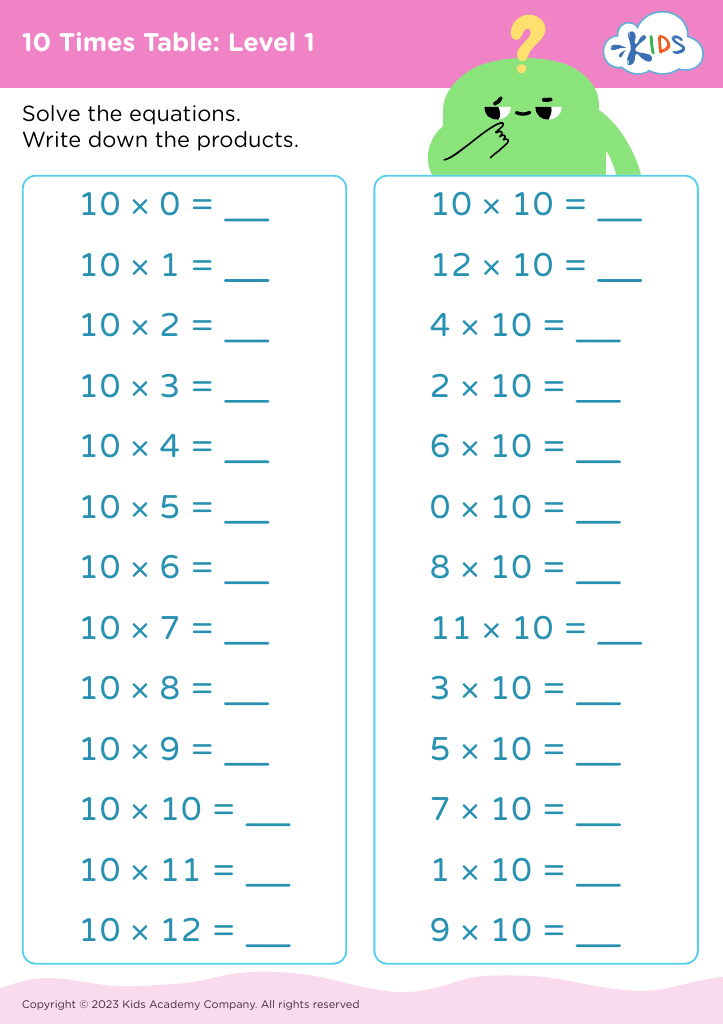
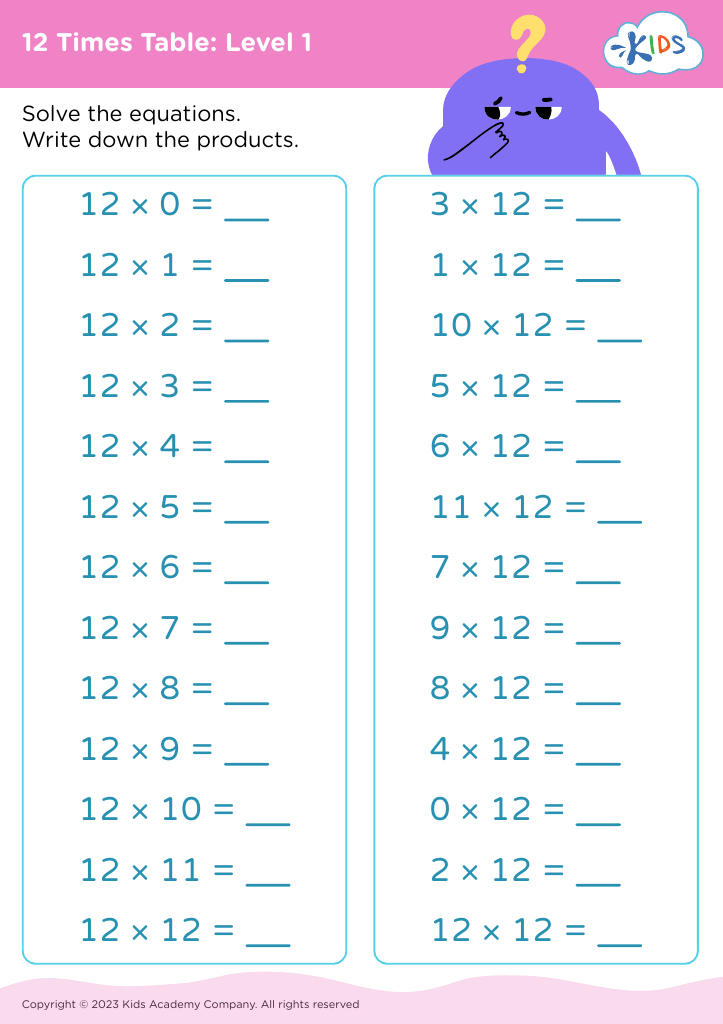
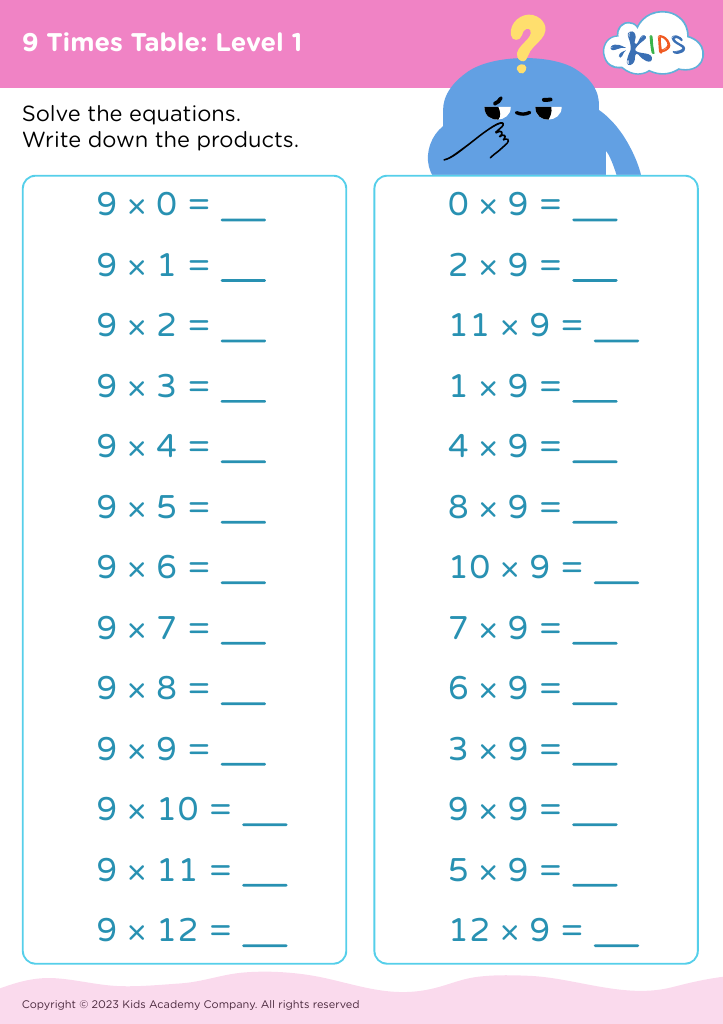




Understanding patterns in Grade 3 times tables is crucial for both parents and teachers because it lays the foundation for mathematical fluency and problem-solving skills. At this stage, students begin to build a strong number sense, and recognizing patterns helps them simplify complex calculations. For instance, recognizing that the times tables for 2, 4, 6, 8, etc., follow an even number pattern enables students to anticipate answers and enhances their confidence.
When teachers focus on helping students discover and understand these patterns, they promote deeper comprehension rather than rote memorization. This leads to improved retention and application of multiplication concepts as students progress to more advanced mathematics.
Moreover, encouraging parents to engage in activities that reinforce these patterns—like games or real-life applications—creates a supportive learning environment at home, fostering a positive attitude toward math. It’s not just about learning multiplication tables; it’s about developing critical thinking and analytical skills that students will carry with them throughout their academic journey.
Ultimately, understanding patterns in times tables prepares students for more complex mathematical concepts and problem-solving scenarios in the future. Thus, both parents and teachers play a vital role in this essential learning process.