Animal recognition Grade 3 Word Problems Worksheets
4 filtered results
Difficulty Level
Grade
Age
-
From - To
Subject
Activity
Standards
Enhance your third grader's math skills with our engaging "Animal Recognition Grade 3 Word Problems Worksheets." Designed to combine learning and fun, these worksheets encourage children to apply their knowledge of animals while tackling grade-level math challenges. Students will solve real-world problems through exercises that interplay animal facts and mathematical concepts. These worksheets foster critical thinking and improve comprehension, making learning enjoyable. Perfect for classroom use or homeschooling, our resources support diverse learning styles and include various interactive activities. Download our worksheets today to inspire a love for math and enrich your child's understanding of the animal kingdom!
Favorites
With answer key
Interactive
Animals of Amazon Worksheet
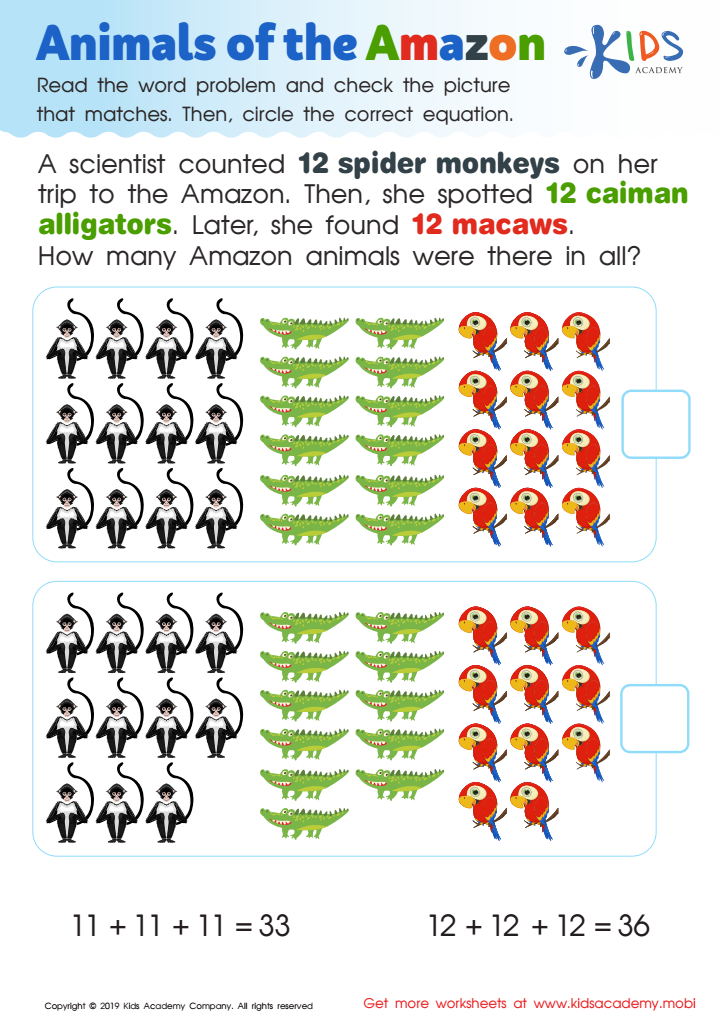
Kids will love exploring the Amazon while solving addition problems on this colorful PDF worksheet. They need to pay attention to the bolded info in each word problem to figure out the equation picture that matches. It's an exciting way to learn about the Amazon and practice adding multiple numbers!
 Assign to My Students
Animals of Amazon Worksheet
Worksheet
Australian Animal Subtraction Worksheet
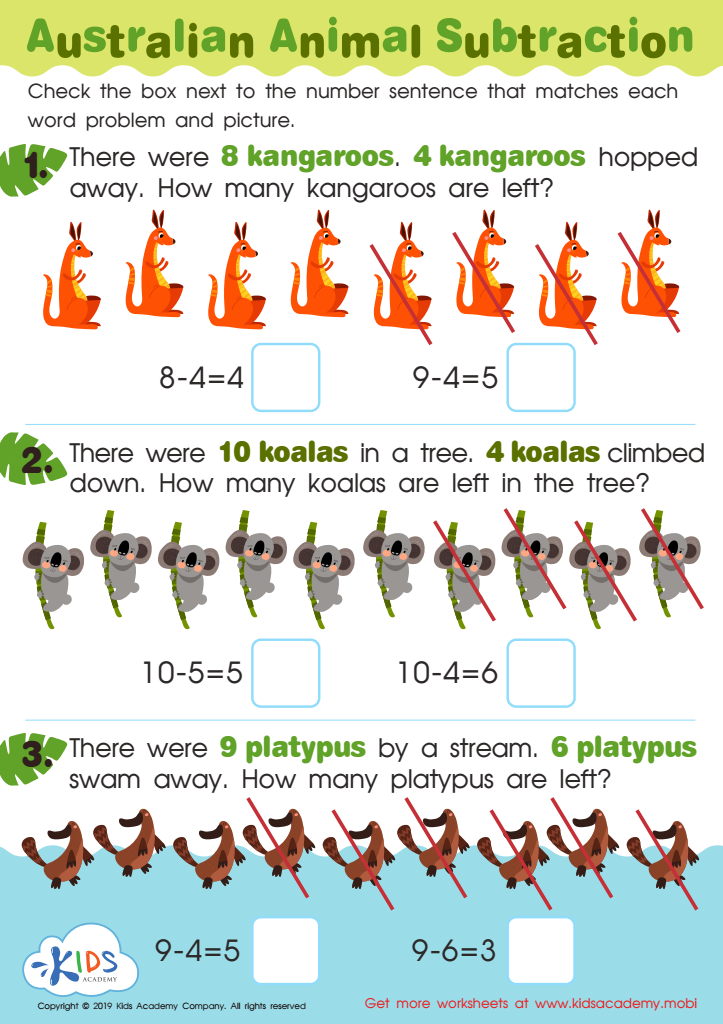
Test your child's wildlife knowledge. Ask them to name animals indigenous to Australia or other countries. Show them the animals in this worksheet and have them match each word problem and picture with the correct number sentence.
Australian Animal Subtraction Worksheet
Worksheet
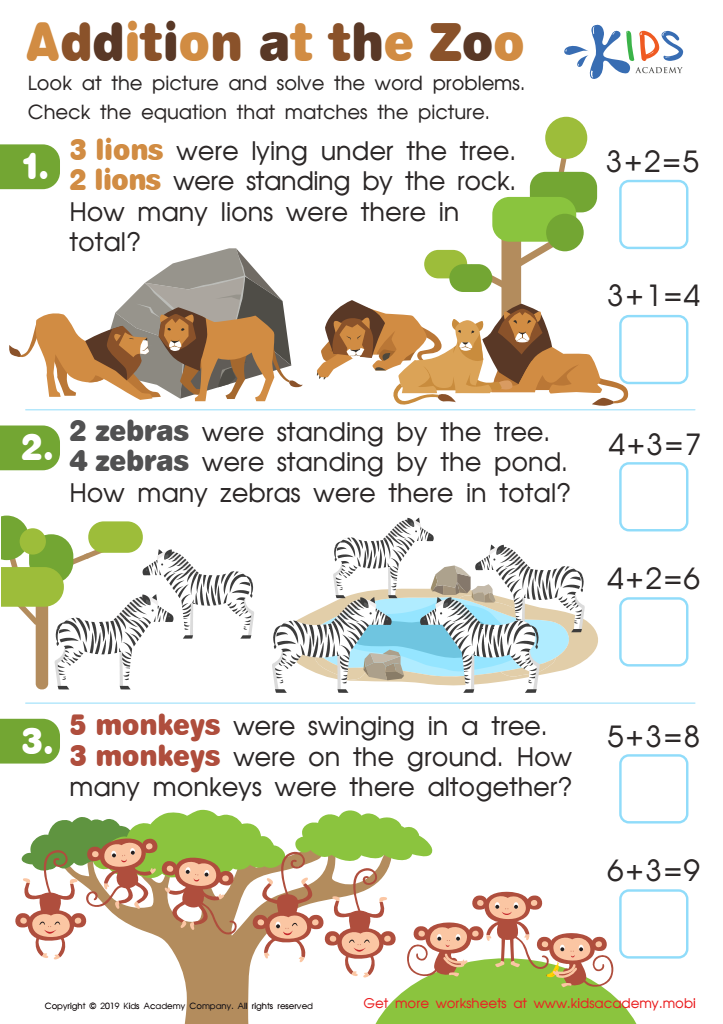
Addition at the Zoo Worksheet
Visit the zoo with your kids and point out all the different animals. Ask them to name their favorites and identify animals on a worksheet. Challenge them to solve word problems related to the pictures. Ask them for the equation that fits the picture and check the answer.
Addition at the Zoo Worksheet
Worksheet
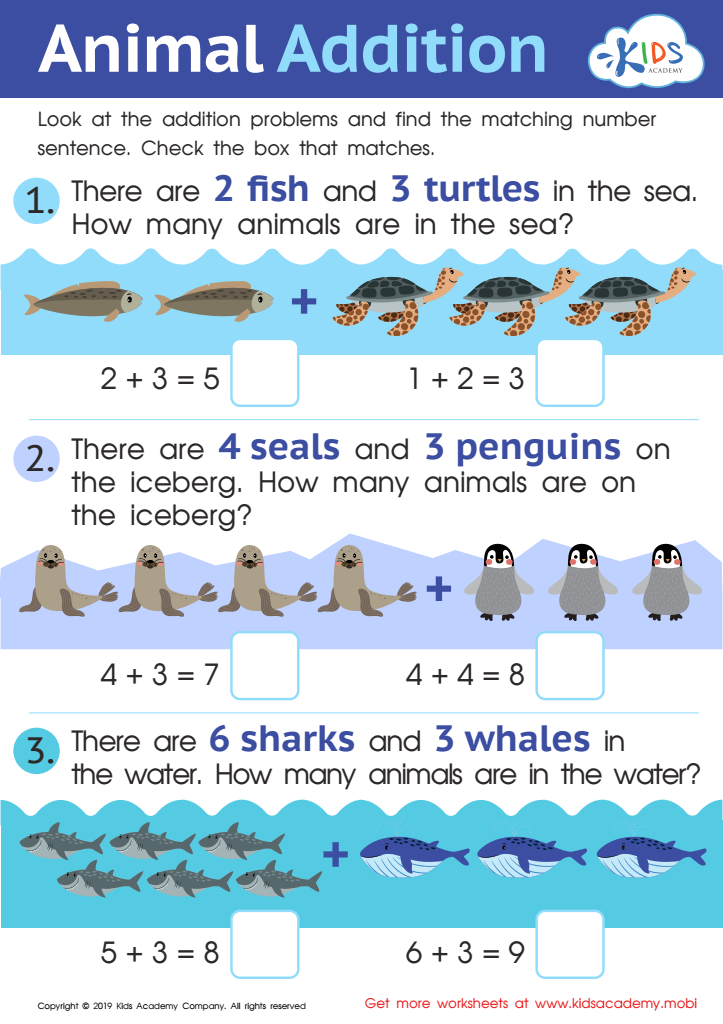
Animal Addition Worksheet
Get your kids learning addition and subtraction with this fun worksheet! Show them that solving equations can be enjoyable and help them match number sentences to the correct boxes. By doing this together, you'll create a positive learning experience that your kids won't forget.
Animal Addition Worksheet
Worksheet
Join Kids Academy for Free
Who is primarily going to use this learning content?








Animal recognition in Grade 3 word problems is crucial for several reasons. Firstly, it enhances children's observation skills and critical thinking. When students identify different animals within a problem, they are required to think about characteristics, habitats, and behaviors, promoting comprehension and retention.
Secondly, incorporating animal recognition aligns with interdisciplinary learning. It merges subjects like science, language arts, and math, showing students how knowledge converges in real-life situations. For instance, understanding a problem involving different animals can help in grasping how counting or sorting works within a natural context.
Additionally, these word problems foster a sense of empathy and interest in wildlife. When children learn about various species, they become more aware of environmental issues and develop a sense of responsibility toward conservation.
Finally, animal-related problems make learning more engaging and enjoyable. Vivid visuals and relatable scenarios captivate students’ attention, making math feel less daunting and more accessible. Hence, focusing on animal recognition in grade 3 word problems nurtures well-rounded, compassionate, and analytically capable individuals, making it essential for parents and educators to integrate this aspect into their teaching methodologies.