
Understanding number sequences Worksheets for Ages 3-4
3 filtered results
Difficulty Level
Grade
Age
-
From - To
Subject
Activity
Standards
Introduce your child to the exciting world of number sequences with our "Understanding Number Sequences Worksheets" designed specifically for ages 3-4. These engaging worksheets provide a fun and interactive way to help young learners recognize patterns and develop their counting skills. Featuring colorful illustrations and age-appropriate activities, your child will enjoy following and completing number sequences, laying a strong foundation for future math knowledge. Perfect for home or classroom use, our resources promote early numeracy skills while encouraging creativity and critical thinking. Help your preschooler build confidence in their mathematical abilities and boost their learning journey today!
Favorites
With answer key
Interactive
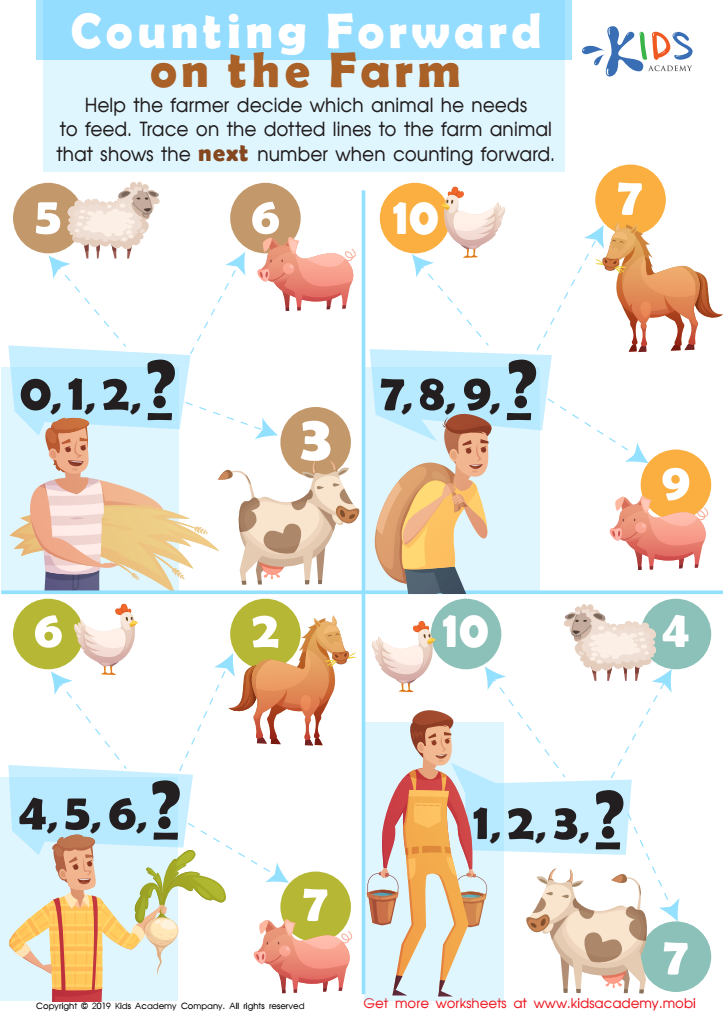
Counting Forward On the Farm Worksheet
Help your child practice counting with this fun worksheet. Have them help a farmer feed the right animal by counting on from a starting point. This activity will help them build number line thinking and refine fine motor skills.
 Assign to My Students
Counting Forward On the Farm Worksheet
Worksheet
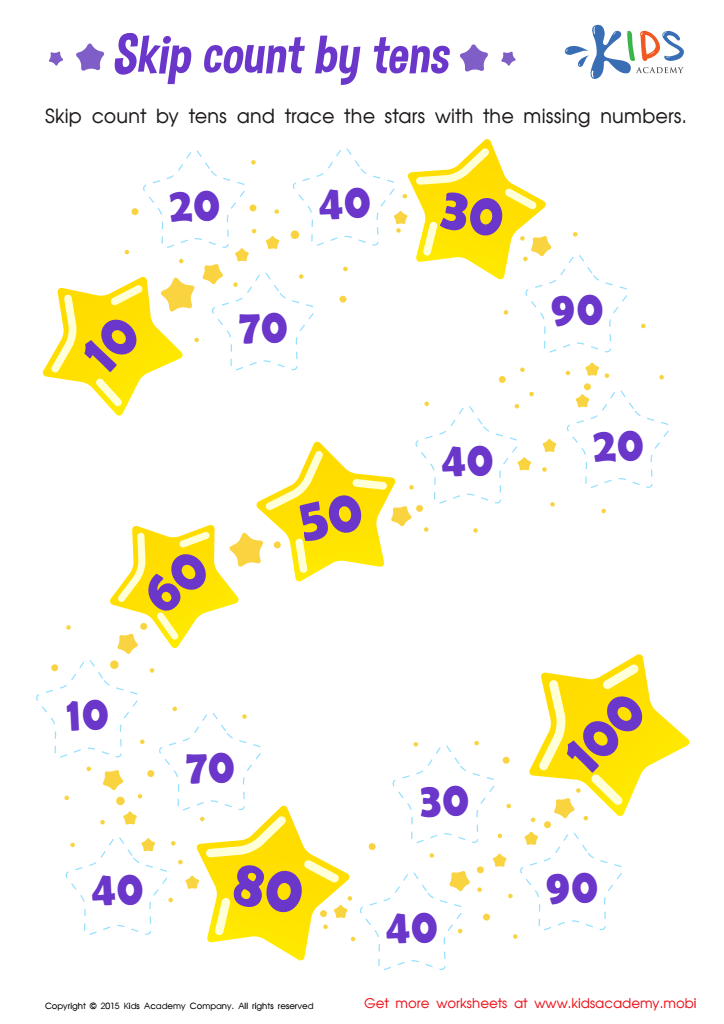
Learn dozens: Skip Count by Tens Printable
Follow a shooting star on an adventure of skip counting by 10s. Strengthen math skills with this fun and colorful worksheet. Kids will solve a puzzle, exercise logical reasoning and problem-solving skills. Get them ready for multiplication and division through increased skip counting abilities. Print this worksheet and take your star to the next level!
Learn dozens: Skip Count by Tens Printable
Worksheet
Join Kids Academy for Free
Who is primarily going to use this learning content?


.jpg)





Understanding number sequences is crucial for young learners aged 3-4 as it lays the foundation for their mathematical development. At this age, children are naturally curious and eager to explore patterns, which number sequences exemplify. Early exposure to counting and ordering fosters essential cognitive skills, encouraging children to recognize patterns in numbers, which will support more complex mathematical concepts later on.
Parents and teachers play a vital role in this development. Engaging children in activities that involve number sequences helps them build a strong numerical sense, enhances problem-solving skills, and boosts their confidence in mathematics. These activities can be as simple as counting toys, singing counting songs, or ordering objects by size. Such experiences encourage children to express their thoughts, improving their communication skills while reinforcing their understanding of numbers.
Moreover, recognizing patterns and sequences assists children in various real-life situations, from sharing snacks to organizing segments of their day. Thus, by prioritizing an understanding of number sequences, adults can cultivate not only numerical literacy but also critical thinking, ensuring their children are well-prepared for future academic challenges. These foundational skills ultimately contribute to a child's overall cognitive growth and success in school and beyond.








