
Critical Thinking Addition & Subtraction Worksheets for Ages 3-4
5 filtered results
Difficulty Level
Grade
Age
-
From - To
Subject
Activity
Standards
Enhance your child's mathematical skills with our engaging Critical Thinking Addition & Subtraction Worksheets tailored for ages 3-4. Designed to foster a love for math, these worksheets combine fun activities with essential problem-solving techniques. Your little one will enjoy colorful illustrations and interactive exercises that promote logical thinking while mastering basic addition and subtraction concepts. Each worksheet encourages children to think critically and develop their reasoning skills, setting a strong foundation for future math success. Perfect for classroom use or at-home learning, these worksheets make math enjoyable and accessible for young learners. Start building essential skills today!
Favorites
With answer key
Interactive
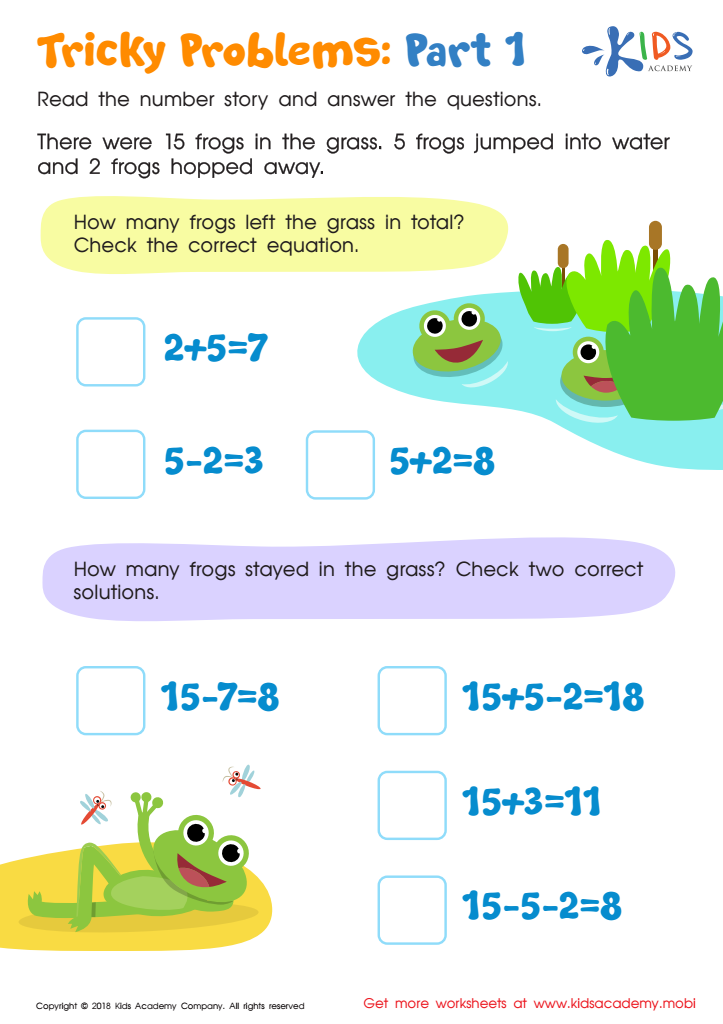
Tricky Problems Worksheet: Part 1
Visualizing word problems can help students solve them. This fun PDF worksheet encourages students to create mental images using math facts, then check boxes to match the equations for basic addition problems. It's a great way to build confidence in solving math.
 Assign to My Students
Tricky Problems Worksheet: Part 1
Worksheet
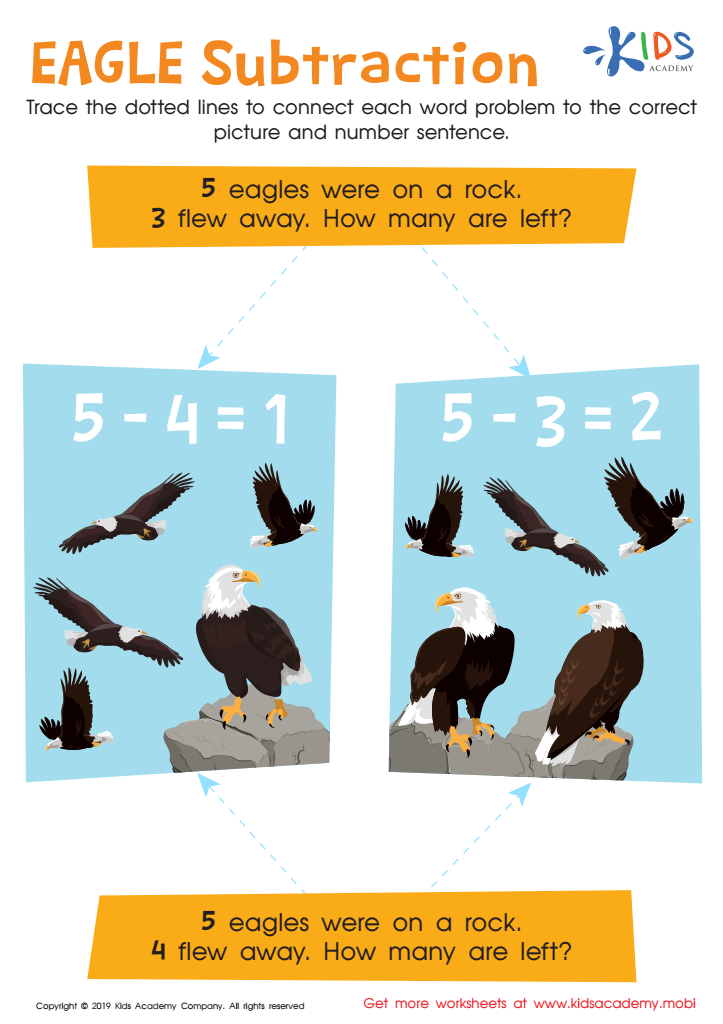
Eagle Subtraction Worksheet
Help your kids become math experts! Through practice and adult guidance, even addition and subtraction can seem simple. Show them how with this worksheet - get them to trace the dotted lines to connect each word problem to the correct picture and solve the number sentence with some eagles!
Eagle Subtraction Worksheet
Worksheet
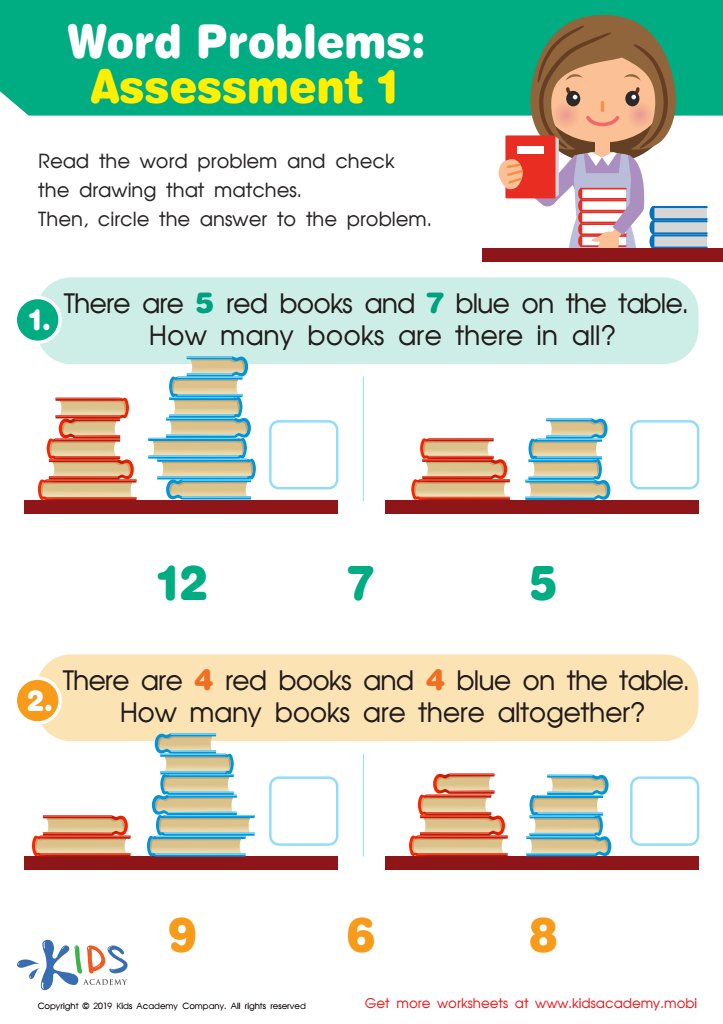
Word Problems: Assessment 1 Worksheet
This free worksheet assesses your child's basic addition word problem skills. It presents word problems with pictures offering clues in one-to-one representation. Your child will select the correct drawing to match the problem, without even knowing they're being assessed! This is a great way to gauge their math computation and reasoning abilities.
Word Problems: Assessment 1 Worksheet
Worksheet
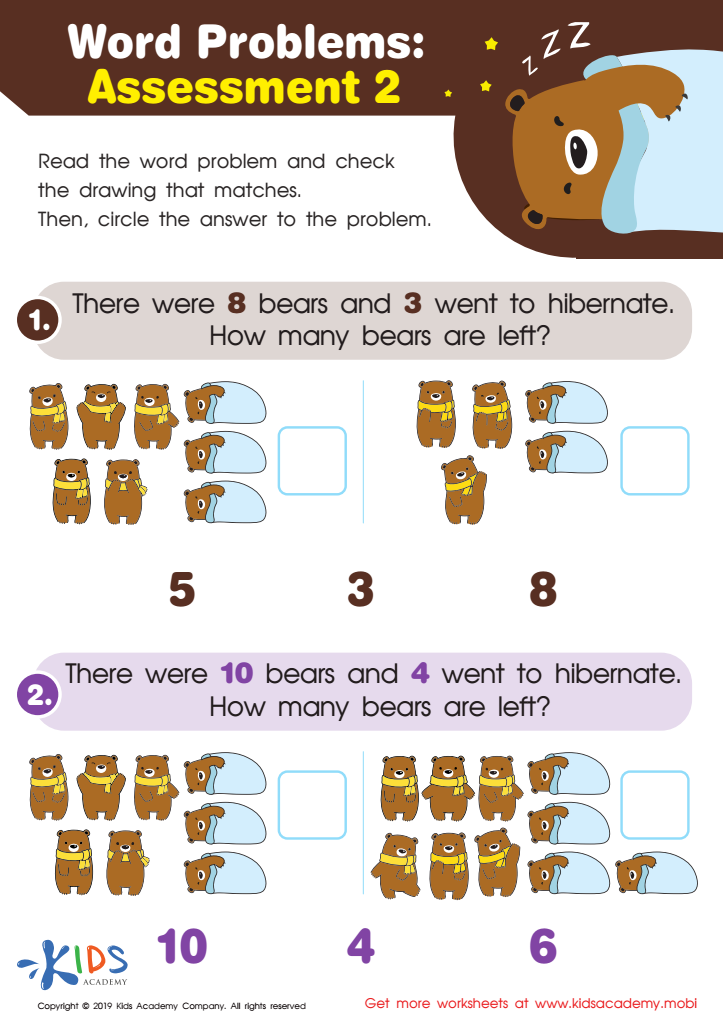
Word Problems: Assessment 2 Worksheet
This bear-themed worksheet is a great way to test subtraction skills. Have your child read the word problems and match the correct drawing with the answer. It's a fun way to quiz them without them even knowing. Enjoy counting cute snoozing bears! (80 words)
Word Problems: Assessment 2 Worksheet
Worksheet
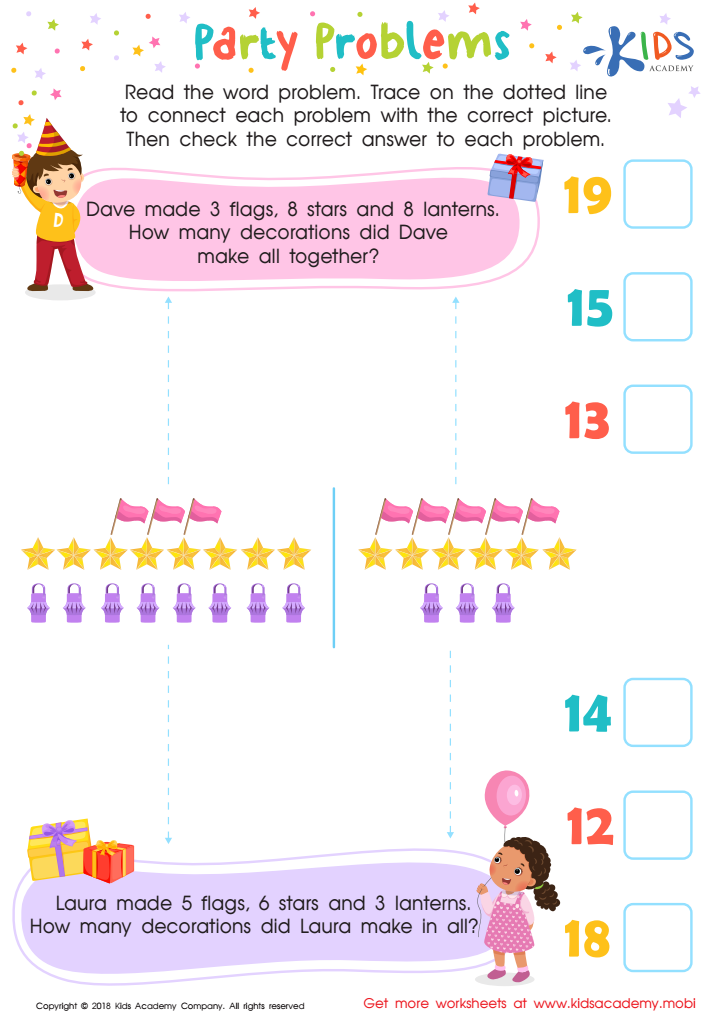
Party Problems Worksheet
Problems at parties? No problem! With this engaging PDF worksheet, your student can connect word problems to pictures, check correct answers, and find the sum of 3 addend problems. They'll be a party-saving hero in no time!
Party Problems Worksheet
Worksheet
Join Kids Academy for Free
Who is primarily going to use this learning content?








Parents and teachers should care about fostering critical thinking in addition and subtraction for children aged 3-4 because it lays a vital foundation for future mathematical skills and cognitive development. During these early years, children are naturally curious and eager to explore concepts, making it an ideal time to introduce basic mathematical principles. Engaging kids in critical thinking related to addition and subtraction nurtures their problem-solving abilities, encouraging them to analyze, question, and make connections between numbers and their real-world applications.
Furthermore, these activities boost cognitive skills such as reasoning and logic, helping young learners approach challenges with confidence. When parents and teachers employ playful methods—such as using toys, counting objects, or interactive games—the concepts become relatable and enjoyable. This not only aids in retention but also fosters a positive attitude towards learning.
Introducing critical thinking in early math lays the groundwork for more complex mathematical understanding later on, thus equipping children with skills that extend beyond academics. Ultimately, investing time in these foundational skills contributes to children's overall confidence in their abilities as learners, empowering them to navigate future educational journeys successfully.








