
Comparing lengths Math Worksheets for Ages 3-4
3 filtered results
Difficulty Level
Grade
Age
-
From - To
Subject
Activity
Standards
Unlock your child's potential with our "Comparing Lengths Math Worksheets" designed for ages 3-4! Perfectly tailored to introduce young learners to the concept of length, these engaging worksheets foster critical thinking, fine motor skills, and a fundamental understanding of measurement. Through fun activities and vibrant visuals, kids practice comparing short, long, shorter, and longer objects, paving the way for future math success. Enhance your child's early education journey with these expertly crafted, playful exercises that make learning enjoyable and effective. Ideal for both classroom and at-home use, these worksheets ensure a solid math foundation.
Favorites
With answer key
Interactive
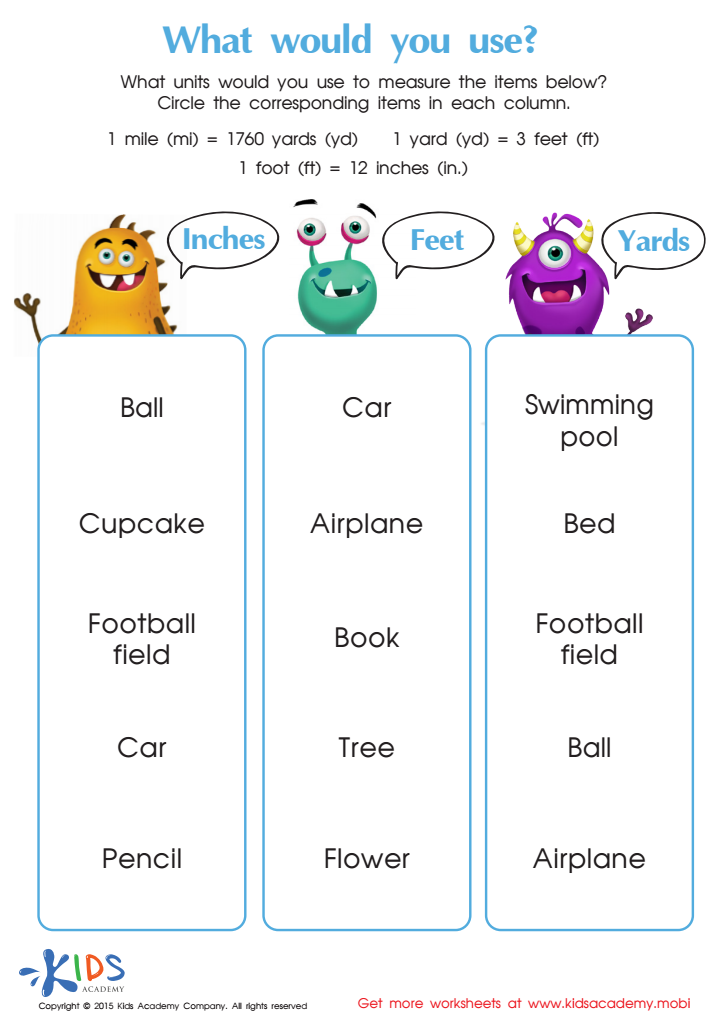
Learning about measuring objects in inches, feet and yards Worksheet
Download, cut and let your preschoolers learn and have fun estimating objects like pencils, airplanes and swimming pools in inches, feet and yards!
 Assign to My Students
Learning about measuring objects in inches, feet and yards Worksheet
Worksheet
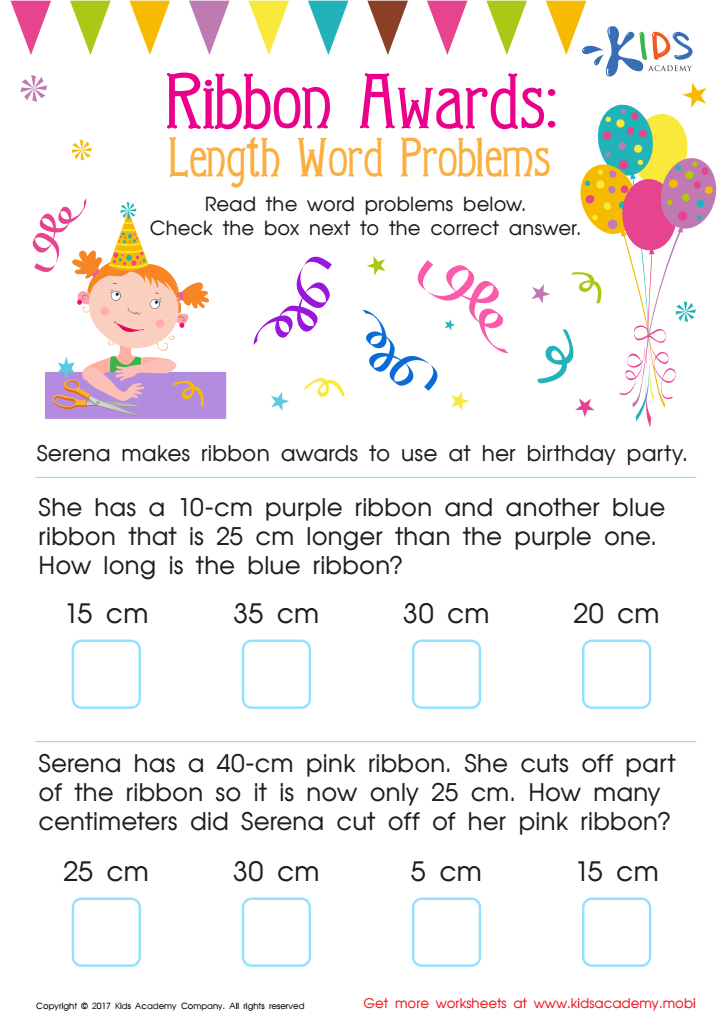
Length Word Problems Worksheet
Word problems help grade 2 students practice measurement using everyday scenarios. This worksheet provides practice in working with centimeters and inches, like measuring ribbon. It's a great way to learn and apply math skills.
Length Word Problems Worksheet
Worksheet
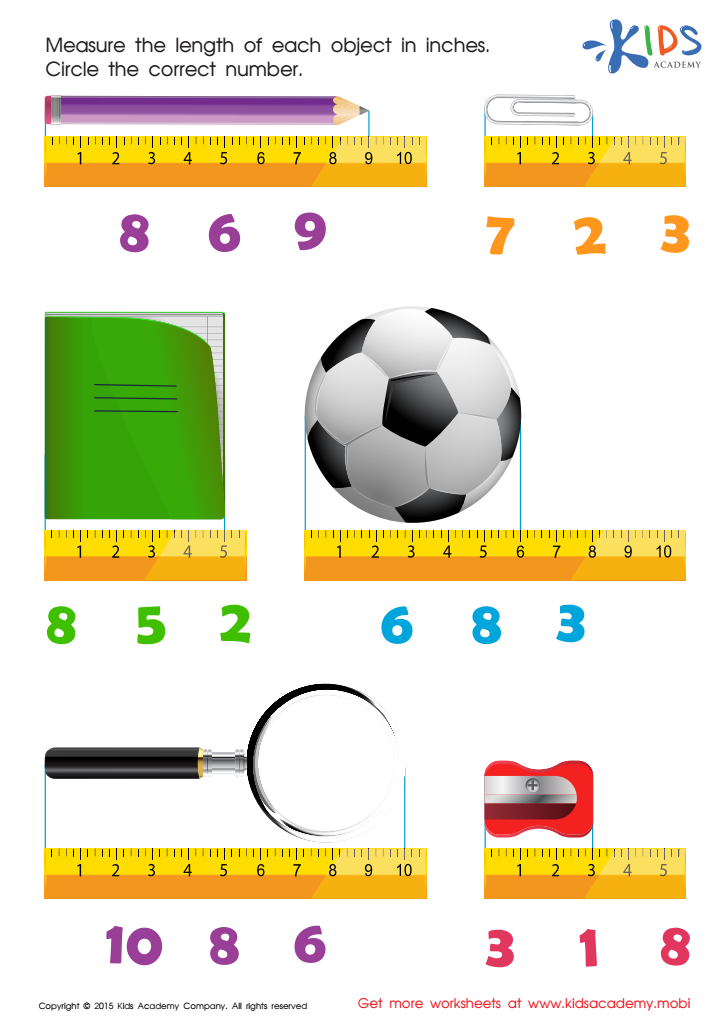
Learning measuring objects in inches Worksheet
Help your little learners gain confidence in using a ruler! Print out our free worksheet, cut out the inch ruler, and let them measure and record objects' width and length. Kids Academy has a variety of math worksheets to make learning math fun! Check out our website for more free printables!
Learning measuring objects in inches Worksheet
Worksheet
Join Kids Academy for Free
Who is primarily going to use this learning content?






Comparing lengths in early childhood (ages 3-4) lays a crucial foundation for developing essential mathematical abilities and problem-solving skills. This seemingly simple activity helps young children build critical thinking and observation skills, fostering their overall cognitive development.
When children engage in comparing lengths, they begin to understand the concepts of measurement, size, and scale. These activities require them to use vocabulary such as "shorter," "longer," "taller," and "smaller," enhancing their language and communication abilities. Moreover, the process of measuring and comparing nurtures their reasoning skills as they learn to make predictions, comparisons, and logical conclusions.
Additionally, comparing lengths prepares students for more advanced mathematical concepts. It introduces them to the idea of quantification and proportional relationships, which are fundamental principles in mathematics, science, and everyday life. Hands-on activities in comparing lengths often involve collaboration with peers, promoting social skills and cooperative learning.
Teachers and parents play critical roles in facilitating these activities. By providing varied, interactive, and engaging comparisons, they ensure that children not only grasp these concepts but also find joy and confidence in learning. Early practices in comparing lengths thus set a solid stage for future academic success and lifelong mathematical understanding.








