
Counting practice Subtraction Worksheets for Ages 3-4
3 filtered results
Difficulty Level
Grade
Age
-
From - To
Subject
Activity
Standards
Introduce young learners to the world of numbers with our Counting Practice Subtraction Worksheets for ages 3-4! Designed to strengthen early math skills, these engaging worksheets make learning subtraction fun and intuitive. With colorful illustrations and simple exercises, children will develop a solid foundation in counting and subtracting small numbers. Perfect for both classroom and home use, our printable worksheets offer parents and educators an effective tool to support children's learning and build their confidence in math. Download now from Kids Academy and watch your little ones explore the joys of subtraction!
Favorites
With answer key
Interactive
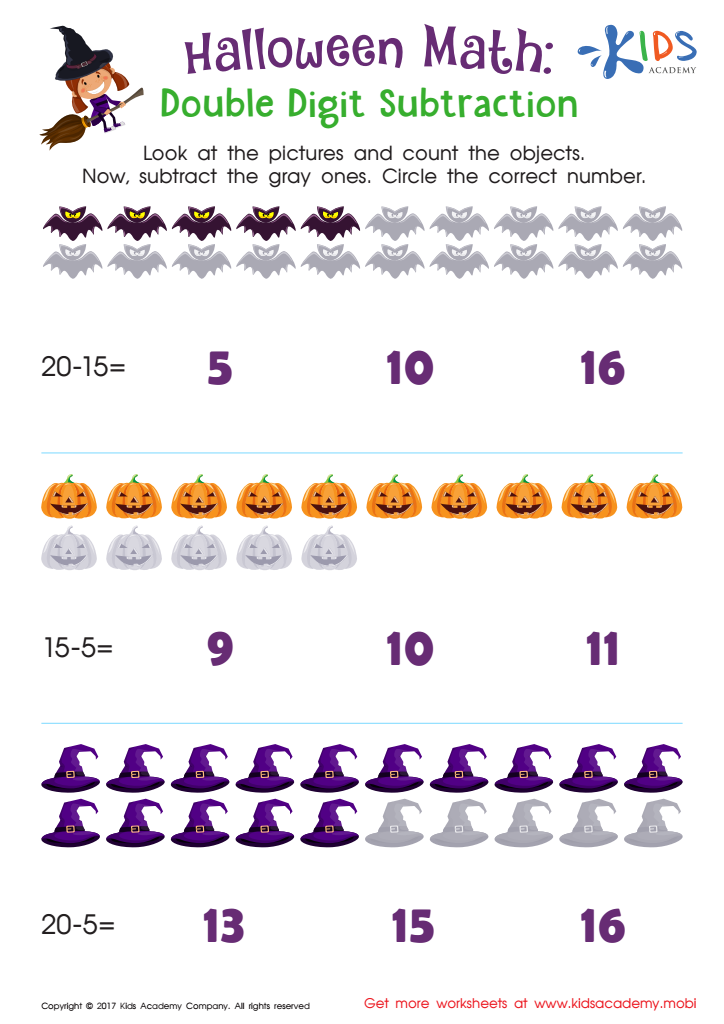
Halloween Math Subtraction Worksheet
Kids can easily understand subtraction by using the visuals provided in this worksheet. Get ready for some fun math!
This Halloween math worksheet uses spooky images to help kids understand subtraction. With it, they can count and solve double digit problems more easily. Get ready for some fun and engaging math practice!
 Assign to My Students
Halloween Math Subtraction Worksheet
Worksheet
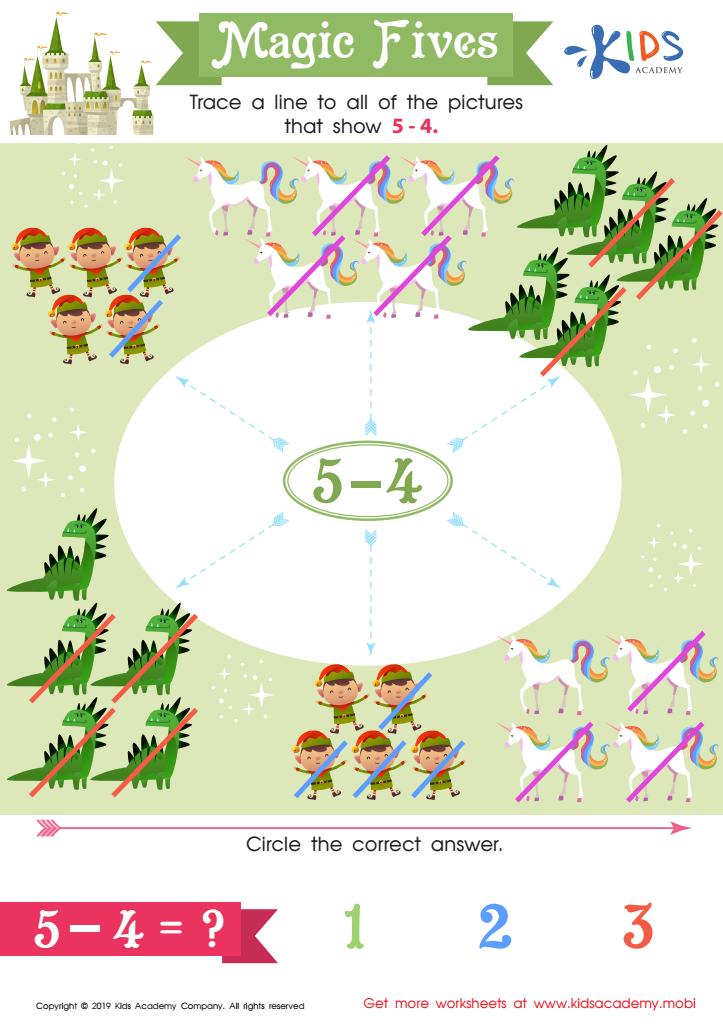
Magic Fives Worksheet
Help your students identify the objects & people in the worksheet. Point to the equation 5 -4 in the center, then get them to count the items and trace a line connecting those that add up to 5 - 4.
Magic Fives Worksheet
Worksheet
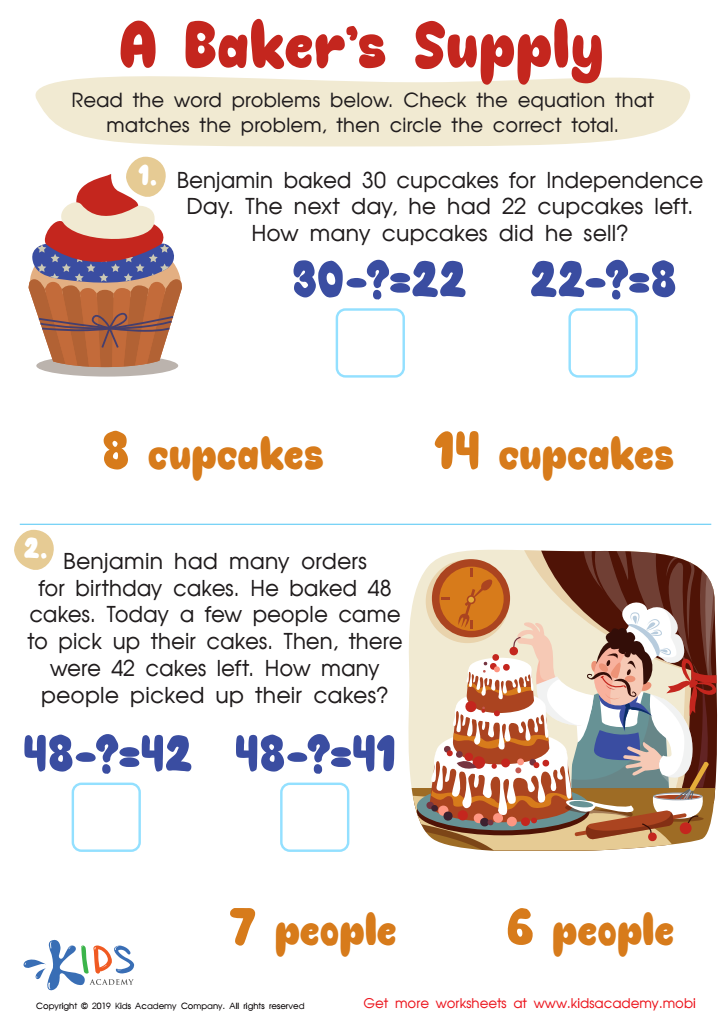
A Baker's Supply Worksheet
A visit to the baker's shop is thrilling! Your kids will love it! From scrumptious goodies to the mouthwatering aroma, it's a magical experience. Ask your kids what they're most eager to see and do. Now, read the word problems in this worksheet to them. Help them choose the correct answer for each problem and circle the correct total.
A Baker's Supply Worksheet
Worksheet
Join Kids Academy for Free
Who is primarily going to use this learning content?







Introducing counting practice and basic subtraction to children ages 3-4 is crucial for early childhood development. This age range holds immense potential for cognitive and motor skill growth, and engaging children with introductory math concepts can lay a solid foundation for future academic success.
Counting helps children understand number sequences and quantitative concepts, serving as the groundwork for more advanced mathematical application. By practicing counting, children develop number recognition, a keen sense of order, and the ability to compare quantities. These skills are pervasive in daily life, from identifying which group of items is larger to following instructions in a recipe.
Subtraction, while elementary at this stage, fosters critical thinking and problem-solving abilities. It introduces the idea of taking objects away from a set, helping children grasp the concept of 'less than' which is essential for logical reasoning. Subtraction exercises also enhance fine motor skills when physical objects like blocks or beads are used for hands-on practice.
For parents and teachers, creating a learning environment where counting and subtraction are fun and interactive enhances engagement and absorption. Using songs, stories, and games captivates learners' interest and motivates them to explore these foundational concepts. Ultimately, these early educational experiences provide children with vital tools needed to thrive in more complex mathematical understanding and broader cognitive skills.
Parents and educators should care deeply because these early experiences build confidence and curiosity in young learners, which are the most significant predictors of long-term success.








