
Fine motor development Addition & Subtraction Worksheets for Ages 3-6
3 filtered results
Difficulty Level
Grade
Age
-
From - To
Subject
Activity
Standards
Enhance your child's fine motor skills while introducing fundamental math concepts with our engaging Addition and Subtraction Worksheets for ages 3-6. Designed to seamlessly combine these essential skills, our worksheets provide fun and interactive activities that promote hand-eye coordination and dexterity alongside early math learning. Kids will enjoy practicing counting, connecting dots, and tracing numbers, all while solving simple addition and subtraction problems. Perfect for home or classroom use, these worksheets are a valuable resource for educators and parents alike, helping young learners build confidence in their mathematical abilities while refining their motor skills. Start their learning journey today!
Favorites
With answer key
Interactive
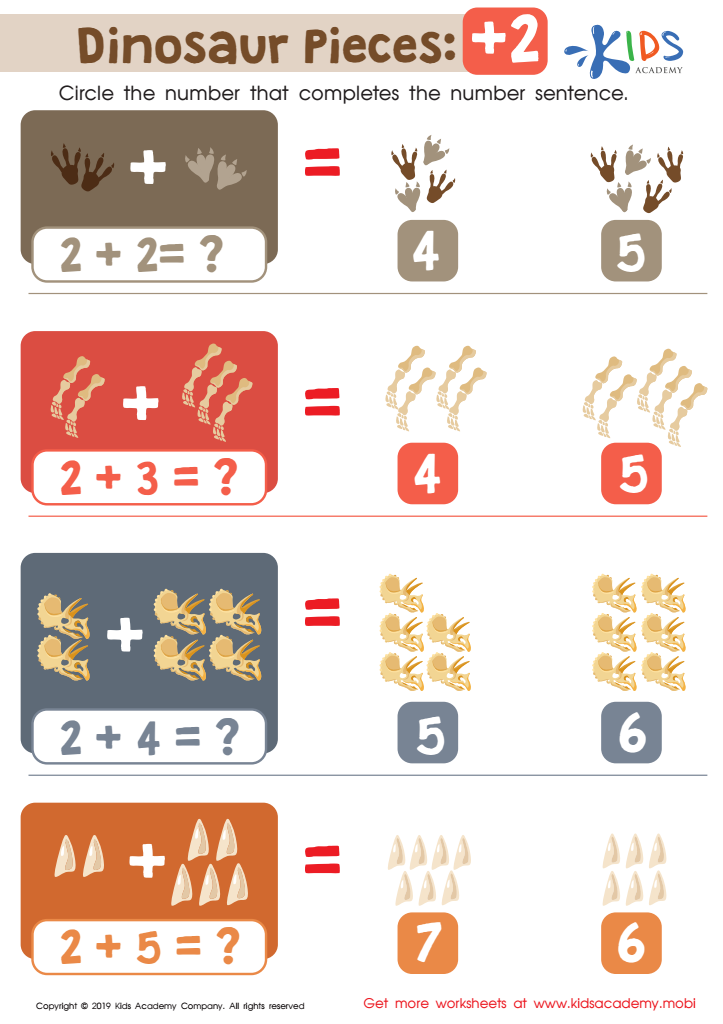
Dinosaur Pieces: +2 Worksheet
Kids love dinosaurs! See if your kids can solve these three equations featuring the mysterious creatures. Download the PDF and have them circle the number that completes each equation. Dinosaurs are extinct, not seen for thousands of years, but they can still help kids work on their math skills!
 Assign to My Students
Dinosaur Pieces: +2 Worksheet
Worksheet
Join Kids Academy for Free
Who is primarily going to use this learning content?








Fine motor development and the understanding of addition and subtraction are crucial for children aged 3-6 because these skills form the foundation for future learning in mathematics and everyday tasks. Fine motor skills, which involve the small muscles of the hands and fingers, are essential for activities like writing, drawing, and self-care tasks such as buttoning clothes. As children develop these skills, they gain confidence and independence, enabling them to interact easily with their environment and engage in learning activities.
Moreover, introducing early mathematical concepts such as addition and subtraction in a hands-on manner, coupled with fine motor activities, can enhance cognitive abilities and problem-solving skills. Engaging children with manipulatives—like blocks or beads—allow them to physically explore numbers, making abstract concepts more tangible. This combination of fine motor skill practice and early math education fosters critical thinking and creativity.
By nurturing both fine motor skills and the understanding of basic math, parents and teachers set children on a path to success in school and daily life. This holistic approach not only prepares them for academic challenges but also supports their overall development, helping them to navigate the world with confidence and curiosity.








