
Reading analog clocks Math Worksheets for Ages 3-6
3 filtered results
Difficulty Level
Grade
Age
-
From - To
Subject
Activity
Standards
Introduce your child to the fascinating world of time-telling with our "Reading Analog Clocks Math Worksheets for Ages 3-6." Designed to build fundamental math skills, these engaging worksheets teach young learners how to read and interpret analog clocks. Through fun and colorful activities, children will practice recognizing hours and minutes while developing a strong foundation for time management. Perfect for preschool and kindergarten kids, these worksheets make learning to tell time an exciting and educational adventure. Equip your child with the essential skill of reading analog clocks, and watch their confidence soar as they master this important milestone!
Favorites
With answer key
Interactive
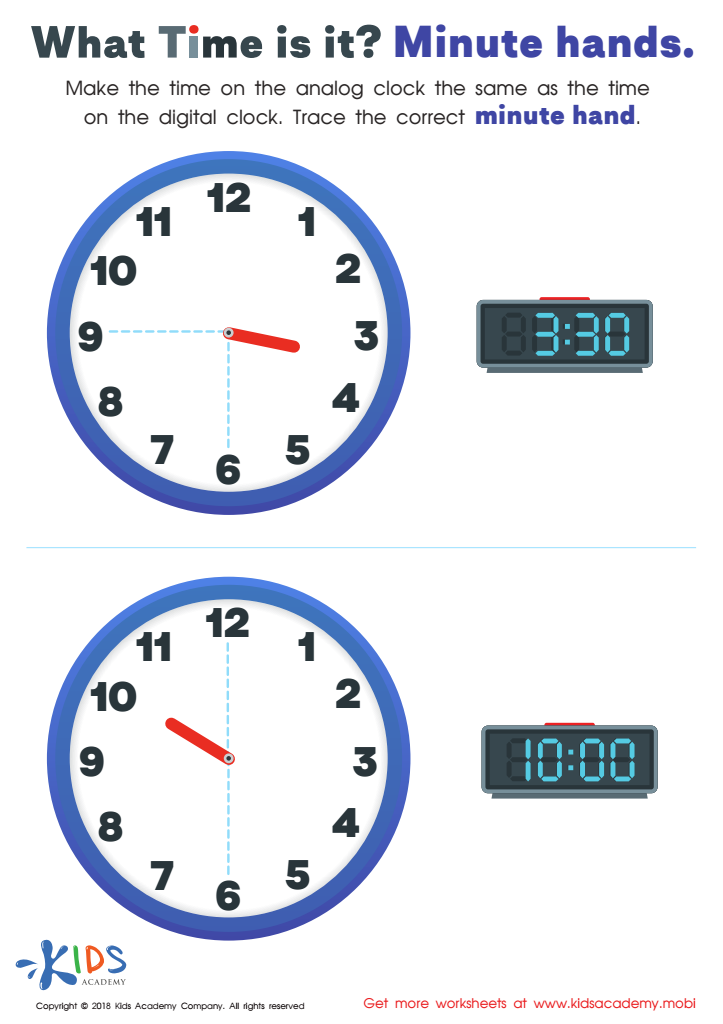
What Time Is it? Minute Hands Worksheet
Help your kids telling time with the minute hand correctly with this tracing sheet. Trace the correct minute hand to make the time on the analog clock the same as the time on the digital clock. Give them a pictured demonstration of how to do it and you'll be all set!
 Assign to My Students
What Time Is it? Minute Hands Worksheet
Worksheet
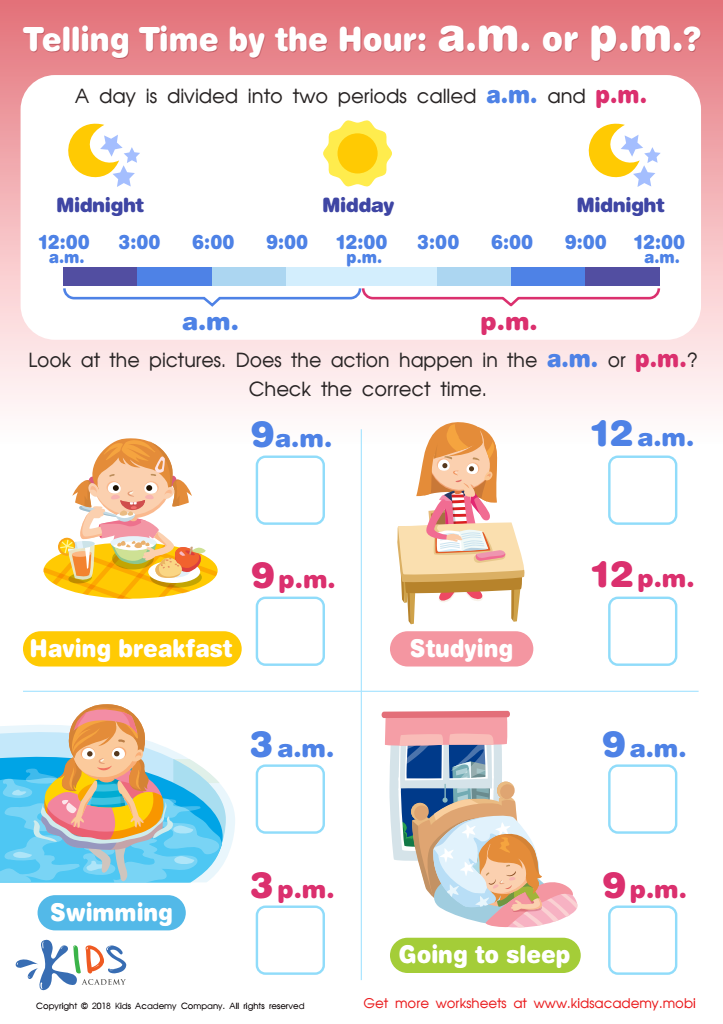
Tilling Time by the Hour: a.m. or p.m.? Worksheet
Can your child tell the time? This worksheet will help them learn. Explain a.m and p.m. and look at the pictures together. Ask your child if the activities happen in the a.m or p.m and help them check the correct time.
Tilling Time by the Hour: a.m. or p.m.? Worksheet
Worksheet
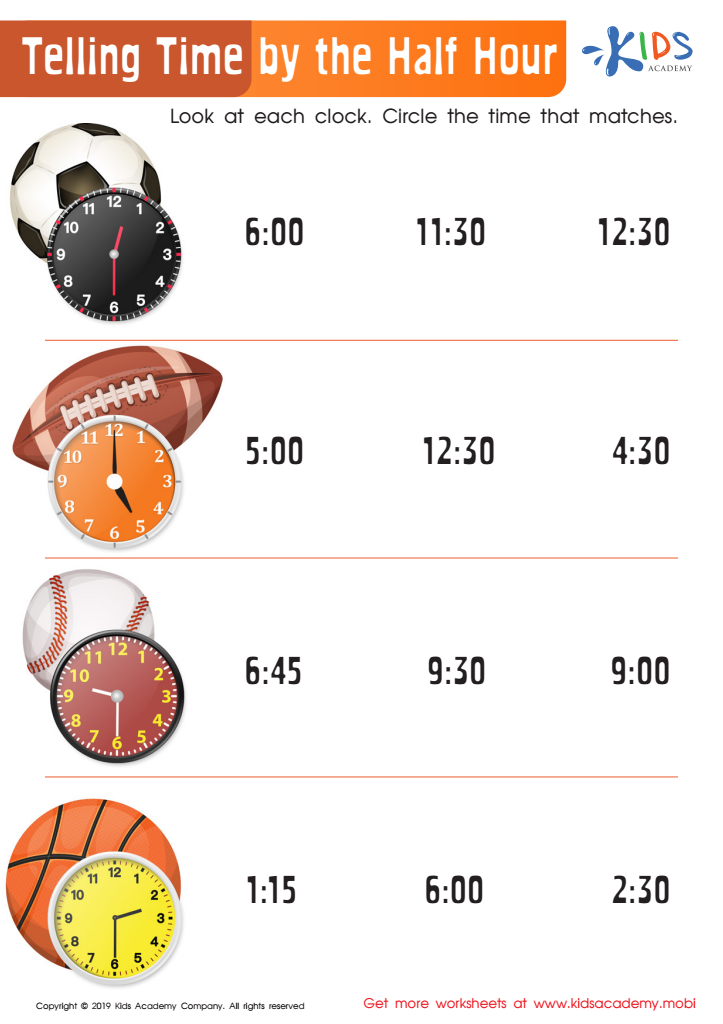
Telling Time by the Half Hour Worksheet
Teach kids to tell time with this worksheet! Four clocks are labeled with different times; help your child circle the right one. It's a great way to teach them to read analog and digital clocks, watches, and written times. Easy and fun learning!
Telling Time by the Half Hour Worksheet
Worksheet
Join Kids Academy for Free
Who is primarily going to use this learning content?








Parents and teachers should care about teaching young children, ages 3-6, how to read analog clocks because it builds foundational skills in math and time management that are crucial for daily life. Learning to tell time on an analog clock encourages the development of number recognition, sequencing, and arithmetic skills, as children learn to differentiate between hours and minutes and understand their relationship. Understanding the concept of time also helps young kids develop a sense of routine and punctuality, essential life skills that contribute to personal responsibility and organization.
Moreover, reading analog clocks enhances cognitive abilities by requiring young learners to interpret visual information and link it to abstract concepts of time. The circular design of the clock fosters the perception of time as cyclical, which is crucial for understanding days, seasons, and schedules.
Making these learning experiences engaging through hands-on activities and interactive lessons not only leverages their natural curiosity but also lays a strong academic foundation. By emphasizing the importance of time-telling at an early age, parents and teachers help children develop a solid understanding of mathematical concepts, time perception, and everyday practicality, preparing them for future social and academic success.








