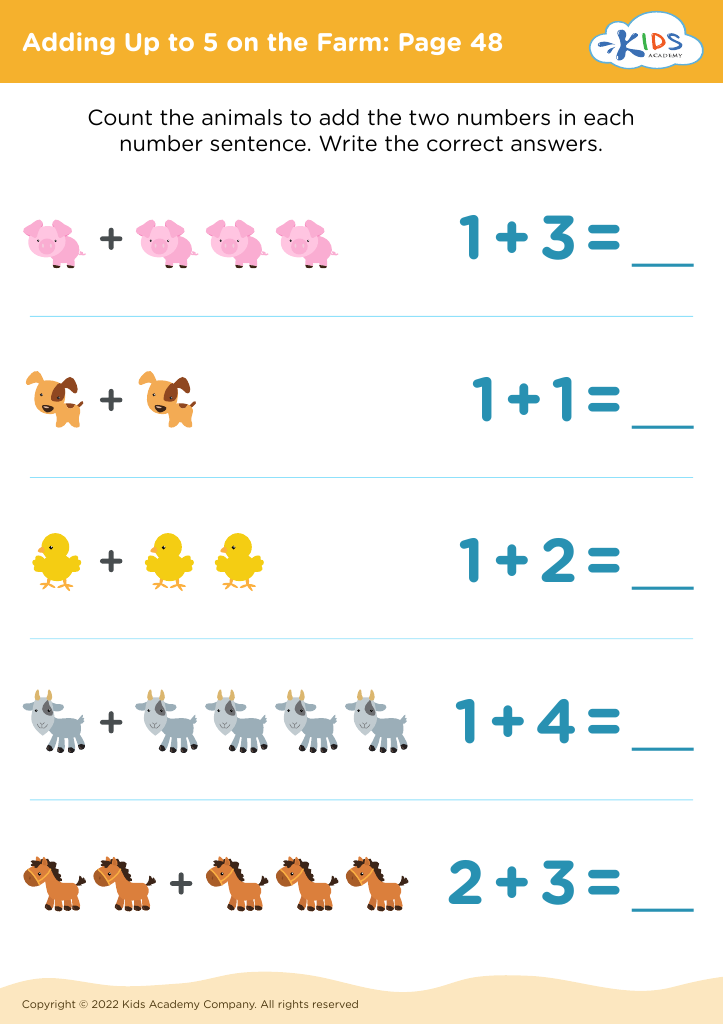
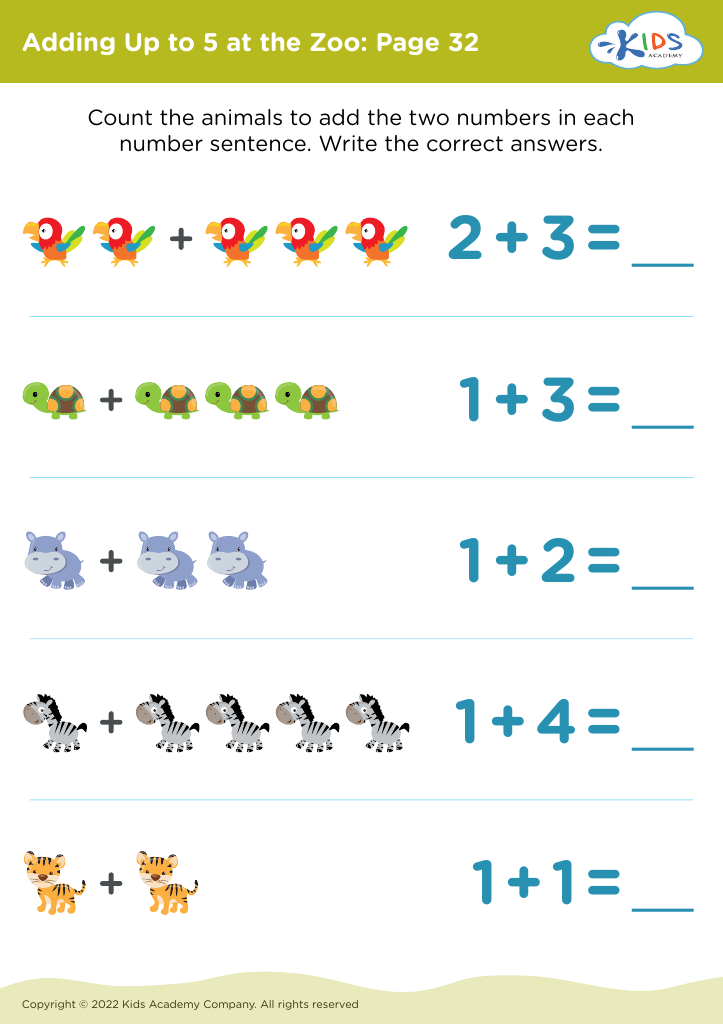
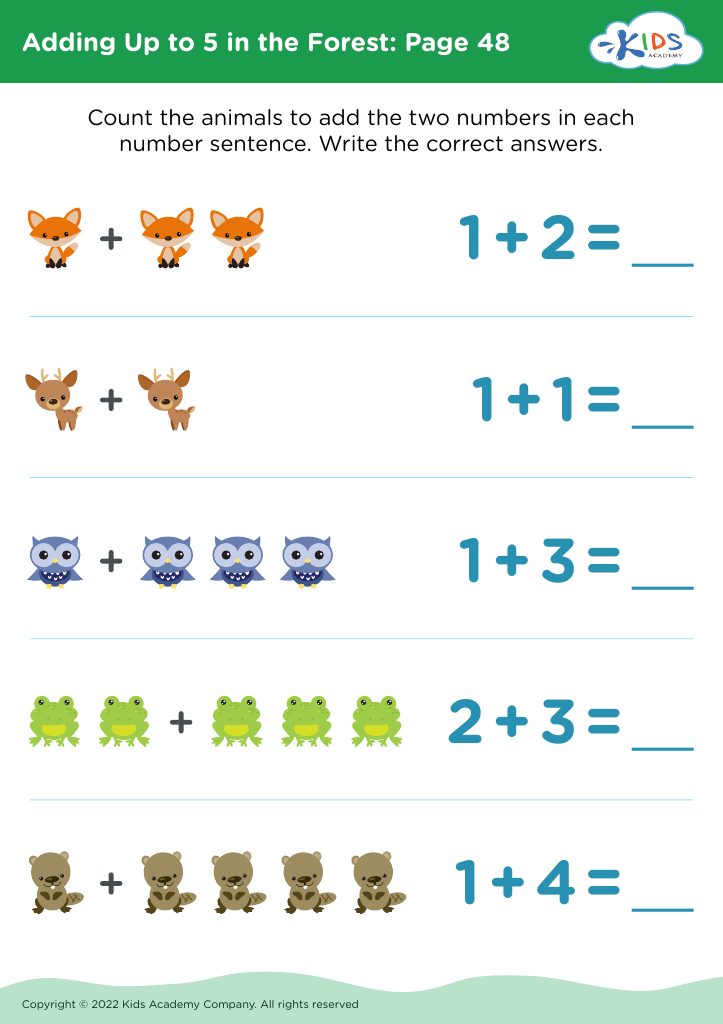
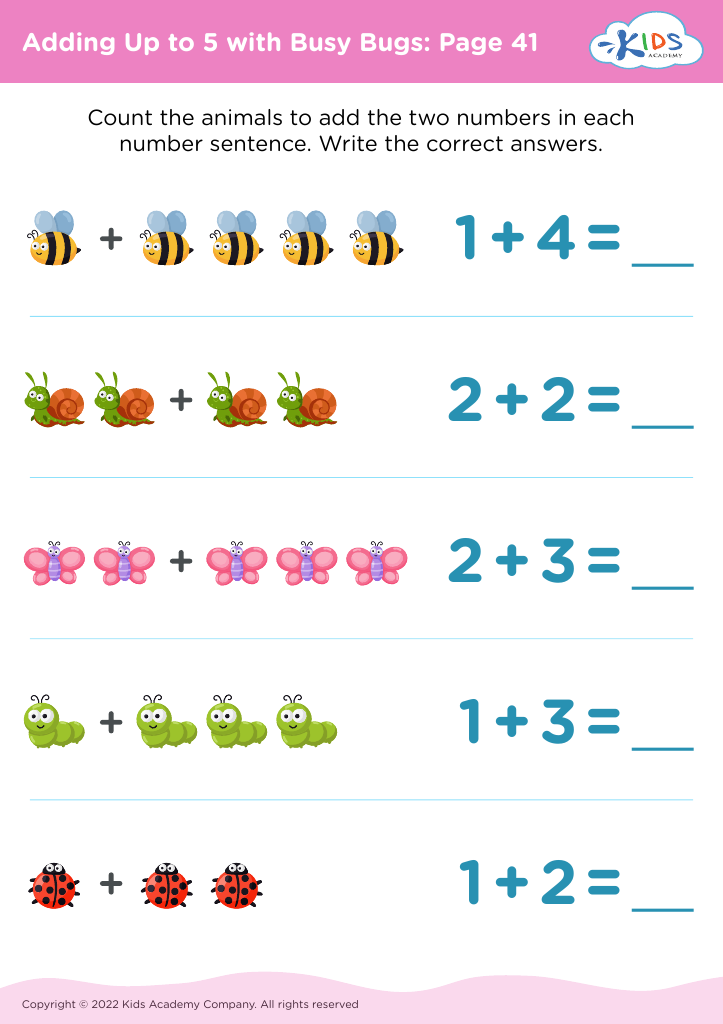
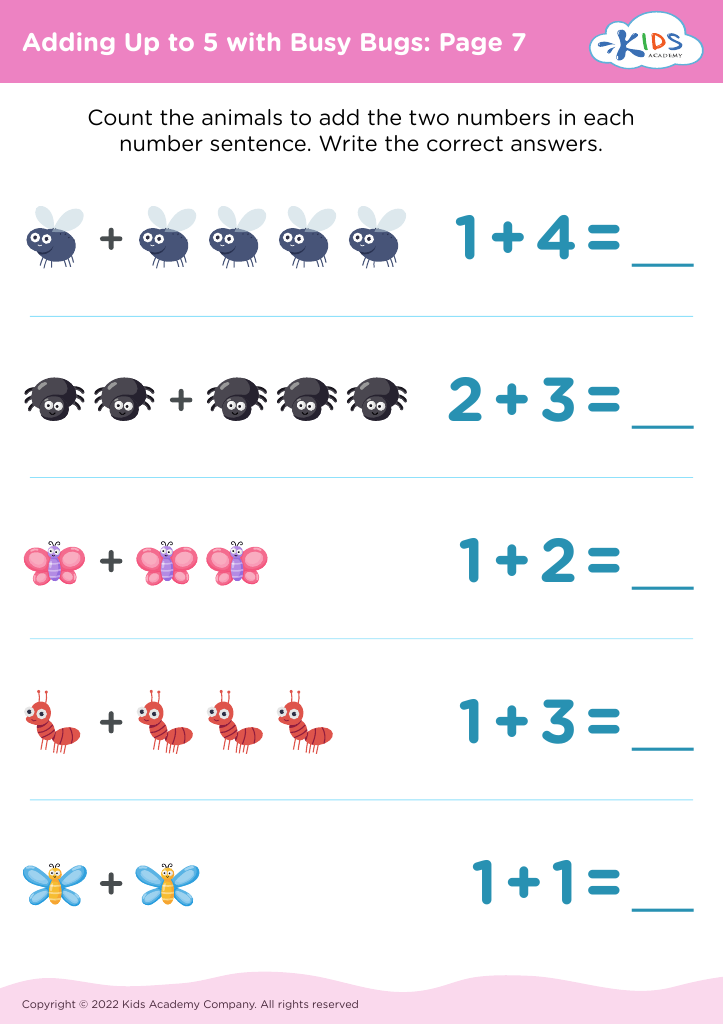
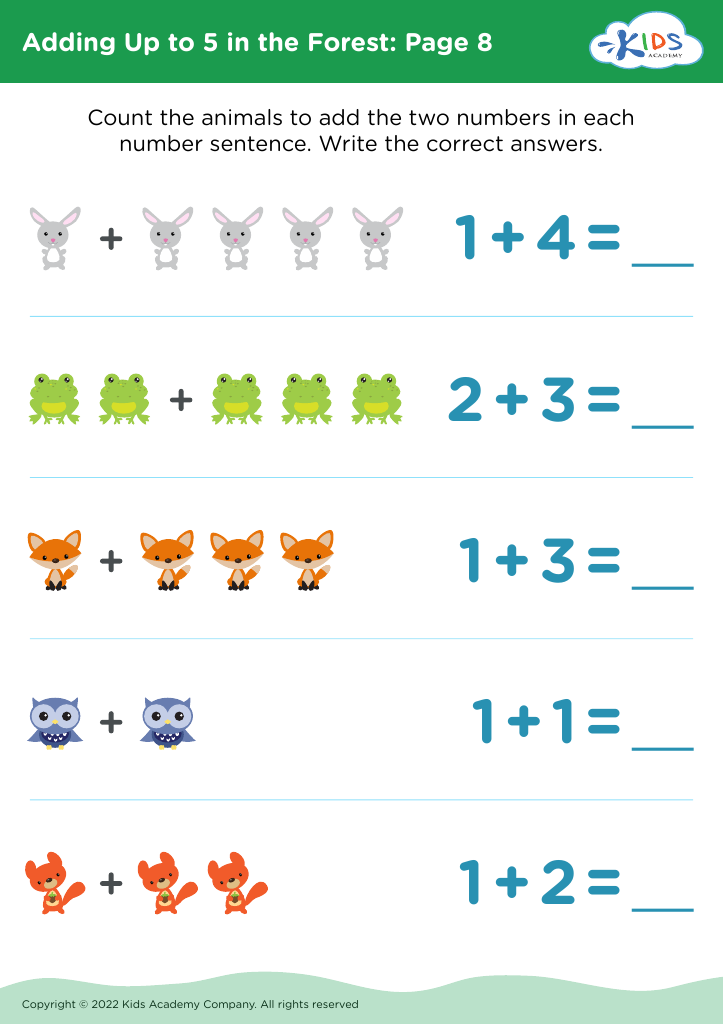
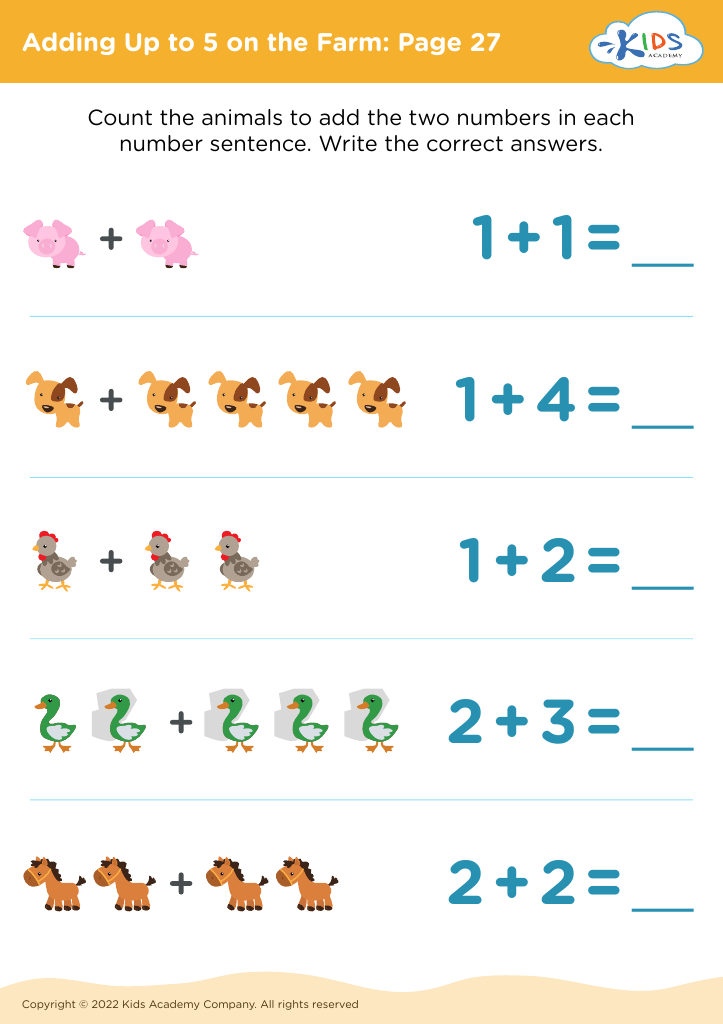
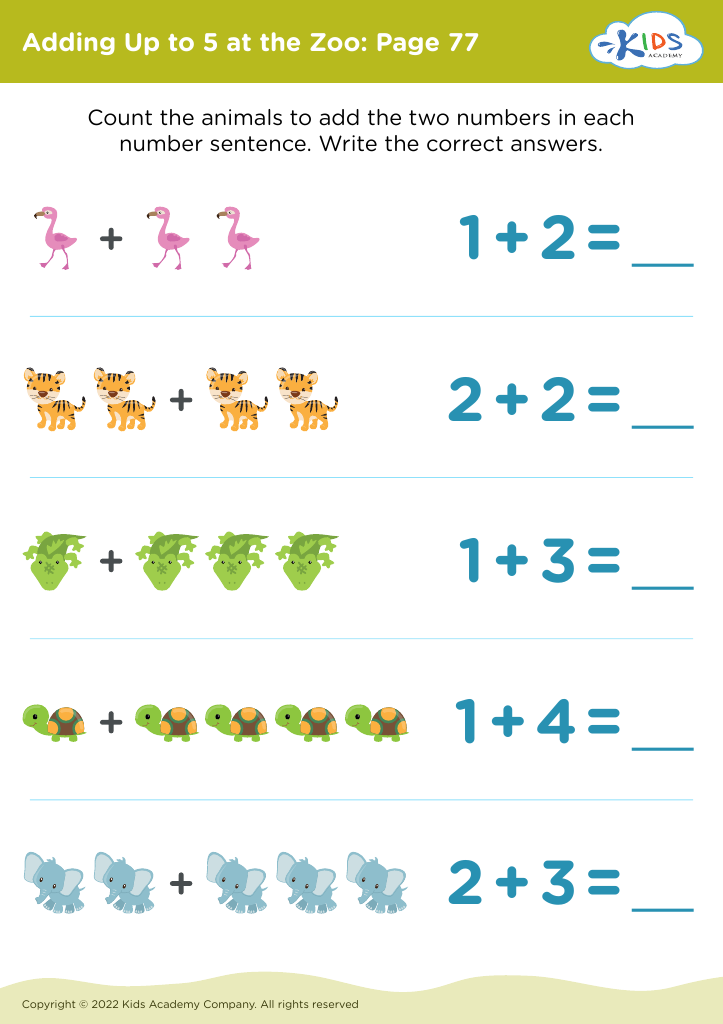
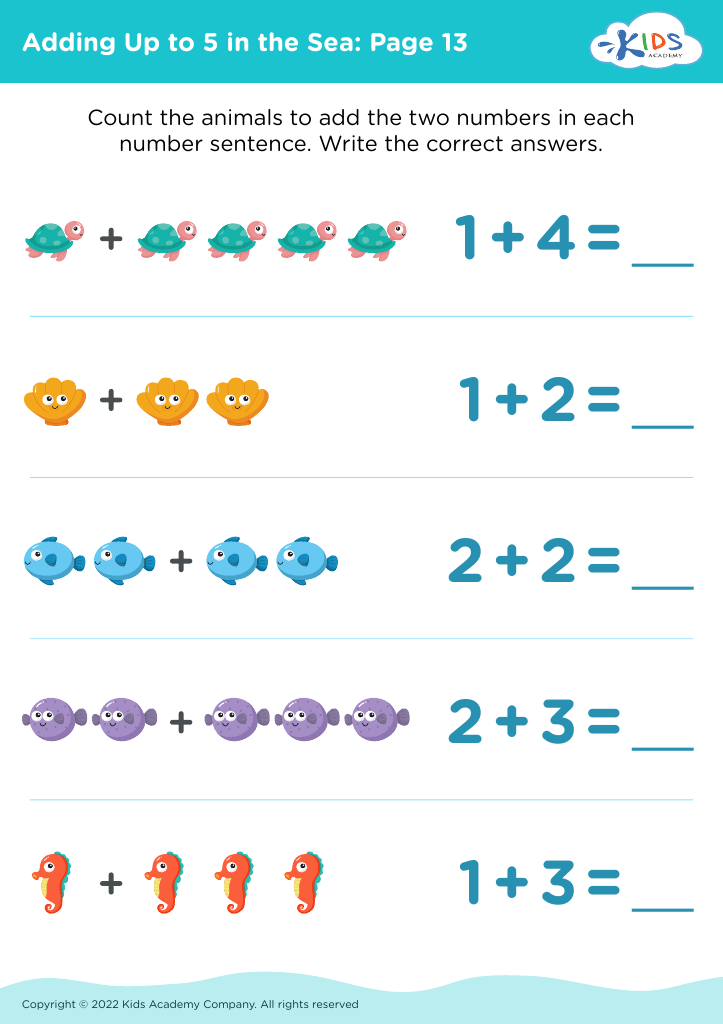
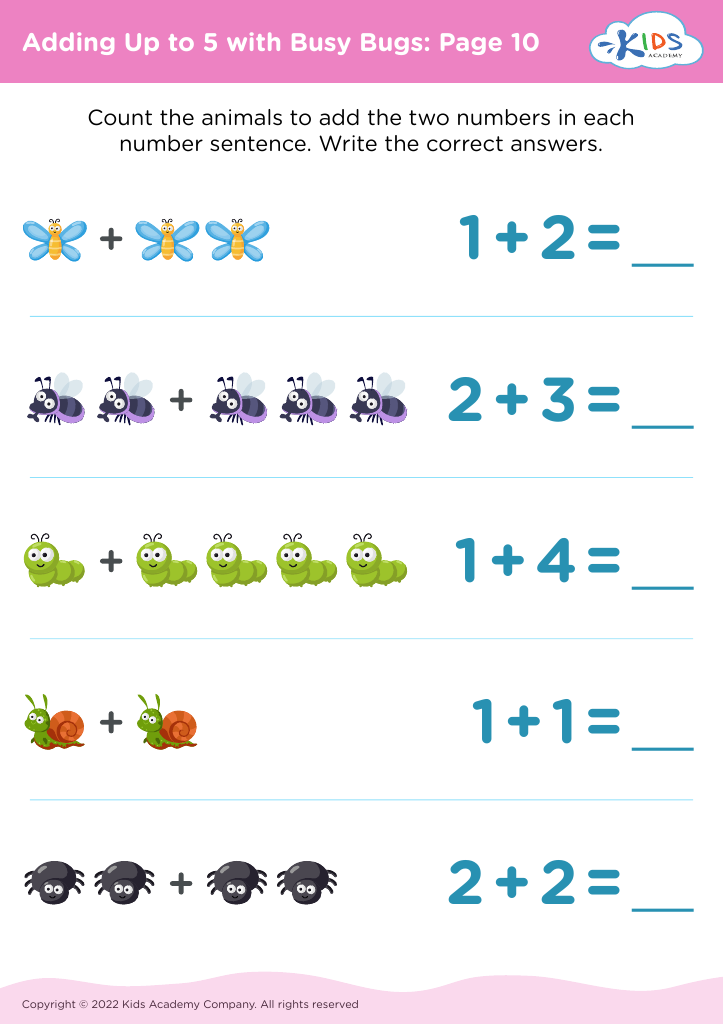
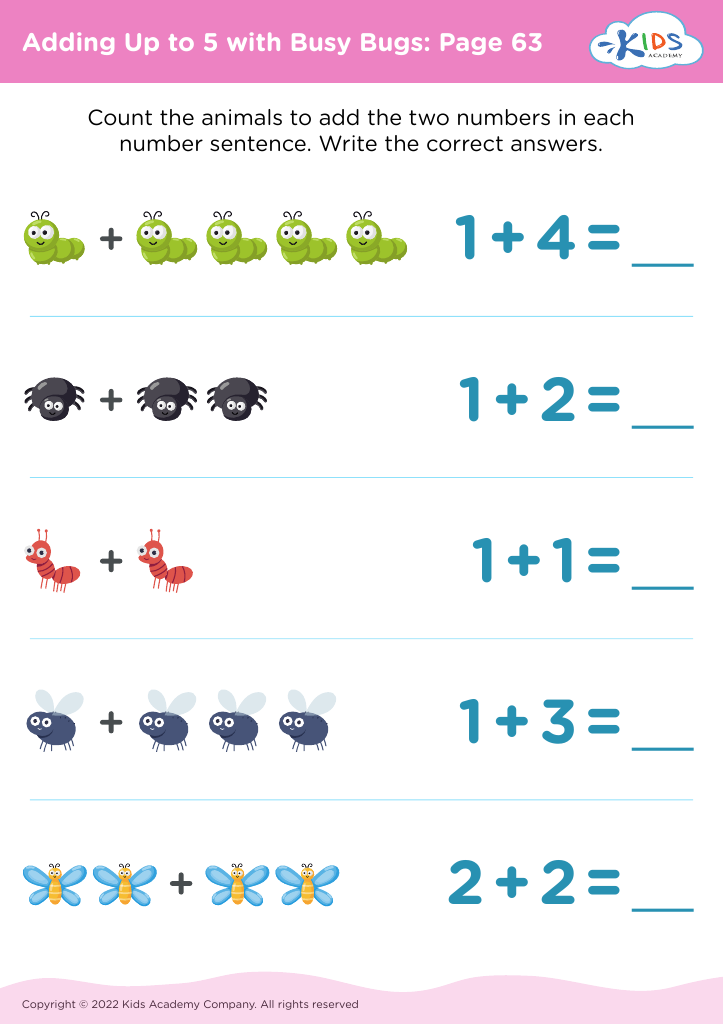
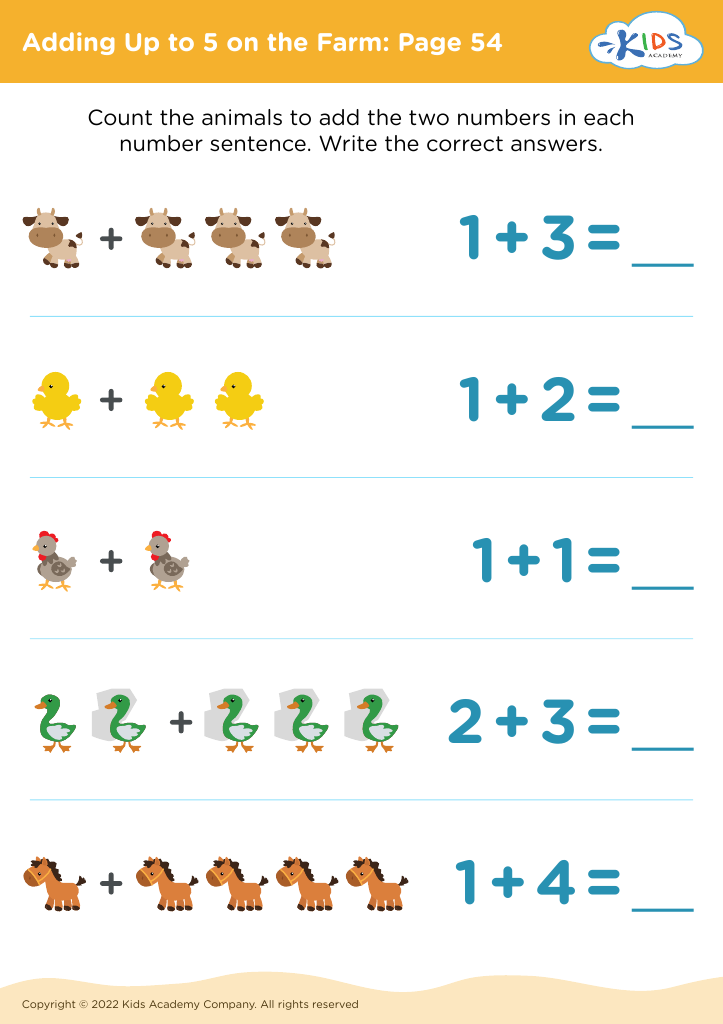
Nurture your child's early math abilities with our Basic Addition Skills Worksheets for ages 3-7! Our expertly designed printable worksheets make learning addition fun and engaging with a variety of colorful exercises. These activities are tailored to introduce young learners to fundamental addition concepts, promoting numeracy, and confidence in math. With easy-to-follow instructions and appealing visuals, children will enjoy practicing and mastering basic math skills. Perfect for home or classroom use, these worksheets provide a solid foundation for future math success. Download now from Kids Academy and watch your little ones thrive in their mathematical journey!

Check out this FREE "Basic Addition Skills" Trial Lesson for age 3-7!

Unknown Parts (basic algebra) Addition

Favorites
With answer key
Interactive
  • 3-7
  • Basic Addition Skills
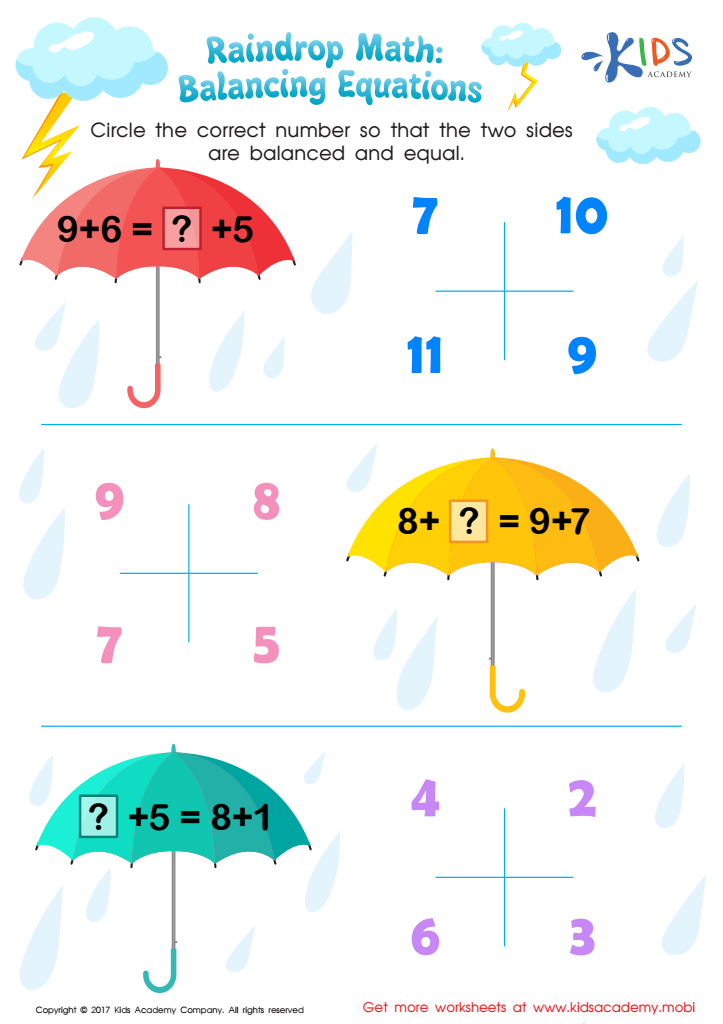
Balancing addition equations worksheet

Raindrop Math Printable

It will help them think deeper about equations, form a foundation for early algebraic thinking, and gain a better sense of numeracy. Plus, they get to practice simple addition skills.
Raindrop Math Printable
Worksheet
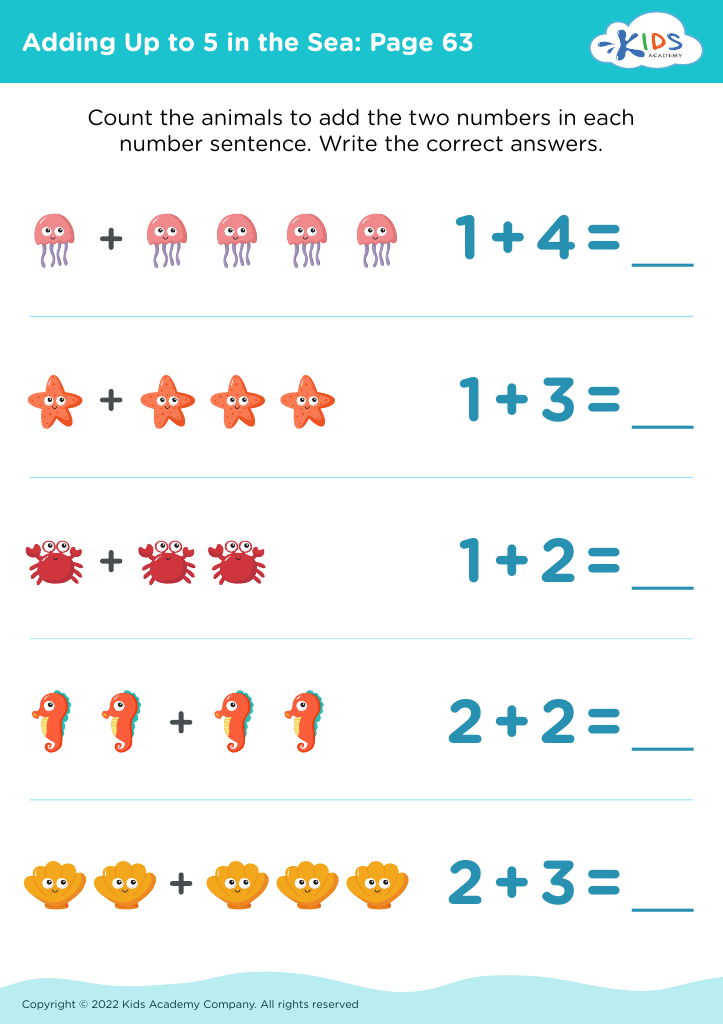
Adding Up to 5 in the Sea: Page 63
Worksheet
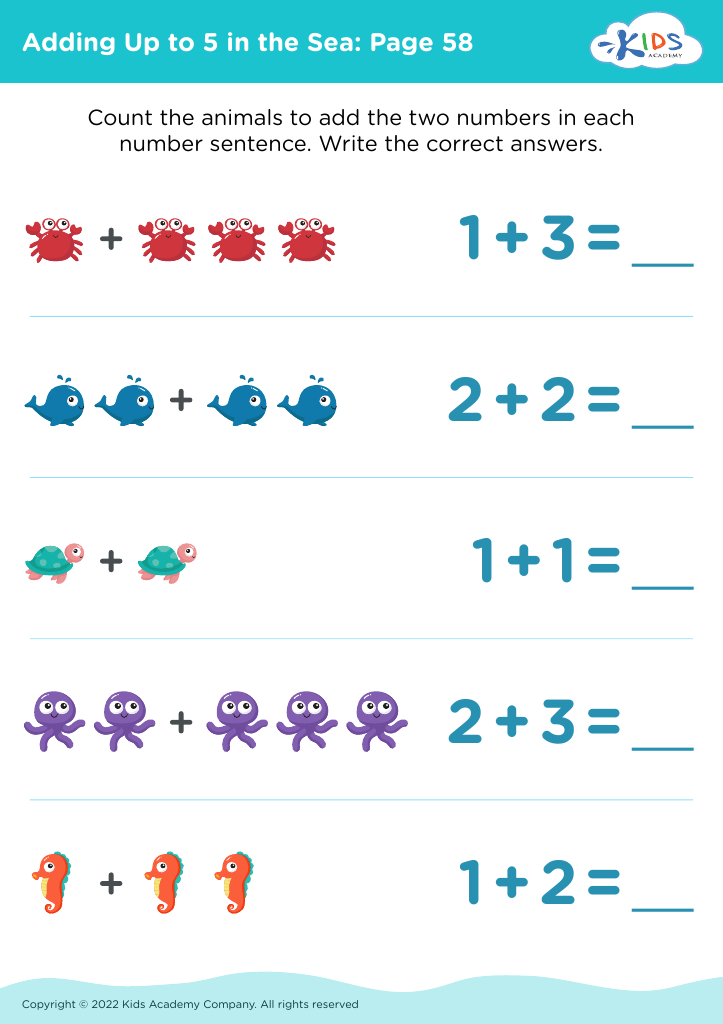
Adding Up to 5 in the Sea: Page 58
Worksheet
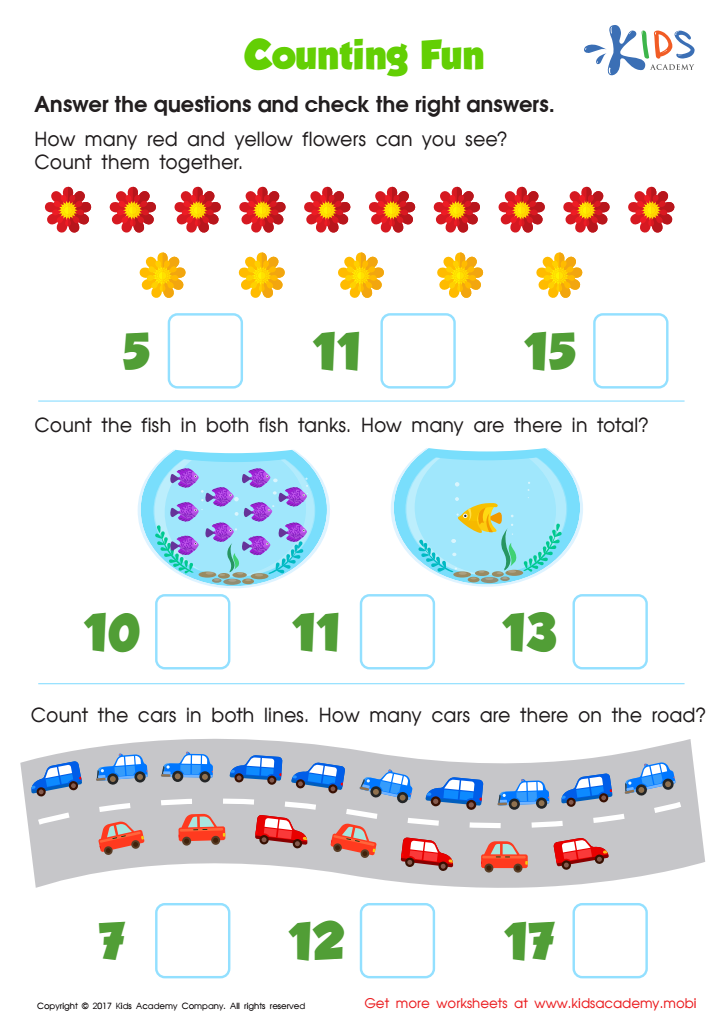
Counting Fun Worksheet

Counting Fun Worksheet

Math and fun can go hand-in-hand with this free PDF worksheet! Bright, colourful illustrations will activate your child's brain, as they count the red and yellow flowers. How many can you see? Count together and write down the total. Make learning and counting fun for your little ones!
Counting Fun Worksheet
Worksheet
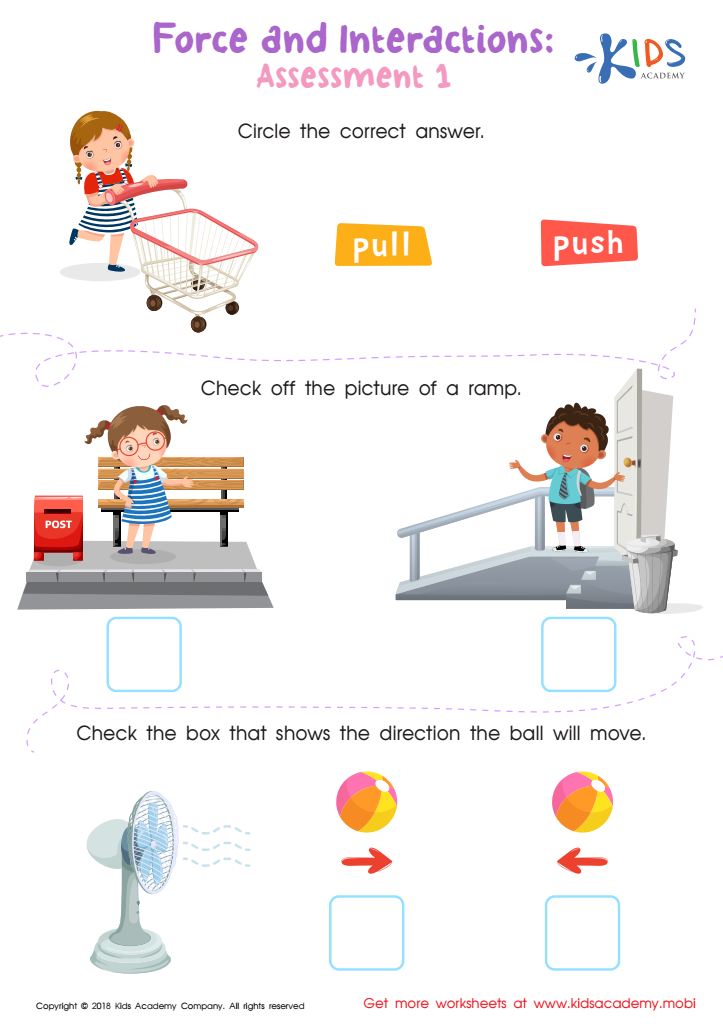
Force and Interactions: Assessment 1 Worksheet
Force and Interactions: Assessment 1 Worksheet
Test your students' knowledge of pushing, pulling, ramps and wind with this worksheet. The first task requires them to identify push or pull pictures. The second asks them to identify a ramp and the third to explain which direction a ball will move when exposed to wind.
Force and Interactions: Assessment 1 Worksheet
Worksheet
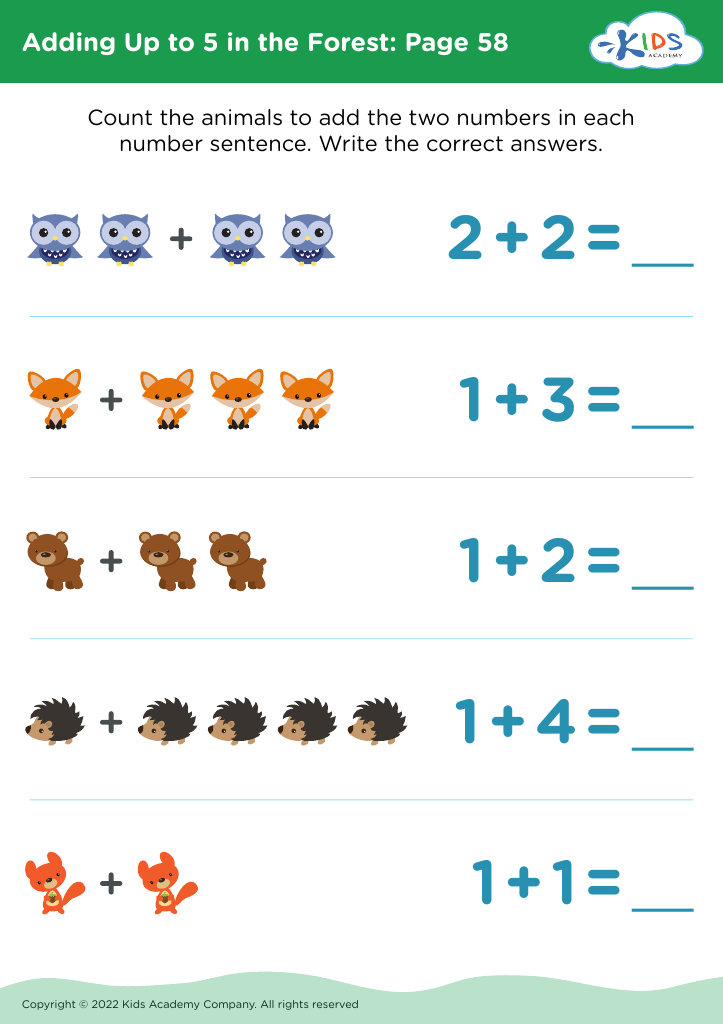
Adding Up to 5 in the Forest: Page 58
Worksheet
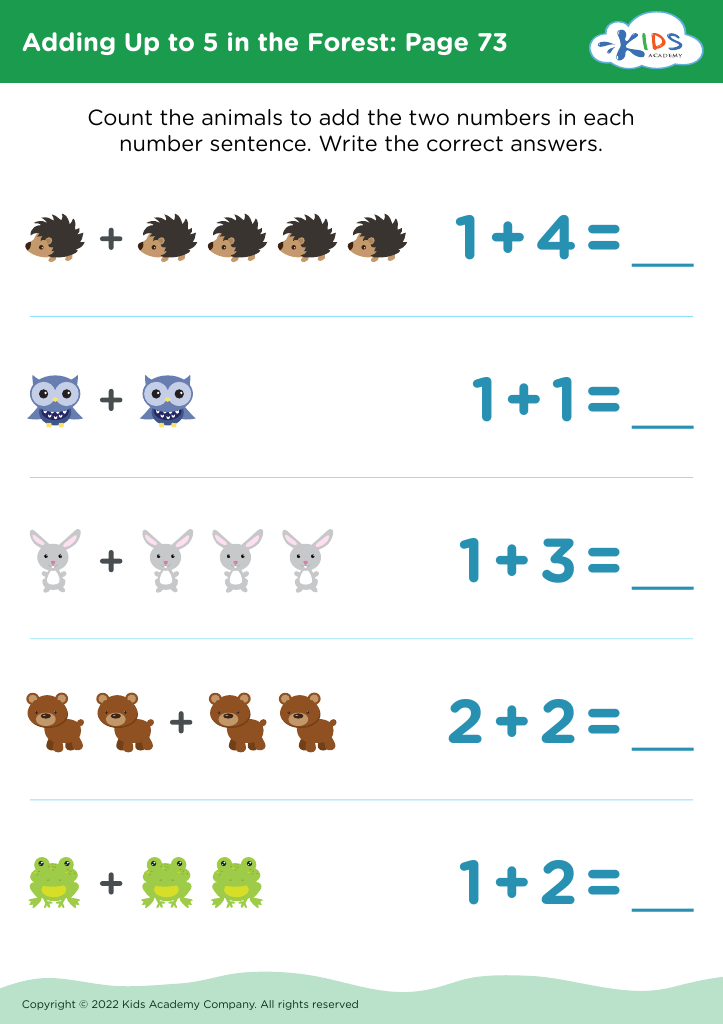
Adding Up to 5 in the Forest: Page 73
Worksheet
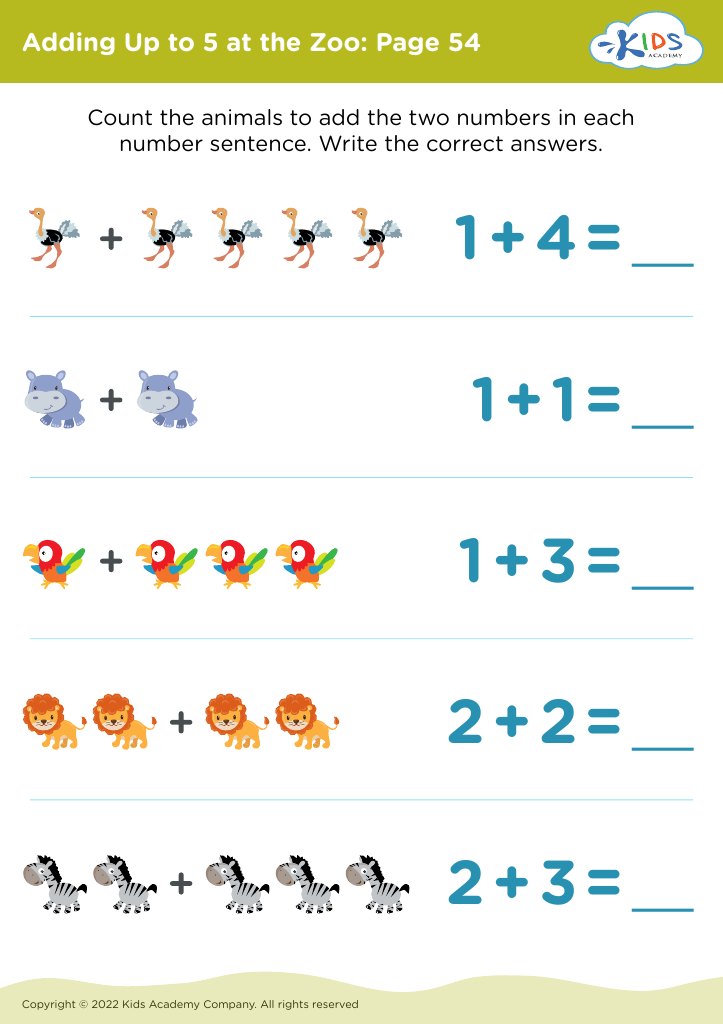
Adding Up to 5 at the Zoo: Page 54
Worksheet
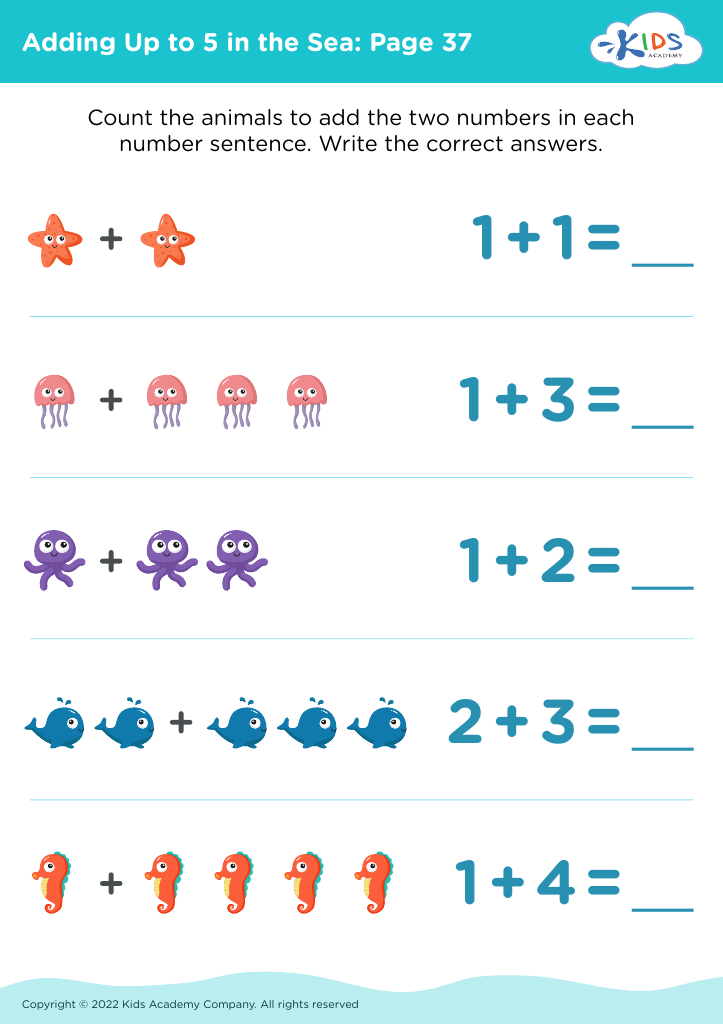
Adding Up to 5 in the Sea: Page 37
Worksheet
Adding Up to 5 on the Farm: Page 48
Worksheet
Adding Up to 5 at the Zoo: Page 32
Worksheet
Adding Up to 5 in the Forest: Page 48
Worksheet
Adding Up to 5 with Busy Bugs: Page 41
Worksheet
Adding Up to 5 with Busy Bugs: Page 7
Worksheet
Adding Up to 5 in the Forest: Page 8
Worksheet
Adding Up to 5 on the Farm: Page 27
Worksheet
Adding Up to 5 at the Zoo: Page 77
Worksheet
Adding Up to 5 in the Sea: Page 13
Worksheet
Adding Up to 5 with Busy Bugs: Page 10
Worksheet
Adding Up to 5 with Busy Bugs: Page 63
Worksheet
Adding Up to 5 on the Farm: Page 54
Worksheet
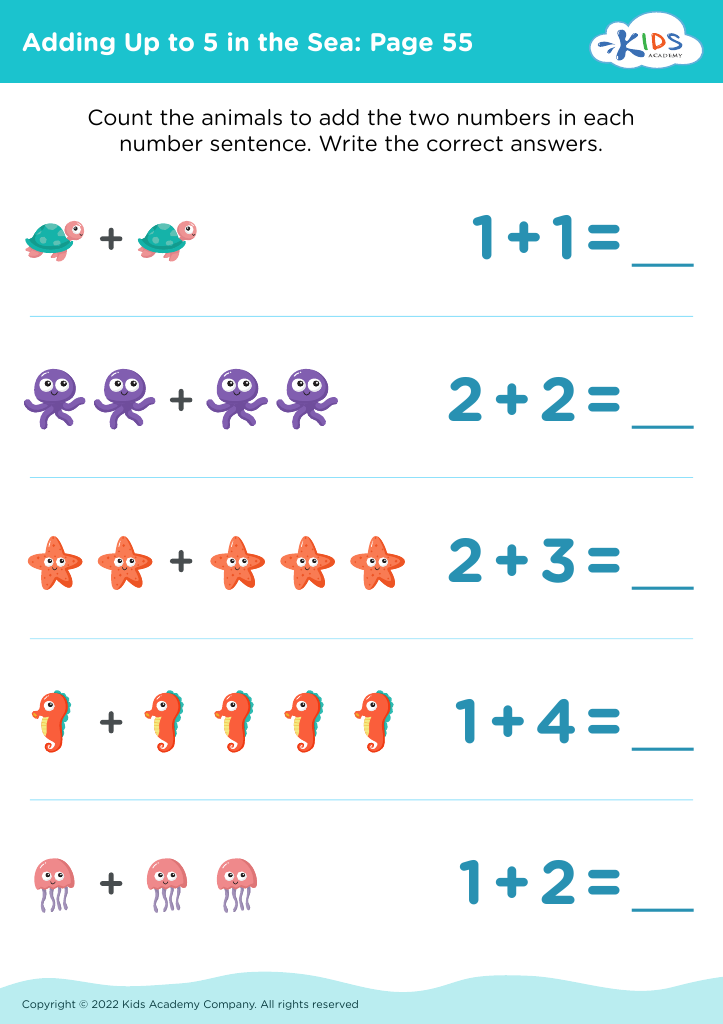
Adding Up to 5 in the Sea: Page 55
Worksheet
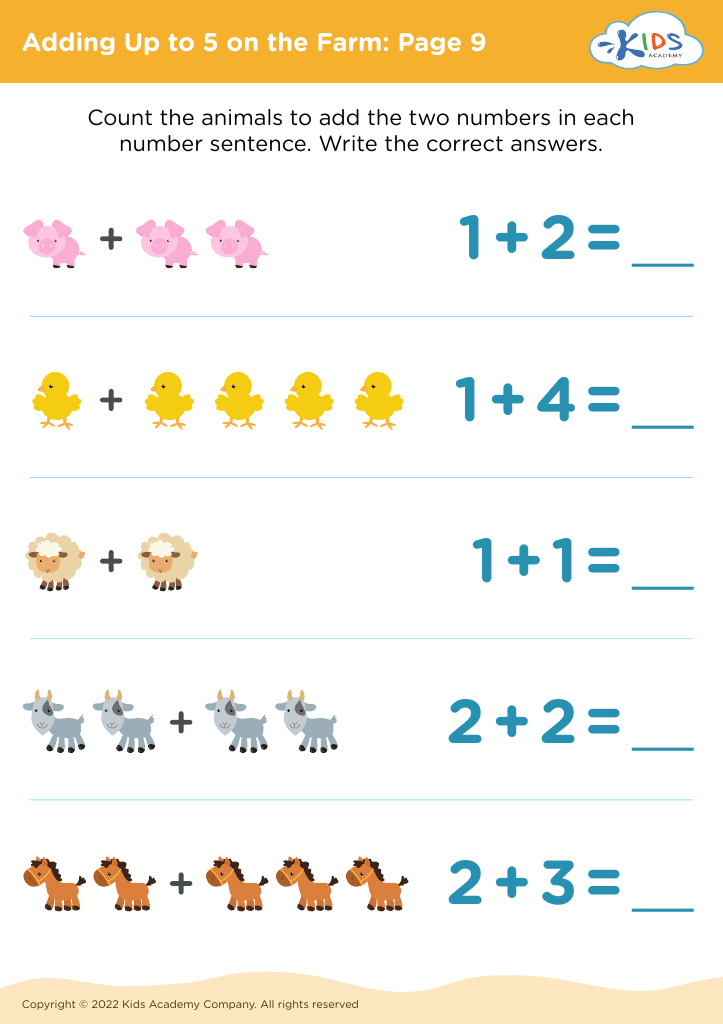
Adding Up to 5 on the Farm: Page 9
Worksheet
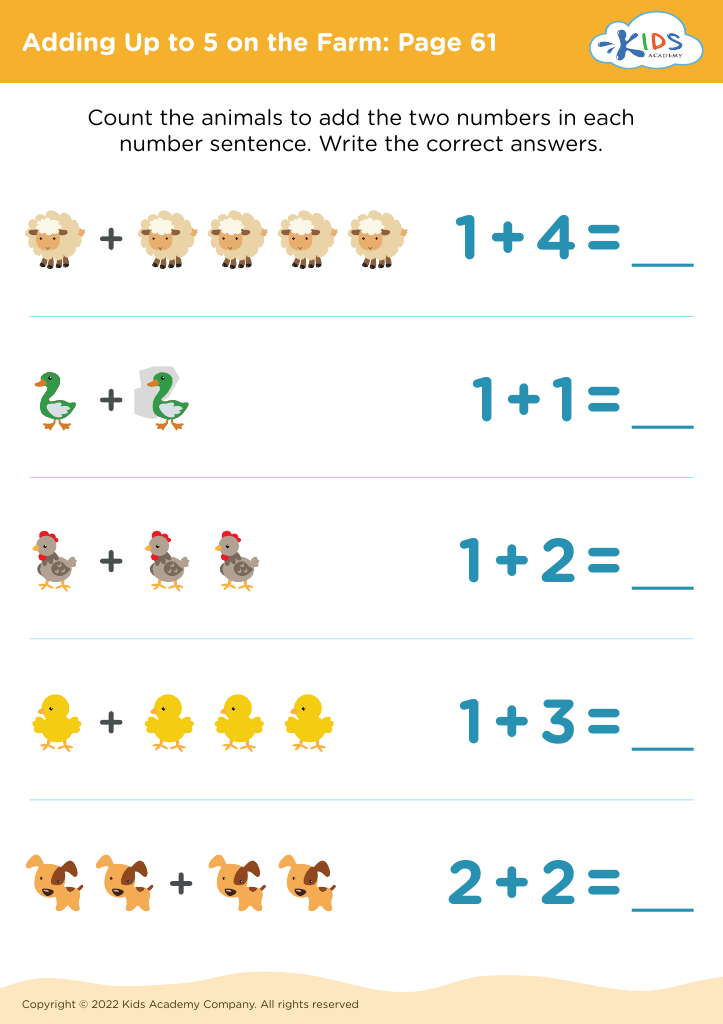
Adding Up to 5 on the Farm: Page 61
Worksheet


Basic addition skills are foundational for children ages 3-7 and play a crucial role in their overall cognitive development. During these early years, children’s brains are particularly receptive to new information and can assimilate foundational mathematical concepts more readily. Basic addition is the stepping stone to more complex mathematical operations such as subtraction, multiplication, and division.

Understanding addition helps young learners make sense of numbers and quantities in their everyday environment, boosting their confidence in handling real-life tasks like sharing items, understanding time, and managing money. Early familiarity with addition also fosters critical thinking and problem-solving abilities, as children learn to recognize patterns, make predictions, and strategize solutions.

From a developmental perspective, mastering addition strengthens memory retention, enhances concentration, and encourages a growth mindset, teaching kids the value of practice and perseverance. Psychologically, early success in math can spur a positive relationship with the subject, significantly affecting academic performance across all disciplines as the child progresses through school.

For the long term, cultivating strong mathematical skills from an early age lays the foundation for careers in science, technology, engineering, and mathematics (STEM). In our increasingly data-driven world, this early investment can spark a lifelong passion for mathematical discovery and career opportunities, positioning children for greater success in the future.