Basic geometry comprehension Worksheets for Ages 3-7
3 filtered results
-
From - To
Enhance your child's math skills with our "Basic Geometry Comprehension Worksheets" designed for ages 3-7. These engaging, age-appropriate printable worksheets focus on shapes, spatial reasoning, and basic geometry concepts, making learning fun and effective. Perfect for preschool through early elementary students, each worksheet features colorful illustrations and interactive tasks that encourage young learners to identify and compare shapes and understand spatial relationships. Ideal for classroom use or at-home practice, these activities build a strong foundation in geometry, setting the stage for future math success. Visit Kids Academy to download our comprehensive worksheets and inspire a love for learning in your child today!
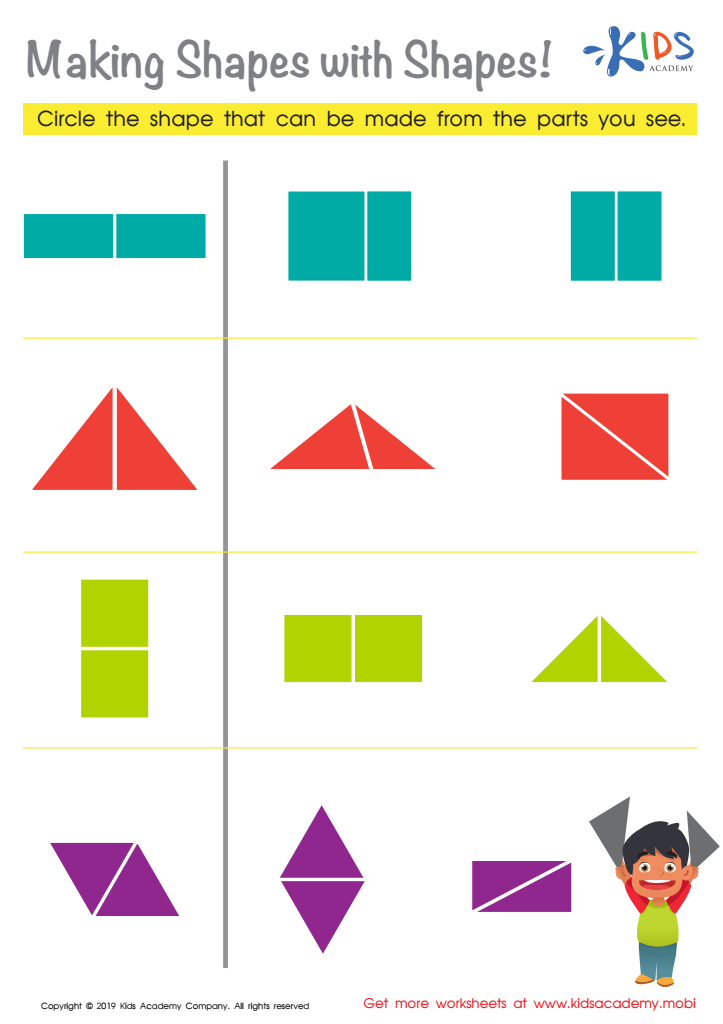
Making Shapes with Shapes Worksheet
 Assign to My Students
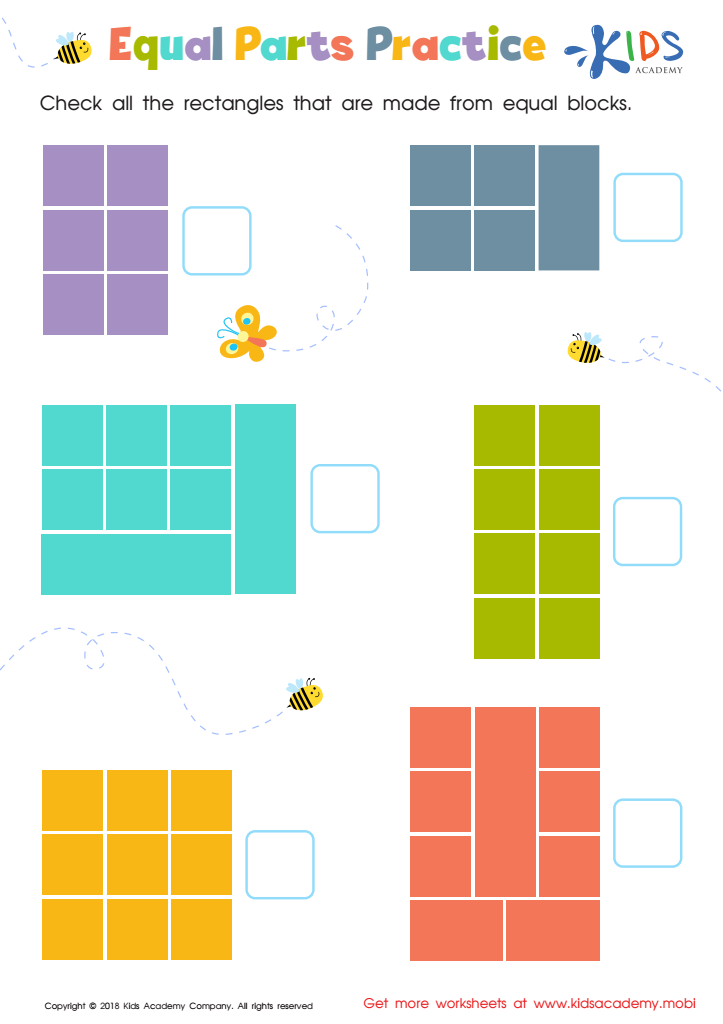
Equal Parts Practice Worksheet








Understanding basic geometry at a young age is crucial for children's cognitive and academic development. For children aged 3-7, grasping geometry can significantly enhance their spatial awareness, which is essential for understanding the world around them. Developing concepts such as shapes, sizes, and spatial relationships helps lay the foundation for later mathematical learning and logical reasoning.
For parents and teachers, fostering an early appreciation and comprehension of geometry can greatly influence a child's problem-solving skills and creativity. Kids adept at recognizing patterns and understanding spatial concepts are better prepared to tackle more complex mathematical problems in the future, such as algebra and calculus. Engaging with basic geometric ideas also encourages critical thinking and attention to detail.
Moreover, early geometric comprehension helps improve language and communication skills. When children describe shapes and spatial relationships, they enhance their vocabulary and ability to articulate ideas clearly. Activities like playing with building blocks, drawing, and assembling puzzles provide hands-on learning experiences that make abstract concepts more concrete.
Therefore, parents and teachers investing time in teaching geometry can provide a robust educational foundation, ensuring that children are well-equipped to navigate and interpret their physical spaces while establishing essential principles for future academic success.








