
Improve handwriting skills Worksheets for Ages 3-7
3 filtered results
Difficulty Level
Grade
Age
-
From - To
Subject
Activity
Standards
Introducing our "Improve Handwriting Skills Worksheets" designed for children ages 3-7! These engaging and interactive worksheets are specifically tailored to help young learners develop essential writing skills in a fun, supportive environment. With a variety of activities, including tracing letters, practicing simple words, and mastering proper letter formation, children will gain confidence and improve their fine motor skills. Our user-friendly resources make it easy for parents and educators to guide children through the learning process. Whether at home or in the classroom, these worksheets are perfect for nurturing your child's handwriting abilities, preparing them for future academic success! Download now!
Favorites
With answer key
Interactive
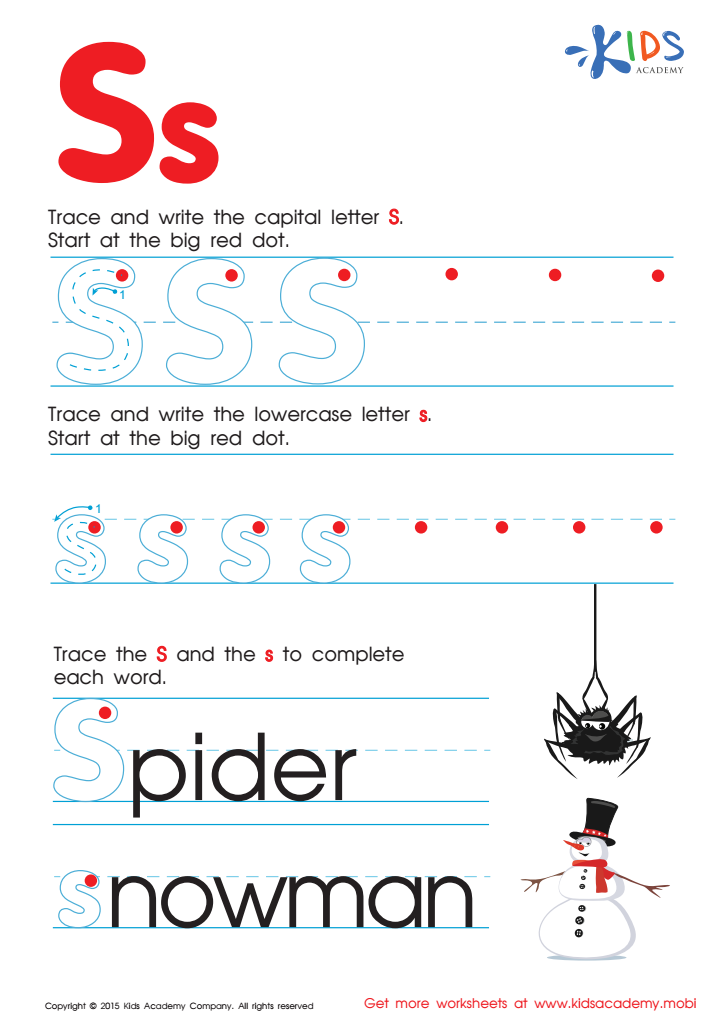
Letter S Tracing Page
Trace and write the capital and lowercase "S" on this ABC worksheet for kindergarten. Start with the big red dot and be careful. When you finish, help the spider and snowman in the pictures restore their words with the capital and lowercase letters. Continue learning the alphabet with Kids Academy.
 Assign to My Students
Letter S Tracing Page
Worksheet
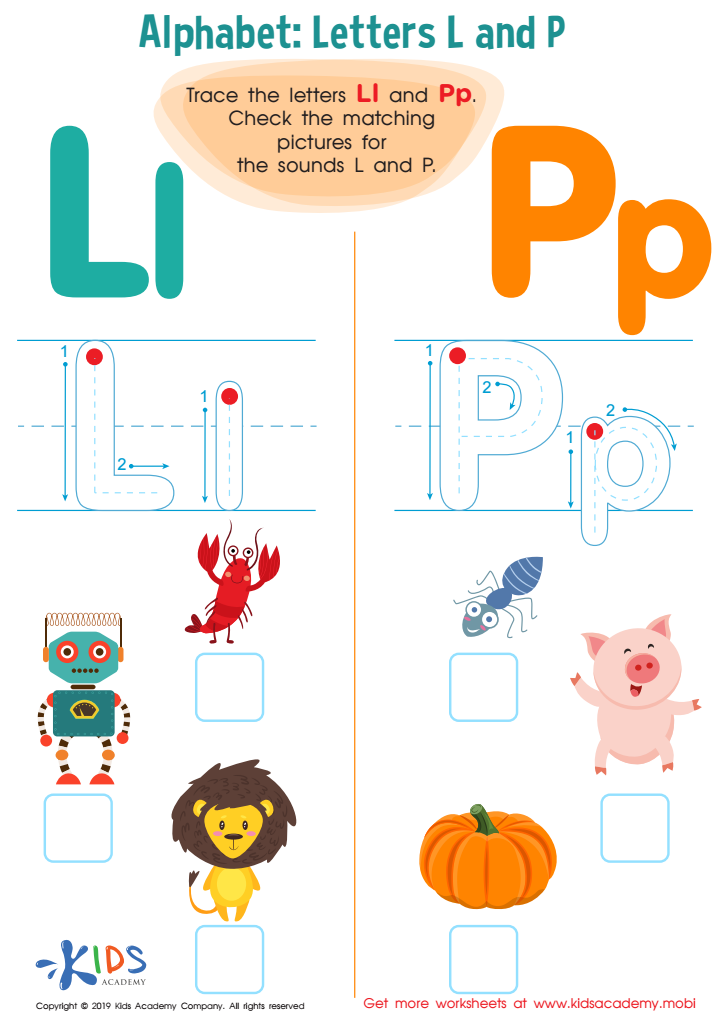
Letter L and P Tracing Worksheet
This traceable worksheet can motivate your students to learn and practice core skills. They'll trace the letters 'L' and 'P' and identify the pictures next to them. With this exercise, they'll unlock their learning abilities and excel in the subject!
Letter L and P Tracing Worksheet
Worksheet
Join Kids Academy for Free
Who is primarily going to use this learning content?








Improving handwriting skills in children aged 3 to 7 is essential for several reasons. Firstly, handwriting is a foundational skill that supports a child's ability to express thoughts and ideas clearly. As young learners engage with writing in school, legible handwriting boosts their confidence and desire to communicate effectively through words. Additionally, the process of writing by hand enhances fine motor skills and hand-eye coordination, both crucial for overall physical development.
Moreover, good handwriting promotes better academic performance. In this age group, children often transition from pre-writing to more complex writing tasks, such as sentence formation and spelling. A strong foundation in handwriting can lead to improved performance in subjects like language arts, where clear and organized writing is critical. Furthermore, as children learn to form letters accurately, they reinforce their understanding of phonetics and literacy, enriching their reading capabilities.
Finally, teaching proper handwriting habits early prevents the development of poor writing techniques that may lead to frustration later. Parents and teachers play a pivotal role in nurturing these skills, as their support ensures that children view writing as an enjoyable, essential means of self-expression and communication throughout their educational journey.








