Mental arithmetic skills Worksheets for Ages 3-7
3 filtered results
-
From - To
Discover our engaging mental arithmetic skills worksheets designed specifically for children aged 3-7. These worksheets aim to enhance early math abilities through fun, interactive activities that promote number recognition, simple addition, and subtraction. Perfect for young learners, each worksheet uses colorful graphics and playful challenges to motivate kids while developing essential math skills. Tailored for home or classroom use, our resources encourage independent learning and foster confidence in young mathematicians. Instill a love for numbers with our carefully crafted worksheets that adhere to educational standards, making math enjoyable and accessible for every child. Start your child's arithmetic journey today!
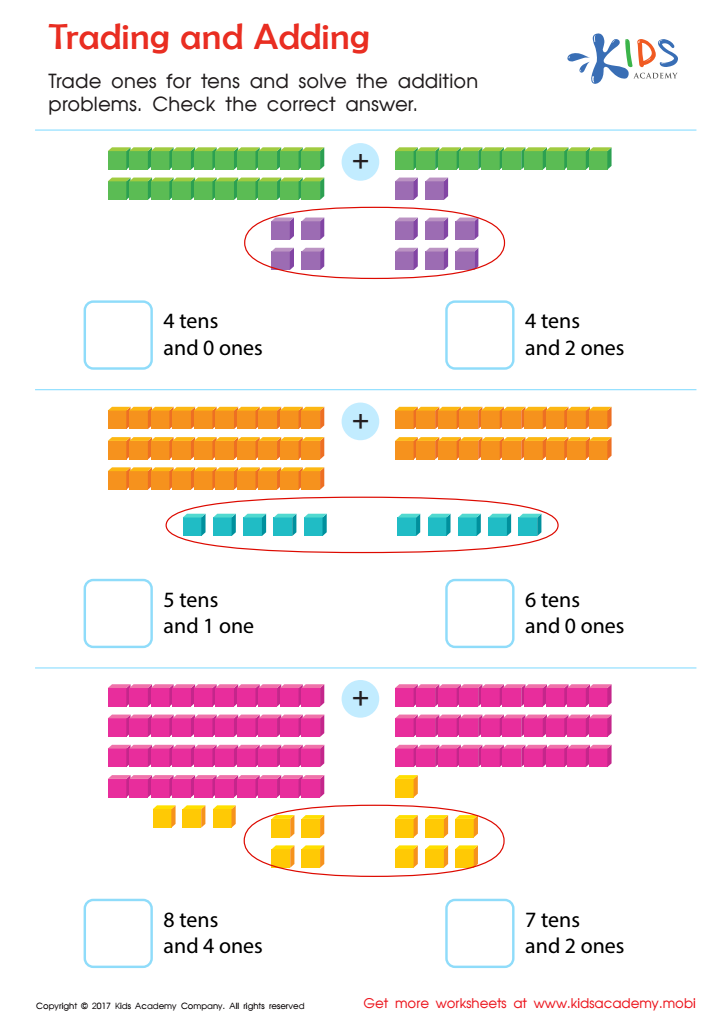
Trading and Adding Worksheet
 Assign to My Students








Mental arithmetic skills are crucial for children aged 3-7 as they lay the foundation for future mathematical understanding and problem-solving abilities. During these formative years, children are in the critical stages of cognitive development, where they begin to grasp basic numerical concepts and operations. Developing mental arithmetic skills helps improve a child's calculation speed, accuracy, and confidence, fostering a positive approach to mathematics.
Moreover, mental arithmetic encourages the use of strategies that are essential in later academic life, promoting logical reasoning and critical thinking. These skills not only enhance mathematical proficiency but also contribute to a child's overall cognitive development. Engaging in fun activities that build these skills, such as games, puzzles, and informal challenges, stimulates curiosity and creativity, making learning enjoyable.
Furthermore, early fluency in mental arithmetic can reduce anxiety associated with math, a common barrier in later schooling. Most importantly, when parents and teachers actively support mental arithmetic development, they cultivate an environment that values and prioritizes learning, empowering children to view mathematics as a meaningful and enjoyable part of their education. This early investment can lead to long-term academic success and, ultimately, to better problem-solving skills in everyday life.








