Solve word problems Worksheets for Ages 3-7
3 filtered results
-
From - To
Introducing Solve Word Problems Worksheets for Ages 3-7 from Kids Academy, a fantastic collection designed to boost young learners' critical thinking and math skills. These worksheets offer engaging and age-appropriate problems, ranging from basic addition and subtraction to more complex scenarios. Each activity encourages children to read carefully, explore varied problem-solving strategies, and apply mathematical concepts in practical contexts. Perfect for both classroom and home use, these resources support foundational math learning and help kids build confidence through fun and interactive exercises. Give your child a head start with our expertly crafted practice sheets!
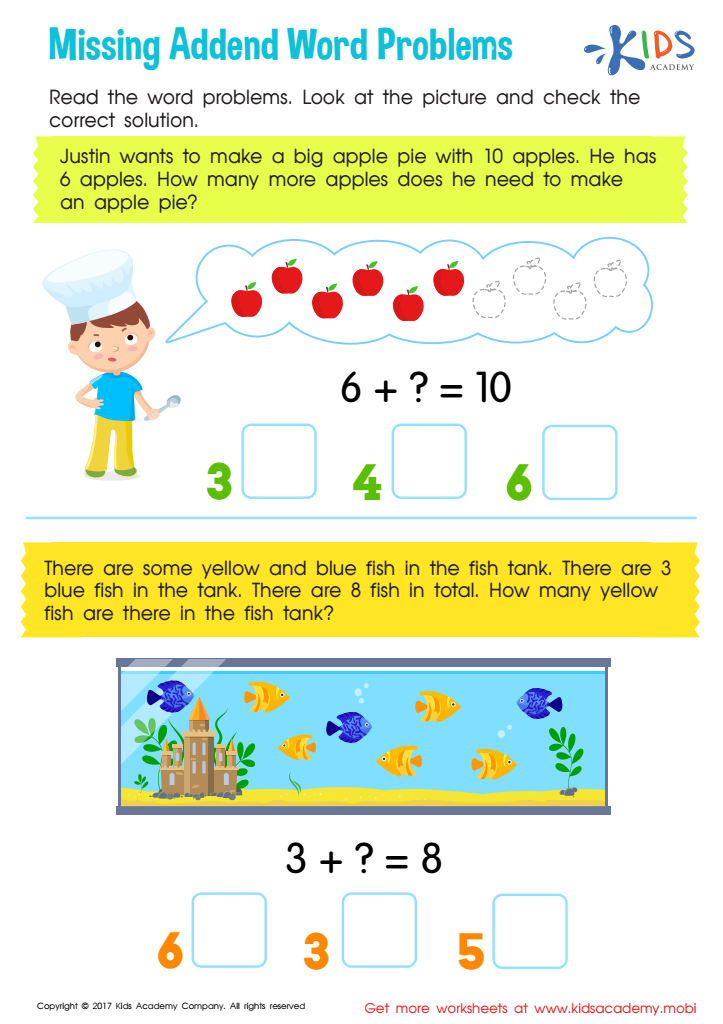
Missing Addend Word Problems Worksheet
 Assign to My Students








Parents and teachers should care about helping young children ages 3-7 solve word problems because it is foundational for their cognitive and academic development. At this age, children are building crucial neural pathways that facilitate not just mathematical understanding but problem-solving skills more generally. Engaging with word problems places math in a meaningful context, making abstract numbers relatable through storytelling.
This early exposure promotes logical thinking, improving children’s ability to reason and think critically. These problems incorporate language skills, enhancing vocabulary and comprehension as kids decipher what the questions require. Word problems also teach patience and perseverance, as young learners must process the problem steps meaningfully rather than simply computing numbers.
For parents, facilitating these exercises at home contributes significantly to children’s readiness for school, making transitions smoother and more successful. For teachers, it strengthens classroom interactions, enabling individualized support and fostering a collaborative learning environment. Additionally, these skills are not limited to mathematics; they are transferable to various subjects and everyday scenarios, laying a versatile foundation for future learning.
Thus, introducing and nurturing the ability to solve word problems at an early age equips children with a toolkit for academic achievement and life-wide practical problem solving.








