Understanding Quantities Worksheets for Ages 3-7 - Page 3
53 filtered results
-
From - To
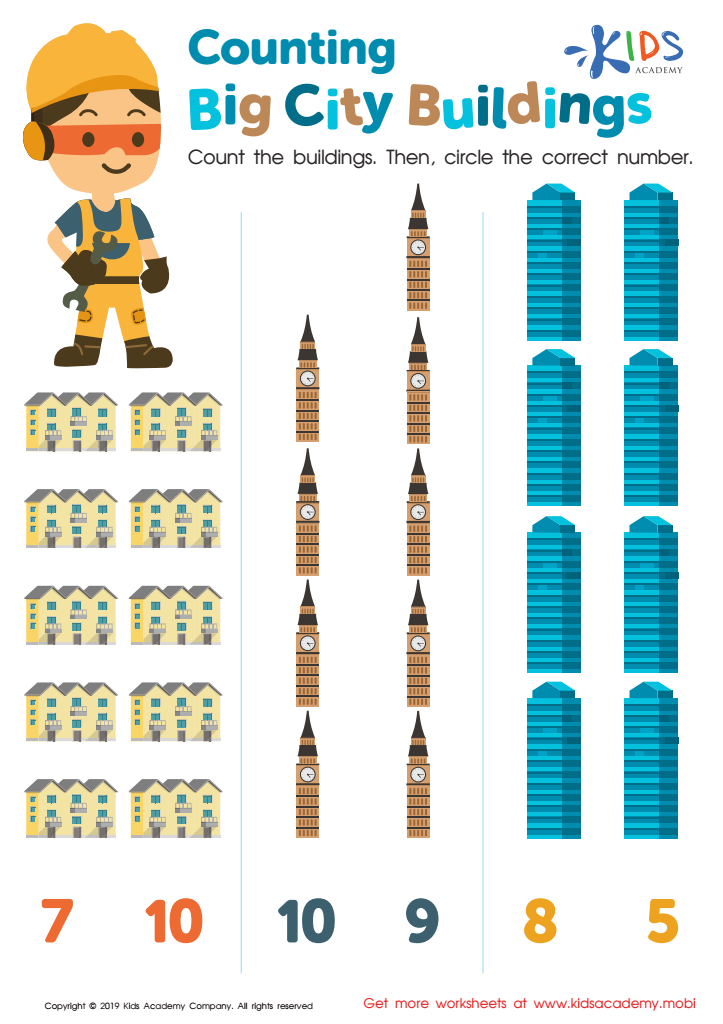
Counting Big City Buildings Worksheet
 Assign to My Students






Understanding quantities is a cornerstone of early childhood development and a critical foundational skill for future learning. For children aged 3-7, grasping basic quantitative concepts helps foster key cognitive abilities that are essential for more complex mathematical thinking. Parents and teachers who prioritize this early learning focus are setting children up for success in multiple domains.
At this age, children naturally develop number sense—an intuitive understanding of numbers and their relationships. By engaging in counting, sorting, comparing, and measuring activities, children learn to recognize quantities, understand the concepts of more and less, and start to comprehend basic arithmetic. This skill helps with problem-solving and logical thinking, both vital for academic achievement.
Moreover, understanding quantities also aids in everyday activities. From determining whether they have enough toys to share with friends to discerning how much cereal to pour in a bowl, quantitative skills permeate day-to-day experiences. This practical understanding fosters independence and confidence.
Additionally, early understanding of quantities is linked to language development. Discussing numbers and quantities enriches vocabulary and enhances communication skills as children learn to articulate what they observe and feel.
Therefore, parents and teachers who invest time in helping children master quantitative concepts are not merely teaching math; they are nurturing holistic cognitive development that will benefit children across various aspects of their lives.








