
Visual fraction representation Worksheets for Ages 3-7
3 filtered results
Difficulty Level
Grade
Age
-
From - To
Subject
Activity
Standards
Unlock the world of fractions for your little learners with our engaging Visual Fraction Representation Worksheets designed specifically for ages 3-7! These creative resources make abstract concepts tangible, using colorful visuals and interactive activities to foster understanding. Each worksheet enhances number sense and fraction comprehension through hands-on experiences that cater to young minds. Kids will enjoy identifying, comparing, and manipulating fractions in a fun, supportive environment. Perfect for both classroom and home learning, these worksheets will ignite a passion for math and build a strong foundation for future success. Explore our collection today and watch your child thrive in their mathematical journey!
Favorites
With answer key
Interactive
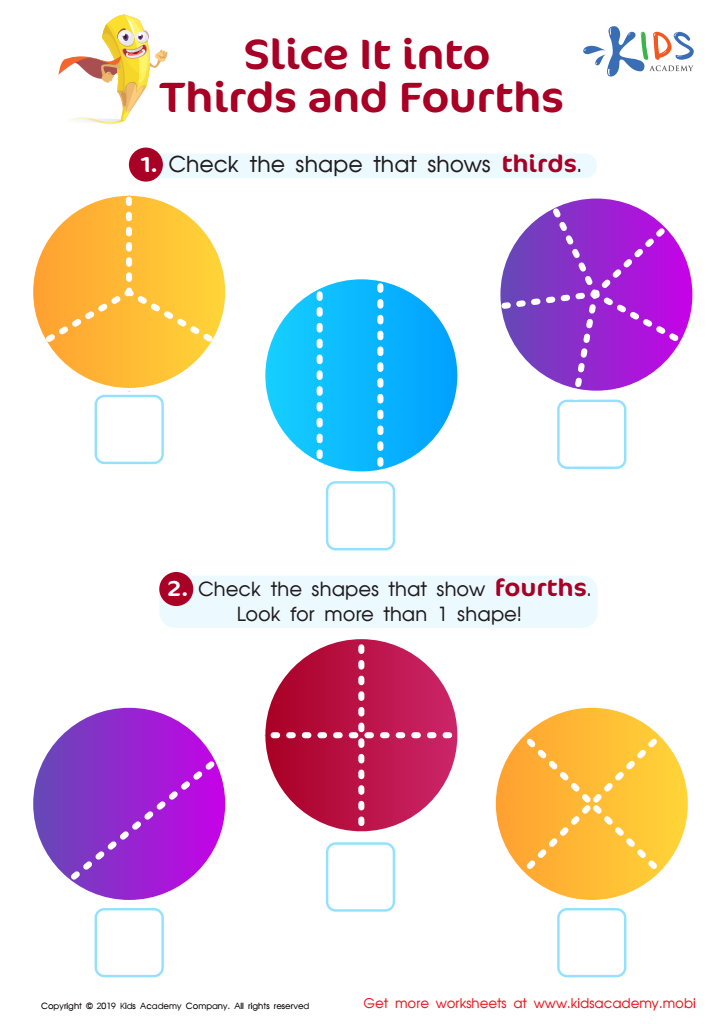
Slice in Thirds Fourths Worksheet
This worksheet helps kids learn fractions visually by dividing circles into thirds and fourths. They will learn that fractions must be equal parts, not just sets, by choosing the right colorful circles. It's an easy way to master fractions and have fun doing it!
 Assign to My Students
Slice in Thirds Fourths Worksheet
Worksheet
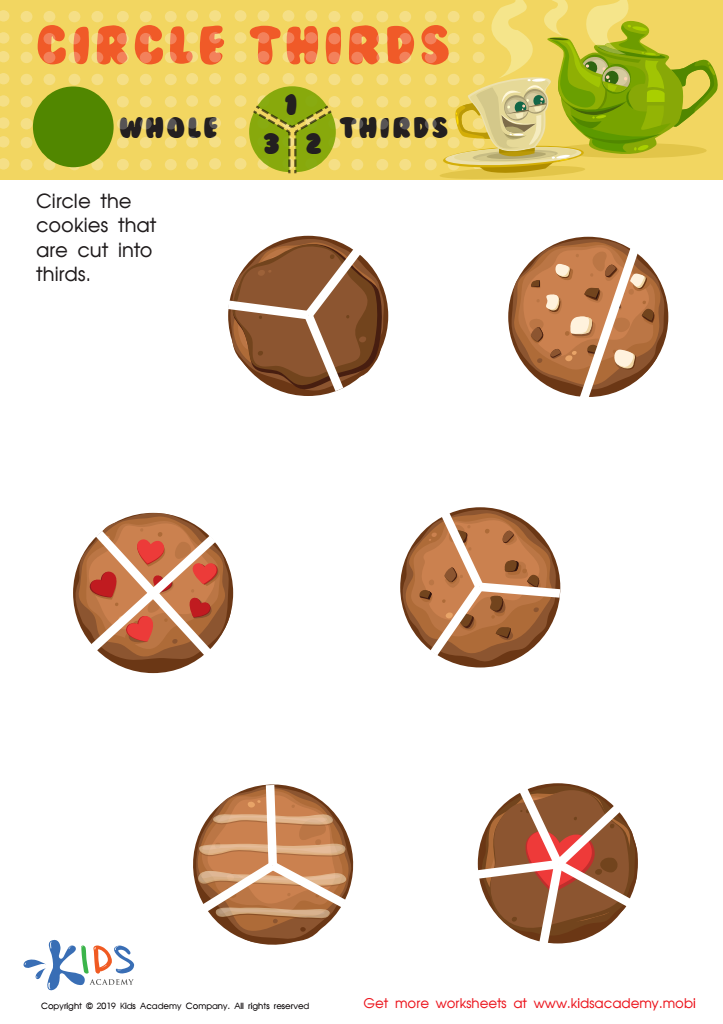
Circle Thirds Worksheet
Remind your kids of the different ways shapes can be divided: wholes, halves, thirds, and fourths. Now, look at the shapes in the worksheet and have them circle the cookies cut into thirds.
Circle Thirds Worksheet
Worksheet
Join Kids Academy for Free
Who is primarily going to use this learning content?








Visual fraction representation is essential for early childhood education, particularly for children ages 3-7, as it lays a vital foundation for mathematical understanding. During these formative years, children are highly visual learners, and using visuals like pie charts, blocks, or number lines helps them grasp abstract concepts such as fractions more concretely. By representing fractions visually, children can see parts of a whole, identifying relationships and proportional reasoning early on, crucial skills in later math learning.
Additionally, visual representations make fractions more engaging and relatable, which can spark children’s interest in math and develop a positive attitude towards the subject. Understanding fractions also plays a key role in daily life; children learn to compare quantities, share equally, and understand division—invaluable skills they use when sharing toys or snacks.
For teachers and parents, fostering a solid understanding of fractions at a young age can prevent confusion and frustration in later grades, where more complex fraction concepts are introduced. By prioritizing visual fraction representation, caregivers help create confident learners equipped to tackle higher-level math, thus ultimately promoting long-term educational success.








