Critical Thinking Adding 2-digit Numbers Worksheets for Ages 3-7
3 filtered results
-
From - To
Enhance your child's math skills and critical thinking with our engaging "Critical Thinking Adding 2-Digit Numbers Worksheets." Designed for ages 3-7, these printables offer a fun, educational way to practice basic addition while developing problem-solving abilities. Each worksheet is filled with colorful illustrations and creative challenges that encourage young learners to think analytically. By working through these activities, children not only improve their numerical skills but also their logic and reasoning. Perfect for use at home or in the classroom, these worksheets are a fantastic resource for fostering a love for learning in your little mathematician!
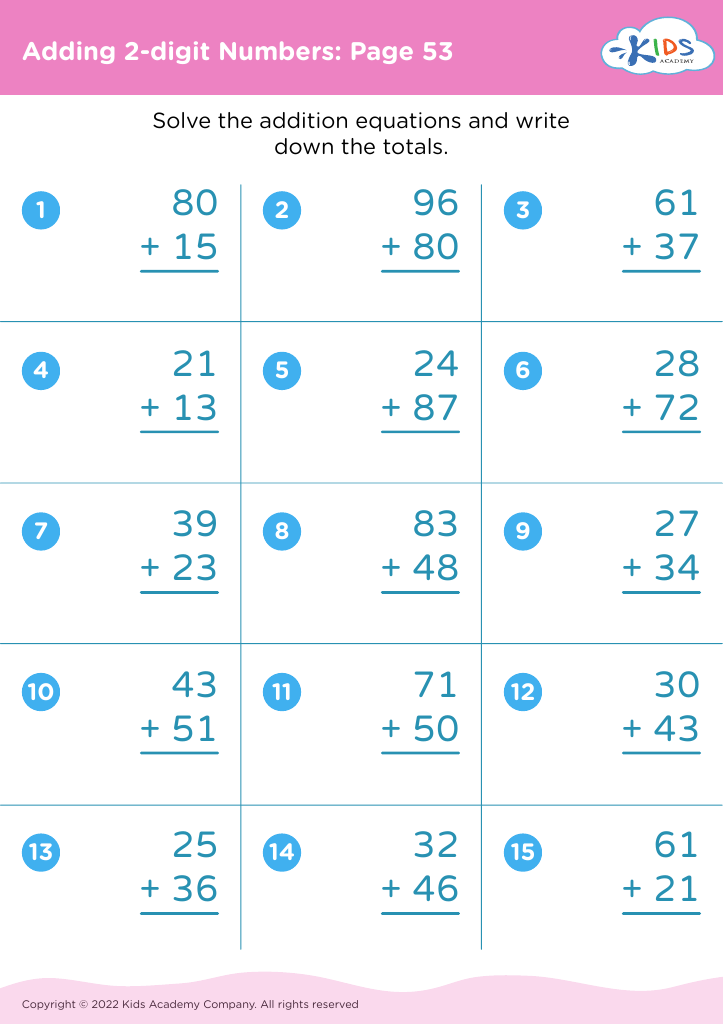
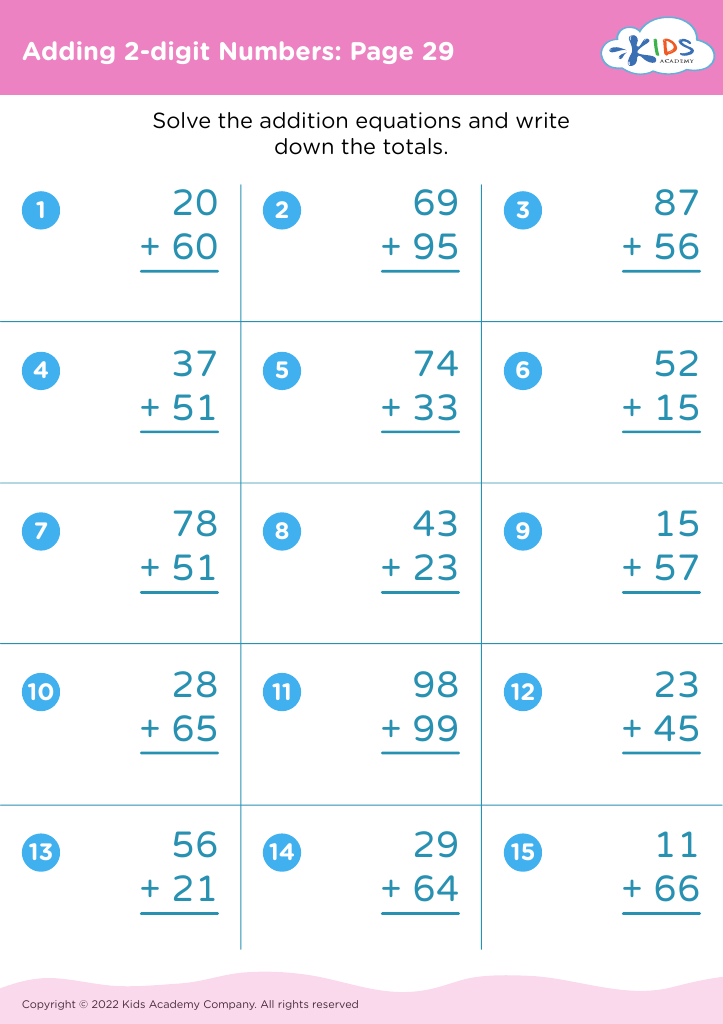
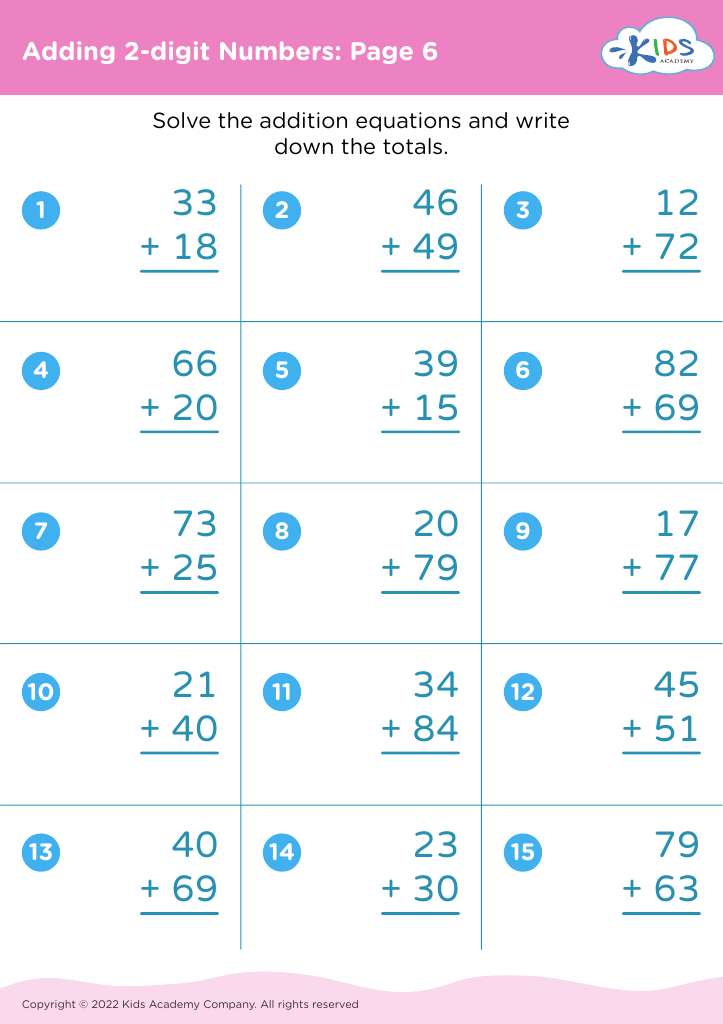








Encouraging critical thinking in early math education, particularly in adding 2-digit numbers, is essential for children aged 3-7. At this age, their cognitive development is rapidly progressing, and fostering critical thinking through math helps build foundational skills. By engaging in adding 2-digit numbers, children learn to approach problems methodically, recognize patterns, and understand numerical relationships, which strengthens their overall mathematical understanding.
Critical thinking in math goes beyond rote memorization. It encourages children to ask questions, explore multiple ways to solve problems, and understand why certain steps are necessary, rather than just how to perform them. This deeper comprehension aids in developing important problem-solving skills and promotes intellectual curiosity.
Furthermore, this approach helps children develop confidence in their abilities, leading to a positive attitude toward learning. As they apply these skills in various contexts, they also build persistence and resilience—qualities crucial for academic success and personal growth. Parents and teachers who prioritize critical thinking in early math education are investing in the child's cognitive and emotional development, laying a solid foundation that supports more advanced learning. Hence, incorporating critical thinking strategies while teaching 2-digit addition ensures comprehensive growth, preparing children for future educational challenges.








