Develop critical thinking Adding up to 100 Without Regrouping Worksheets for Ages 3-7
3 filtered results
-
From - To
Explore our "Adding Up to 100 Without Regrouping" worksheets, specially designed for children aged 3-7 to cultivate critical thinking skills. These engaging and interactive activities not only introduce basic addition concepts but also encourage problem-solving and reasoning. As young learners tackle addition problems without regrouping, they develop essential numerical literacy while boosting their confidence. Perfect for both classroom settings and home learning, these worksheets promote cognitive development through fun tasks, allowing children to visualize numbers and relationships. Whether used for practice or assessment, our resources ensure an enjoyable learning experience that lays a strong foundation for future mathematical success.
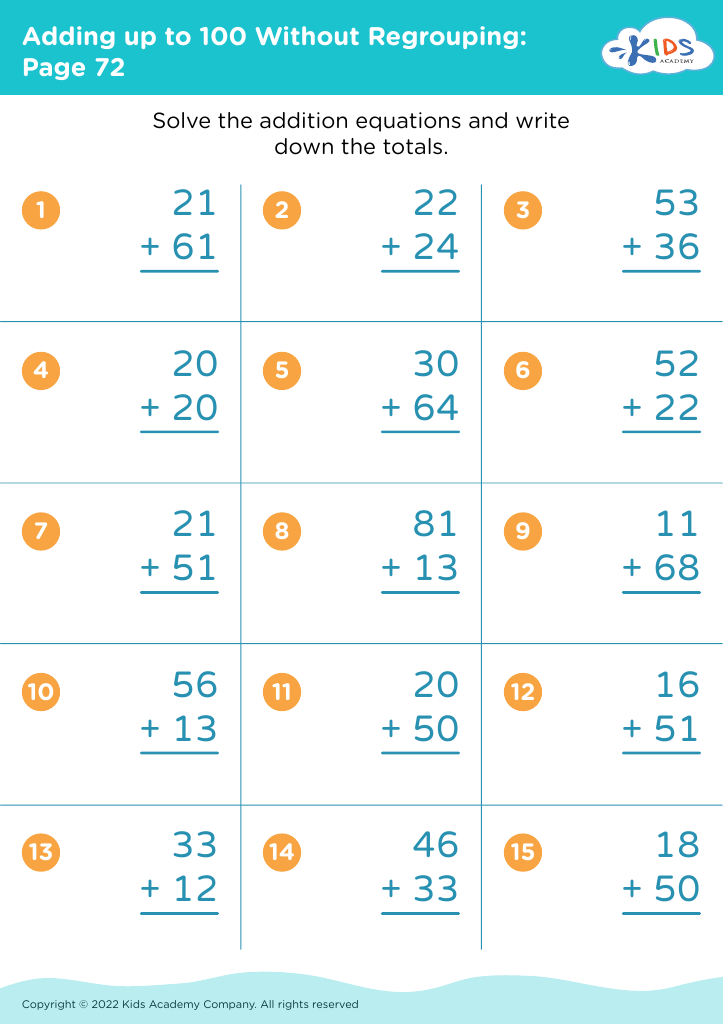
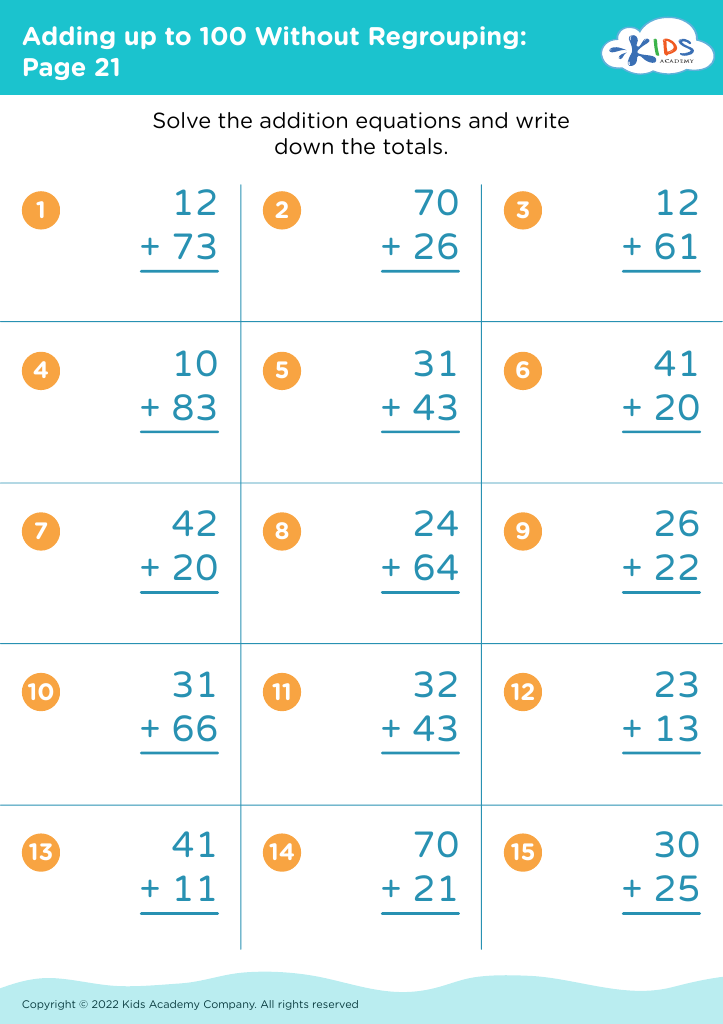
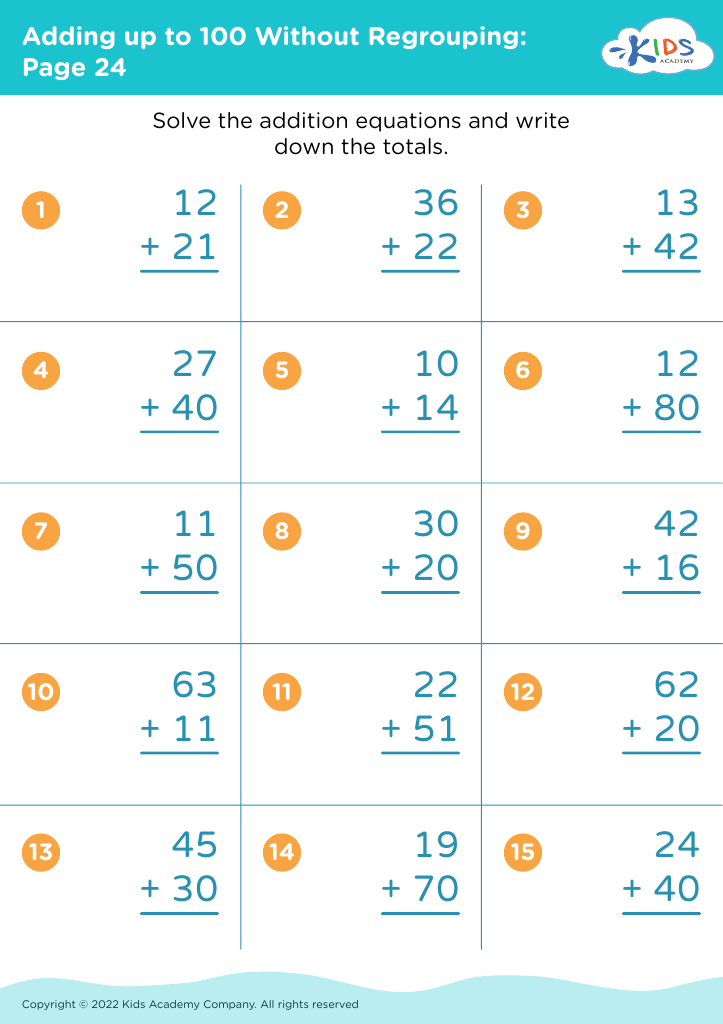




Developing critical thinking skills in young children, particularly in the context of adding numbers without regrouping, is vital for their overall cognitive development. For parents and teachers of children aged 3-7, fostering these skills not only lays the groundwork for mathematical proficiency but also enhances problem-solving abilities and encouraged a deeper understanding of concepts.
Critical thinking encourages children to analyze, evaluate, and synthesize information as they explore different ways to add numbers. When children engage in activities that involve adding up to 100 without regrouping, they are learning to recognize patterns, understand number relationships, and approach problems from various angles. These foundational skills not only contribute to mathematical success but also carry over into literacy, science, and everyday decision-making.
Moreover, when children are encouraged to think critically and independently, they gain confidence in their ability to tackle challenges. This sense of autonomy is essential for lifelong learning. Therefore, parents and teachers should prioritize activities that promote critical thinking, ensuring that children not only reach numerical targets but also develop a love for learning and a capacity to think deeply, setting the stage for academic success and personal growth in the future.