Simplifying Fractions Adding up to 1000 Without Regrouping Worksheets for Ages 3-7
3 filtered results
-
From - To
Introduce your young mathematicians to our expertly crafted "Simplifying Fractions Adding up to 1000 Without Regrouping Worksheets" designed for ages 3-7. These engaging and easy-to-follow worksheets help kids master basic fraction skills while reinforcing addition concepts. By working through problems without regrouping, children build confidence and enhance their number sense. Perfect for educators and parents alike, our printable resources ensure that learning fractions is a fun and rewarding experience. Explore these specially designed activities to support your child's journey in becoming a proficient little mathematician!
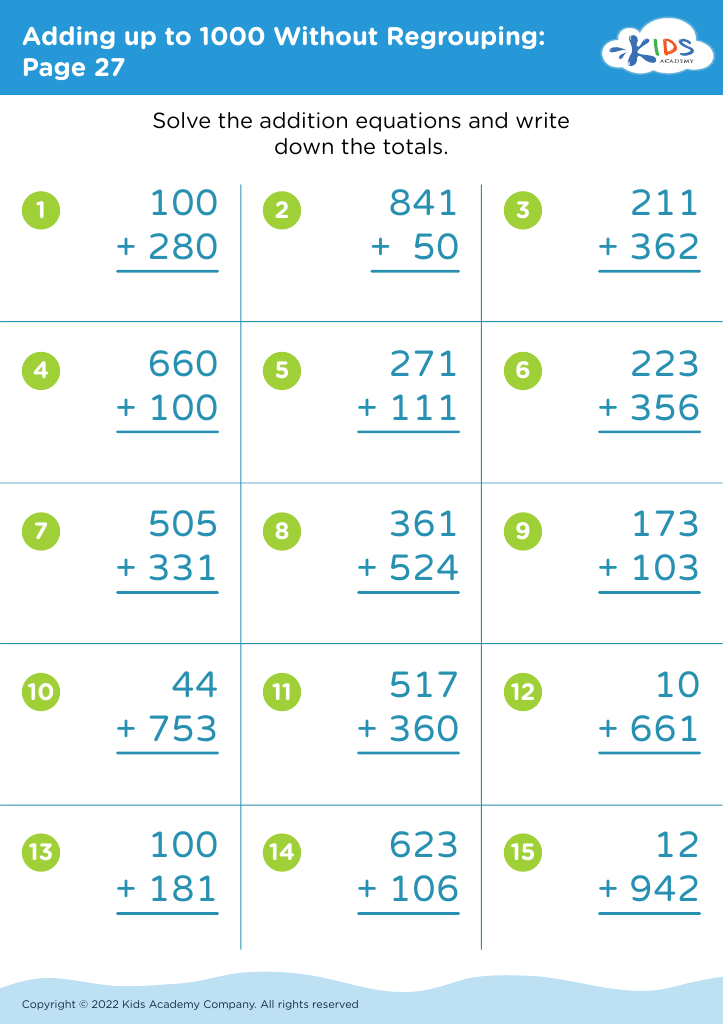
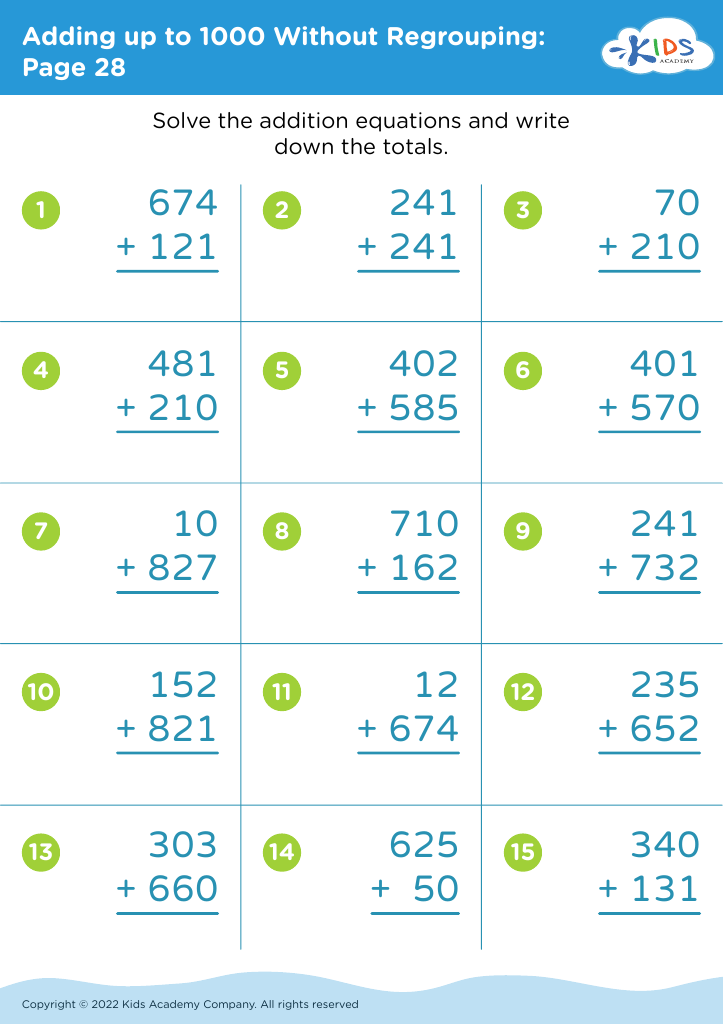
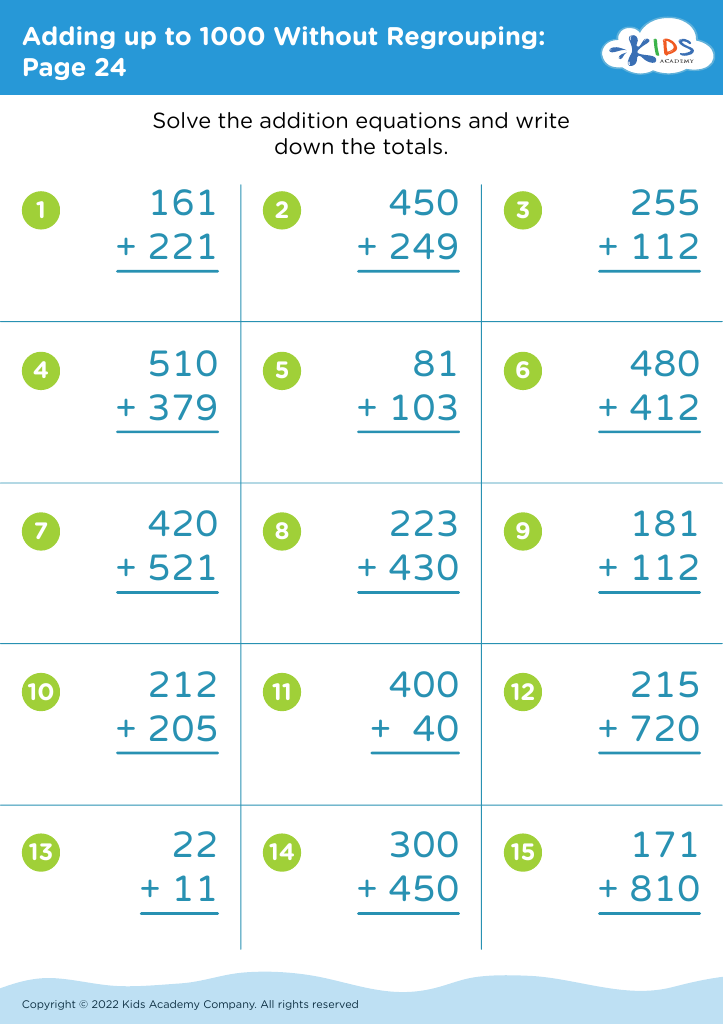


Parents and teachers should care about simplifying fractions and other fundamental math skills for children ages 3-7 because these early years are crucial for cognitive development. Teaching young kids how to simplify fractions, as well as adding up to 1000 without regrouping, lays a solid mathematical foundation that will benefit their future learning.
At this age, children are highly receptive to new concepts and can absorb information more easily. Simplifying fractions helps them understand the relationships between numbers, a skill that is critical for higher-level math. Additionally, practicing adding numbers up to 1000 without regrouping (carrying over) aids in developing arithmetic fluency and confidence.
Moreover, these activities enhance problem-solving abilities, logical thinking, and analytical skills. When children grasp these fundamental concepts, they are less likely to struggle with more complex math problems in the future. Simplifying fractions also introduces children to the importance of ratios and proportional reasoning, which has applications in many real-world situations.
Teachers and parents who prioritize these basic math skills help create a growth mindset and foster a love for learning. Overall, investing time in teaching these concepts early paves the way for academic achievement and equips kids with critical skills they will use throughout their education and life.