Comparing quantities Adding up to 50 Worksheets for Ages 3-7
3 filtered results
-
From - To
Discover our "Comparing Quantities Adding Up to 50 Worksheets" designed for kids ages 3-7! These engaging worksheets help young learners develop essential math skills by comparing and adding quantities effectively. With colorful illustrations and interactive activities, children will enjoy honing their understanding of numbers up to 50 while enhancing their critical thinking and problem-solving abilities. Perfect for home or classroom use, our worksheets empower early learners to grasp fundamental concepts and build confidence in their math skills. Encourage curiosity and a love for learning with our specially crafted resources tailored to young mathematicians. Start their math journey today!
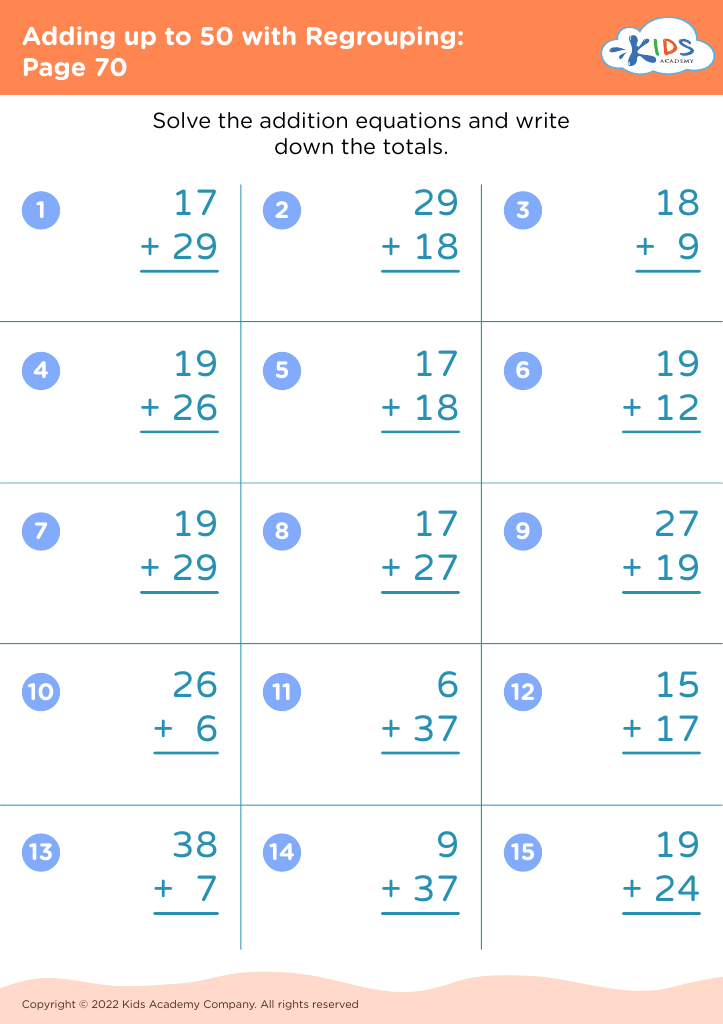
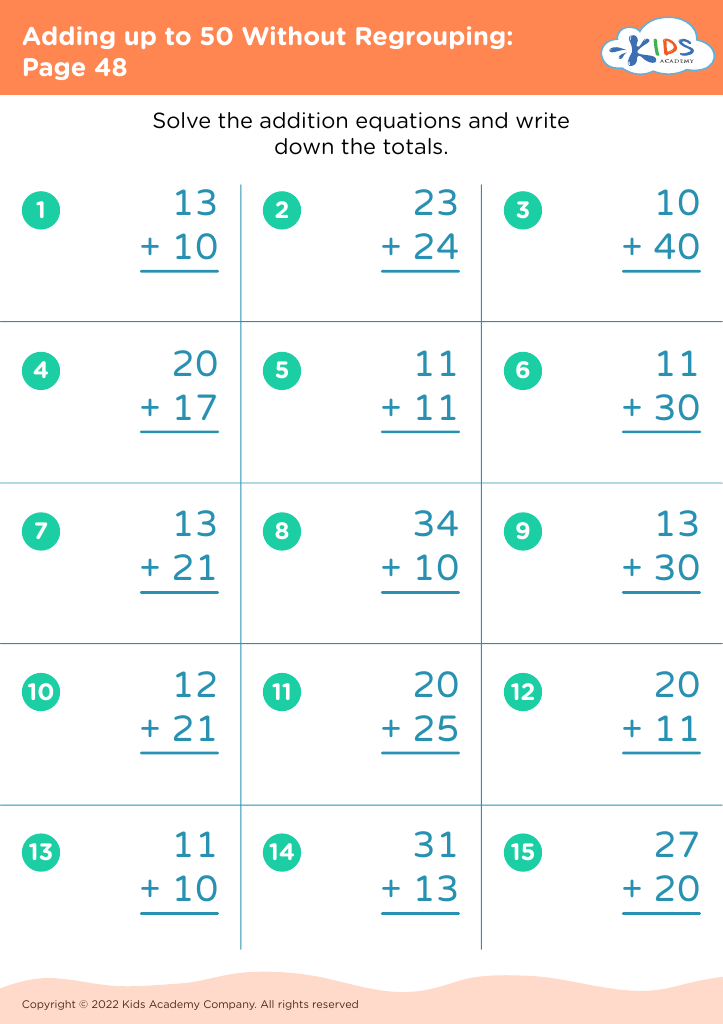
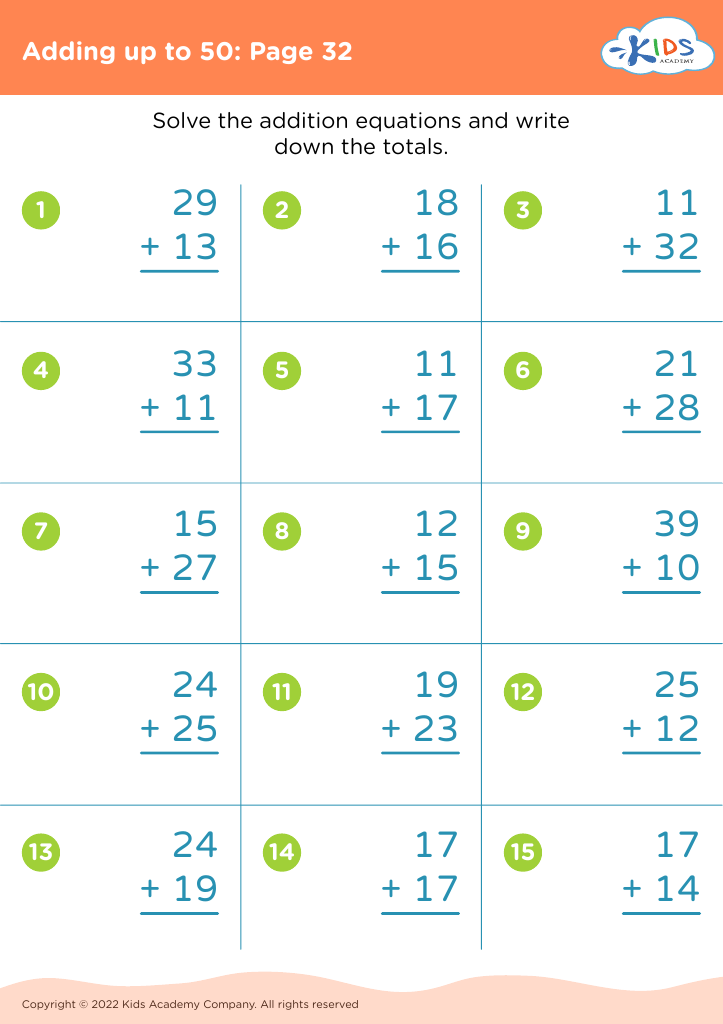




Comparing quantities and adding up to 50 are fundamental skills that serve as the building blocks for mathematical understanding in children ages 3-7. Encouraging these skills is essential for multiple reasons.
Firstly, comparing quantities teaches children to recognize differences and similarities in numbers, which is crucial for developing critical thinking skills. It helps them understand concepts like more, less, and equality, laying the groundwork for future calculations.
Secondly, adding up to 50 fosters numerical fluency. When children practice basic addition within this range, they gain confidence in their mathematical abilities, making it easier for them to tackle larger numbers and more complex operations as they progress in their education. This early proficiency can lead to greater academic success, reducing anxiety around math later in life.
Moreover, these skills enhance cognitive development overall, allowing children to engage in problem-solving and logical reasoning. By making math a fun and integral part of everyday activities, parents and teachers can nurture a positive attitude towards learning.
Ultimately, focusing on comparing quantities and adding up to 50 not only prepares children for future academic pursuits but also equips them with essential life skills in reasoning and quantitative understanding. These foundational elements are essential for success in mathematics and beyond.








