Recognizing equivalent fractions Adding up to 50 Worksheets for Ages 3-7
3 filtered results
-
From - To
Discover the fun and engaging "Recognizing Equivalent Fractions Adding Up to 50" worksheets designed for young learners aged 3-7. These resources help children grasp the concept of equivalent fractions while enhancing their addition skills up to 50. Through colorful illustrations and age-appropriate activities, kids will develop a solid foundation in understanding fractions, boosting their confidence in math. Our interactive worksheets encourage hands-on learning, making it easy for educators and parents to foster a positive learning environment. Perfect for homeschooling or classroom settings, these worksheets are an excellent way for children to explore math concepts while having fun. Start the journey to mathematical mastery today!
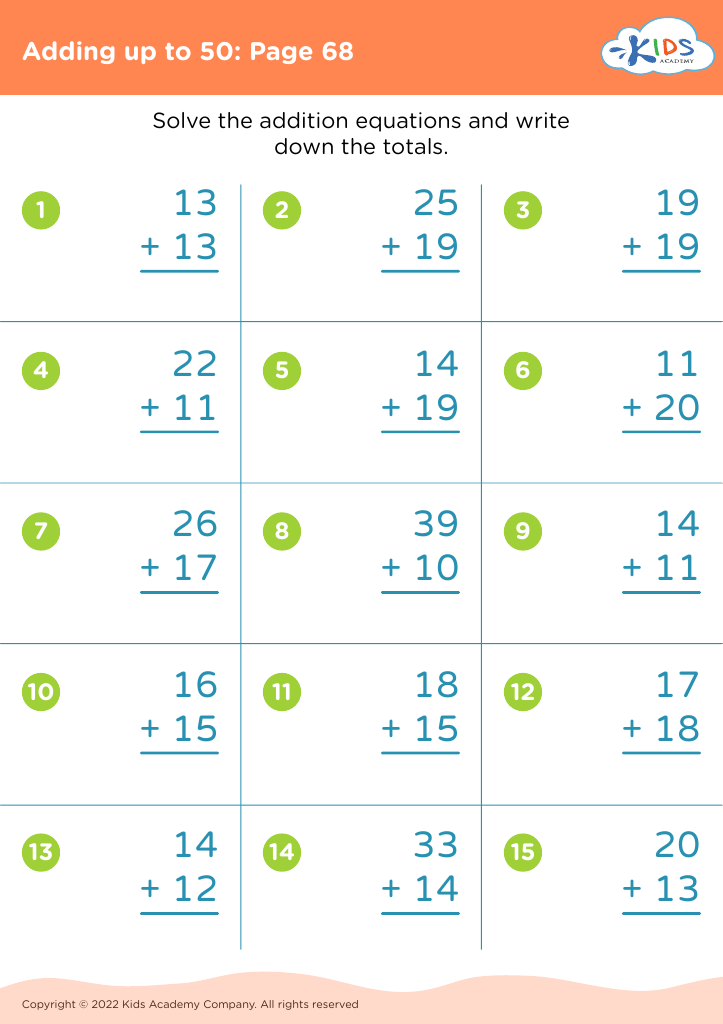
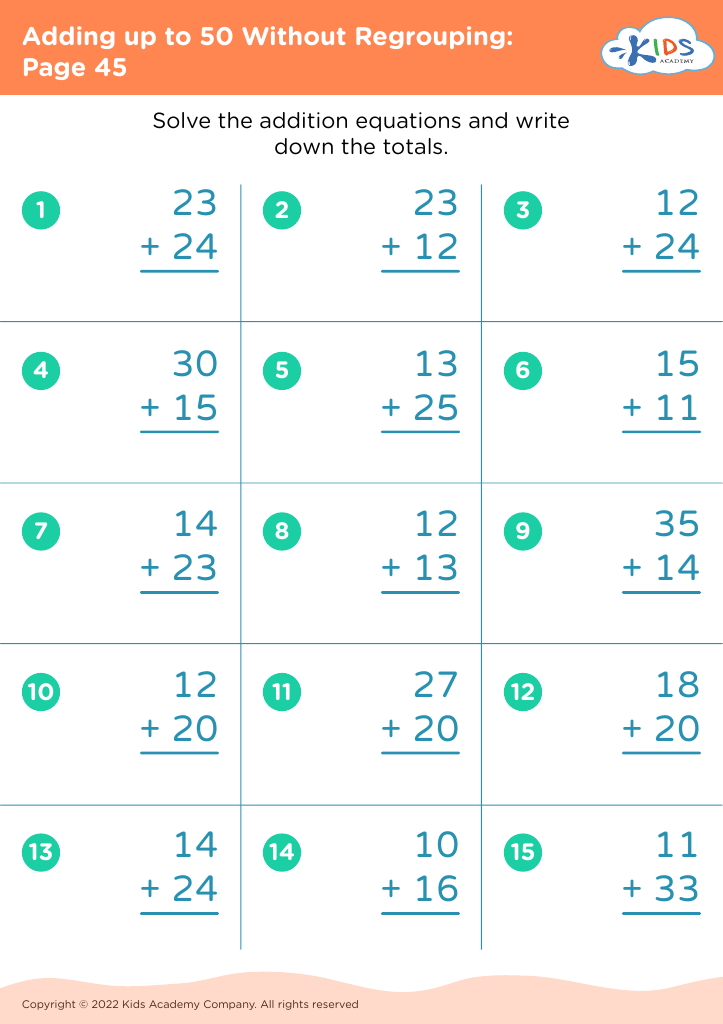
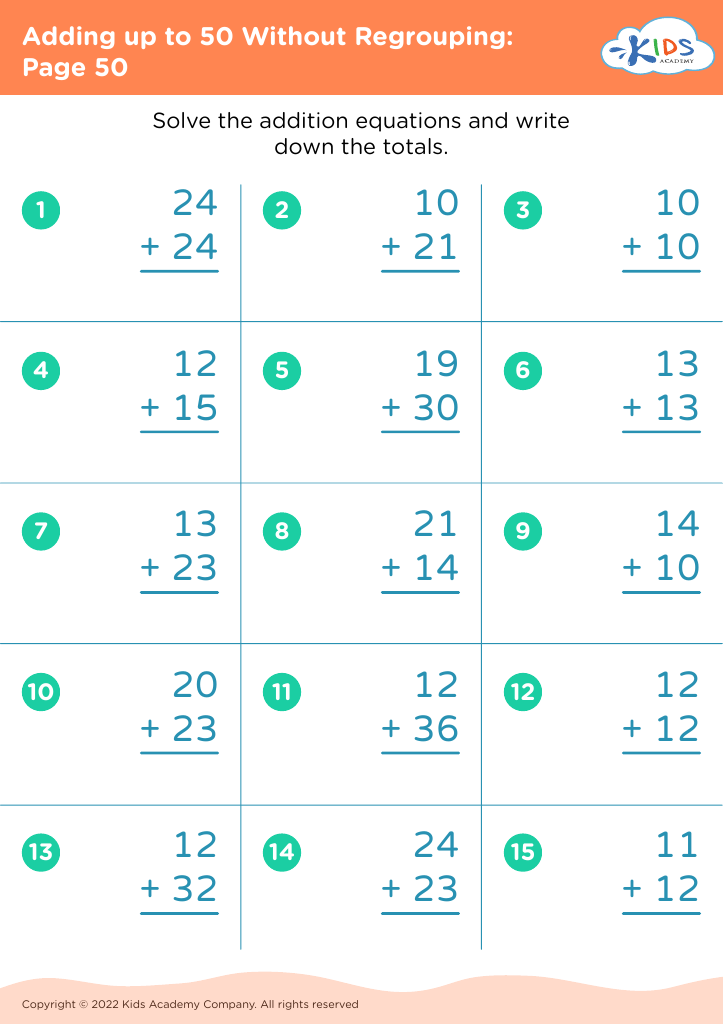




Recognizing equivalent fractions is a foundational mathematical skill that sets the stage for more complex concepts as children grow. For young learners aged 3-7, these fractions introduce them to the idea of parts of a whole, helping them to understand relationships between numbers and develop critical thinking skills. By learning that different fractions can represent the same value—like 1/2 being equivalent to 2/4—children enhance their ability to compare sizes and understand proportions.
For parents and teachers, teaching equivalent fractions through engaging activities—like using visual aids, fraction games, or real-life examples—can foster a love for math. It also builds confidence in problem-solving. When linked to the concept of addition, recognizing fractions that together add up to 50 can introduce children to basic addition and set them on a path toward problem-solving with larger numbers.
Moreover, mastering fractions aids in arithmetic and pre-algebra skills, providing a strong mathematical foundation for future learning. Understanding these concepts enhances children's analytical abilities and promotes a positive attitude towards math—a crucial skill in today's technologically driven world. Thus, both parents and teachers should prioritize teaching equivalent fractions as they contribute to overall math literacy and cognitive development.








