Understanding equality Addition & Subtraction Worksheets for Ages 3-7
4 filtered results
-
From - To
Unlock the foundations of math with our "Understanding Equality Addition & Subtraction Worksheets" designed specifically for ages 3-7. These engaging and educational worksheets help young learners grasp the concept of mathematical equality, ensuring a solid base in addition and subtraction. Through fun activities and colorful illustrations, kids will learn to recognize and balance equations, fostering their problem-solving and critical-thinking skills. Perfect for both classroom and home settings, our worksheets support early math proficiency, laying the groundwork for future success. Explore an enjoyable way to make learning math fun and intuitive for your child today!
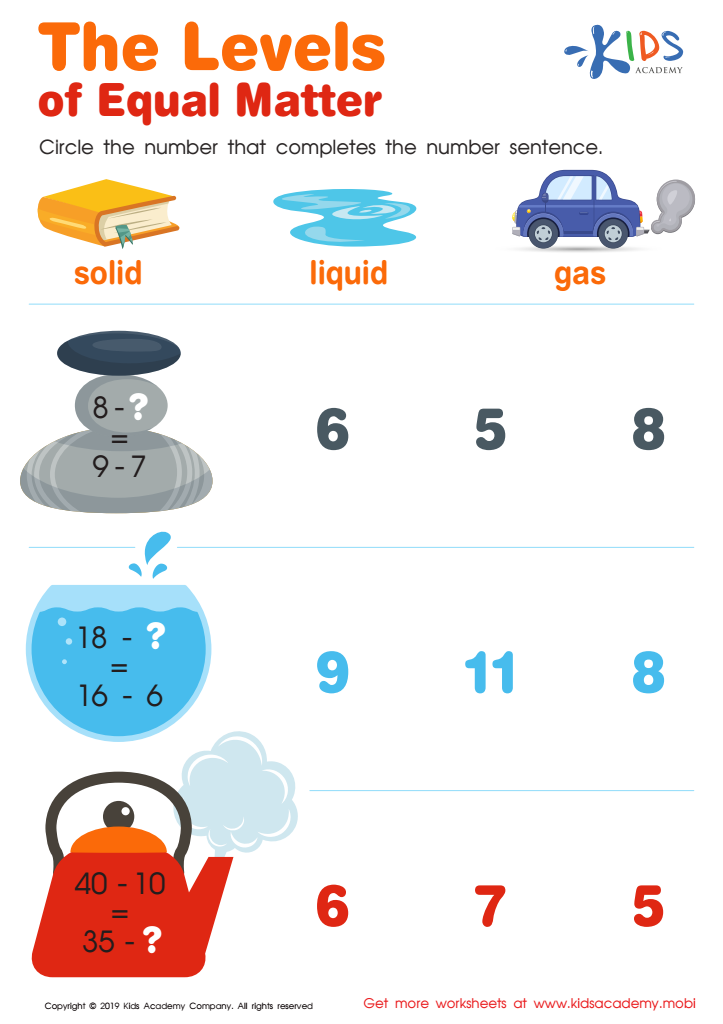
The Levels of Equal Matter Worksheet
 Assign to My Students








Understanding equality in addition and subtraction is crucial for young children ages 3-7 as it forms the foundation for their future mathematical learning. For parents and teachers, recognizing the significance of this concept helps them provide appropriate guidance and support.
Equality helps children grasp the idea that what is on one side of the equation must balance with the other, fostering logical thinking and problem-solving skills. For instance, understanding that 3 + 4 = 7 is the same as 7 - 4 = 3 helps children see the consistency in math. This knowledge aids them in comprehending more complex arithmetic down the road.
Additionally, fostering a strong grasp of addition and subtraction enables kids to perform basic operations needed in everyday life. Whether they’re dividing a treat among friends or figuring out how much money to save for a toy, these skills are functionally important.
Promoting equality in math at an early age supports cognitive development and increases the child's confidence in their abilities. Positive reinforcement from parents and teachers plays a significant role in making learning enjoyable and effective. As a result, children develop a positive attitude towards math, setting a solid groundwork for academic success in the future.








