
Basic subtraction Addition Worksheets for Ages 3-7
5 filtered results
Difficulty Level
Grade
Age
-
From - To
Subject
Activity
Standards
Welcome to our Basic Subtraction and Addition Worksheets page, designed exclusively for children ages 3 to 7! These engaging worksheets are perfect for young learners eager to enhance their math skills through fun and interactive activities. Our carefully crafted exercises help kids grasp essential concepts of subtraction and addition, fostering a solid numerical foundation. Featuring vibrant illustrations and easy-to-follow instructions, each worksheet encourages creativity while reinforcing important math skills. Whether used at home or in the classroom, these resources are invaluable for nurturing confidence and mathematical proficiency in your child. Explore our collection and watch them thrive in their mathematical journey!
Favorites
With answer key
Interactive
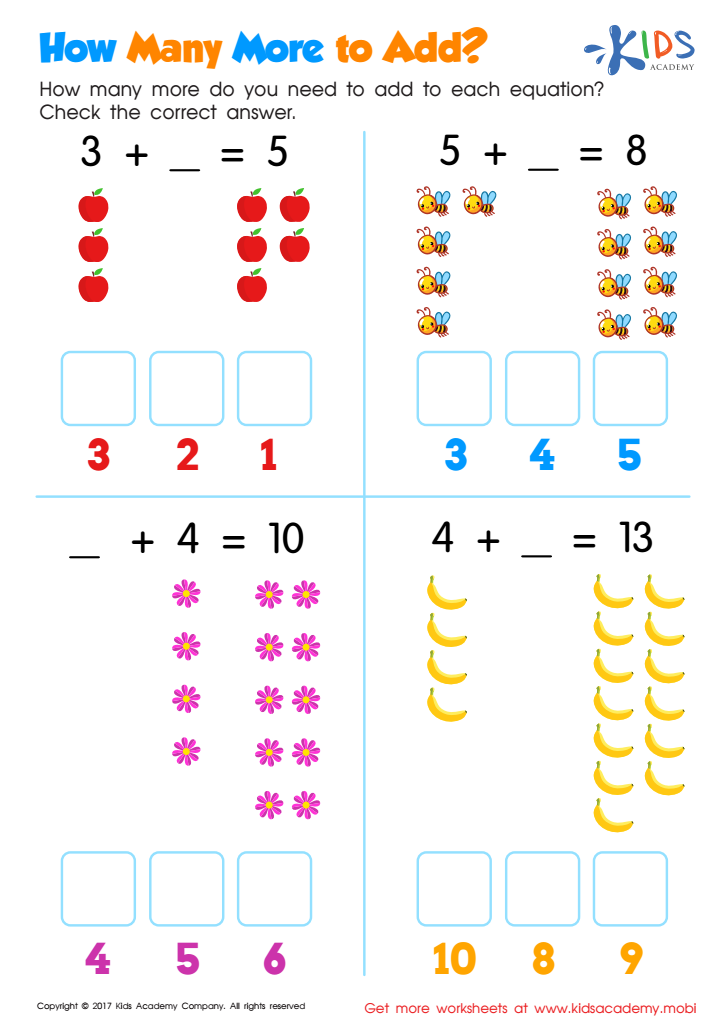
How Many More to Add Worksheet
Sharpen your child's math skills with this pdf worksheet. Help them figure out how many apples, bees, flowers and bananas are needed to reach the answer given. The possible answers are provided at the bottom of the boxes. Have some fun doing some addition and subtraction magic together and get those math skills sharpened!
 Assign to My Students
How Many More to Add Worksheet
Worksheet
Join Kids Academy for Free
Who is primarily going to use this learning content?





.jpg)


Basic subtraction and addition are foundational skills essential for young children's cognitive development and everyday life. For children aged 3-7, understanding these concepts is not just about numbers; it's about building critical thinking and problem-solving abilities. Early exposure to addition and subtraction enriches children's mathematical comprehension, paving the way for more complex concepts later in their education.
Parents and teachers should care about these skills because they help develop logical reasoning and enhance children's ability to make sense of the world around them. Through hands-on activities—like counting objects, sharing snacks, or playing interactive games—children learn to recognize patterns, establish relationships, and practice decision-making. These interactions also nurture attributes like patience, perseverance, and cooperation.
Moreover, mastery in basic arithmetic fosters confidence. Children who are comfortable with simple math are more likely to engage positively with future mathematical endeavors. Since early math skills are strongly linked to later academic success, instilling these abilities at a young age will better equip children for advanced studies.
In summary, engaging young learners in basic subtraction and addition is crucial, ensuring they cultivate a solid mathematical foundation that supports their ongoing educational journey.








