
Understanding equations Addition Worksheets for Ages 3-7
4 filtered results
Difficulty Level
Grade
Age
-
From - To
Subject
Activity
Standards
Dive into our "Understanding Equations Addition Worksheets" tailored for children ages 3-7! These engaging worksheets foster early math skills by introducing foundational concepts of addition. Designed to make learning fun, they feature vibrant illustrations and interactive problems that help young learners grasp the basics of equations. Each activity encourages critical thinking and problem-solving as children explore various ways to represent addition, promoting a solid understanding of numbers. Ideal for parents and educators, these worksheets are an invaluable resource for nurturing mathematical confidence and competence. Start your child's journey towards mastering addition today with our curated selection of worksheets!
Favorites
With answer key
Interactive
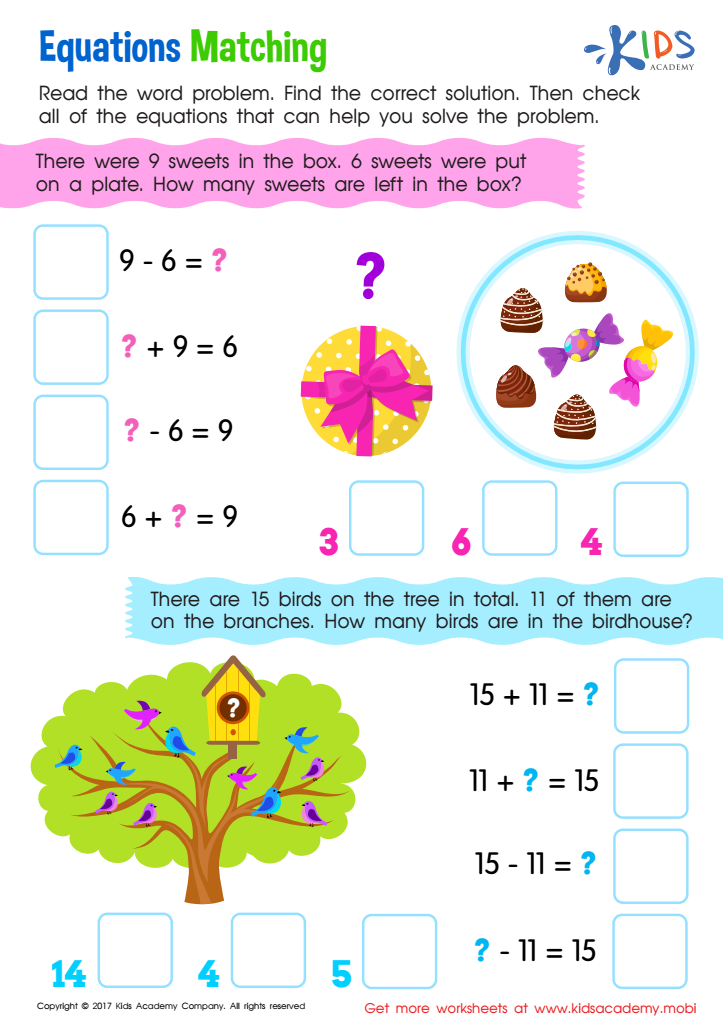
Equations Matching Word Problems Worksheet
Download this worksheet and give your young mathematician practice in solving equations using matching numbers and number family facts. They'll solve word problems, develop critical thinking and algebraic reasoning, and gain success with addition and subtraction.
 Assign to My Students
Equations Matching Word Problems Worksheet
Worksheet
Join Kids Academy for Free
Who is primarily going to use this learning content?








Understanding equations and addition at an early age is crucial for the developmental growth of children between the ages of 3 to 7. During these formative years, children are highly receptive to learning mathematical concepts, laying the groundwork for future academic success.
When parents and teachers emphasize understanding equations and addition, they are not just teaching simple math; they are helping children develop critical thinking, problem-solving skills, and a positive attitude towards math. Early familiarity with numbers and basic equations can demystify mathematics, making it more approachable as children progress in their education.
Furthermore, grasping addition is fundamental for everyday life skills, such as managing money, time, and even planning. Children equipped with these skills are better prepared to tackle more complex math concepts as they advance through school, reducing anxiety associated with mathematics later on.
Encouraging playful and interactive methods of learning addition can also foster a love for learning and collaboration among peers, making math a fun part of their daily experiences. Ultimately, parents and teachers play a pivotal role in nurturing a child's ability to understand equations, fostering a lifelong appreciation for mathematics and promoting a solid foundation for future learning.








