
Word Recognition Addition Worksheets for Ages 3-7
5 filtered results
Difficulty Level
Grade
Age
-
From - To
Subject
Activity
Standards
Boost your child's early literacy and math skills with our engaging Word Recognition Addition Worksheets for ages 3-7! Designed to help young learners understand addition concepts through interactive word recognition activities, these worksheets combine words and numbers in a fun and educational way. Children will develop their vocabulary, enhance reading skills, and grasp the fundamentals of addition as they complete colorful, age-appropriate tasks. Each worksheet supports critical thinking while making learning enjoyable. Perfect for homeschooling, classroom use, or supplemental practice, our resources ensure that your little ones build a strong foundation in math and language, paving the way for future academic success!
Favorites
With answer key
Interactive
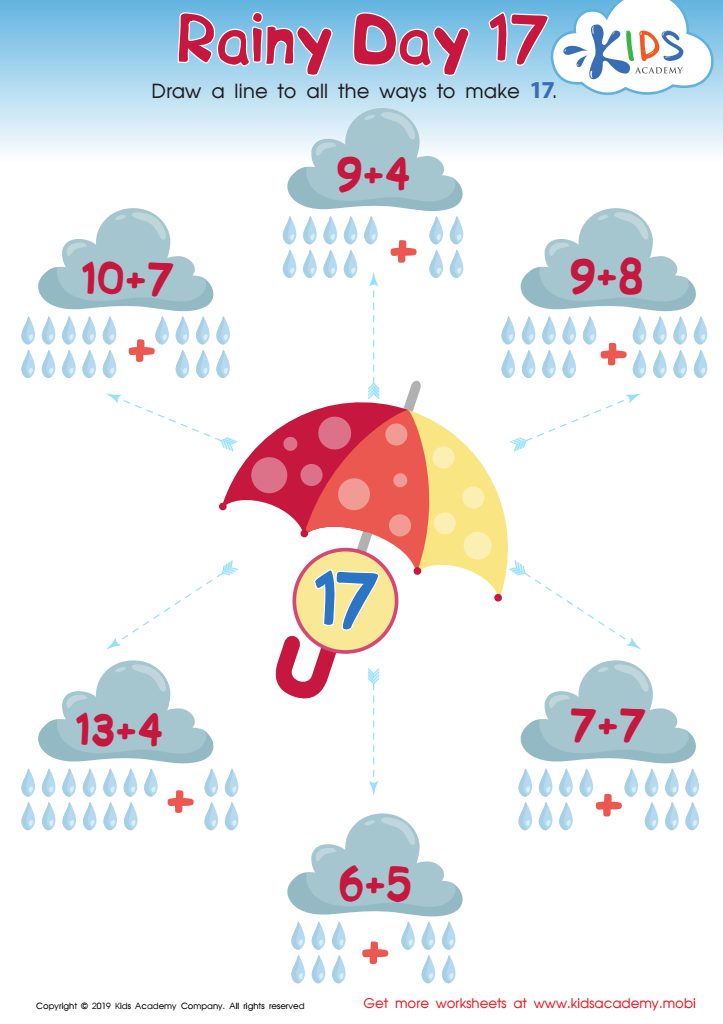
Rainy Day 17 Worksheet
Assist your kids with the 6 equations given. Each cloud displays the sum of two numbers, some of which make 17. Guide them to figure out the total of both numbers when added and draw a line to the umbrella in the center to illustrate the different ways to make 17. This activity will sharpen their addition skills.
 Assign to My Students
Rainy Day 17 Worksheet
Worksheet
Join Kids Academy for Free
Who is primarily going to use this learning content?








Word recognition is a crucial skill for children ages 3-7 as it lays the foundation for reading and language development. During these formative years, children are beginning to make sense of the words they see and hear, which helps them develop comprehension skills and vocabulary.
When children effectively recognize words, they experience increased confidence and enjoyment in reading, making them more likely to engage with texts and literature. For parents and teachers, emphasizing word recognition helps foster a love for reading and encourages children to explore storytelling, which can enhance critical thinking and creativity.
Moreover, early mastery of word recognition is linked to future academic success. It simplifies the process of decoding unfamiliar words and allows children to concentrate on understanding the meaning behind the text rather than getting bogged down by pronunciation.
By focusing on word recognition from an early age, parents and teachers can create a supportive learning environment that nurtures language skills. Providing practical activities—like matching words to images or reading together—can reinforce both word recognition and overall literacy development, setting children on a positive trajectory in their educational journey. This early intervention ultimately supports not just reading proficiency but also a lifelong love of learning.








