Counting skills Arrays Worksheets for Ages 3-7
3 filtered results
-
From - To
Unlock your child's potential with our Counting Skills Arrays Worksheets tailored for ages 3-7! These engaging printables introduce young learners to counting through visually appealing arrays, helping them grasp fundamental math concepts. By using patterns and organized groups, children will enhance their counting abilities while having fun. Our worksheets foster critical thinking and problem-solving skills, making learning an enjoyable adventure. Designed by educators, each worksheet aligns with early learning standards, offering various difficulty levels to suit your child’s needs. Dive into a world of exploration and excitement as your little ones become confident counters, laying a strong foundation for future mathematical success!
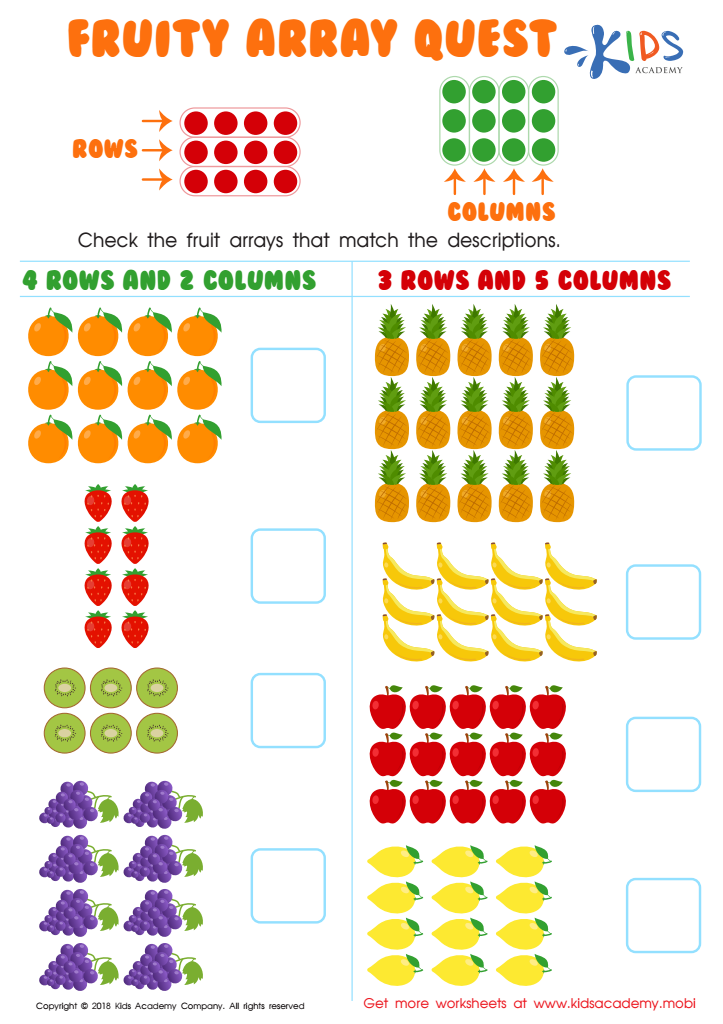
Fruity Array Quest Worksheet
 Assign to My Students
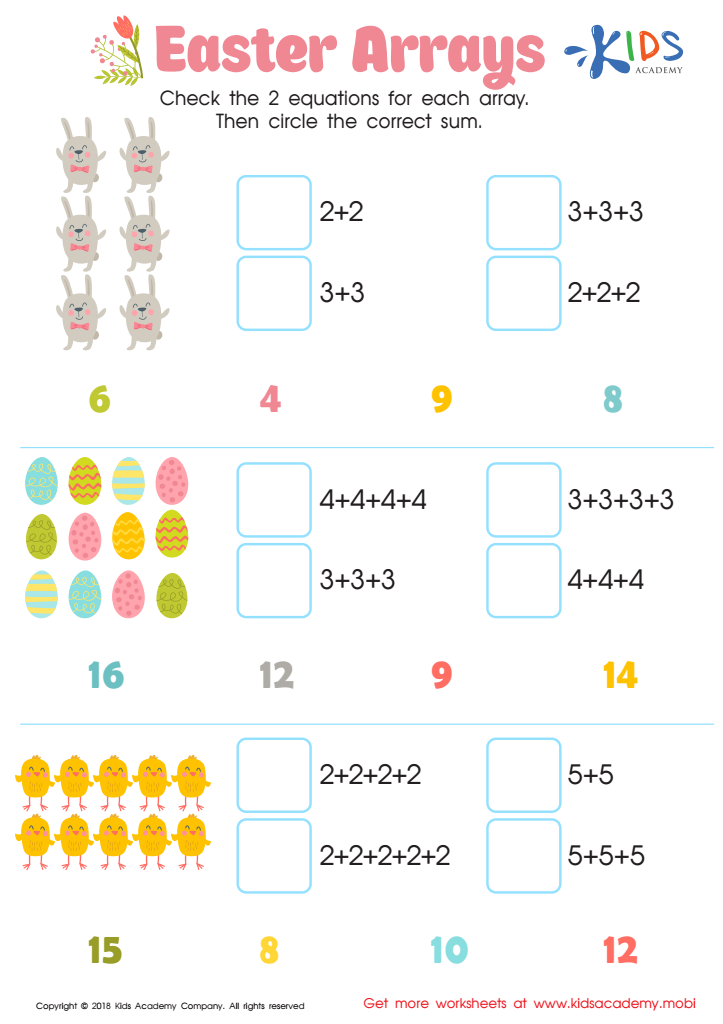
Easter Arrays Worksheet
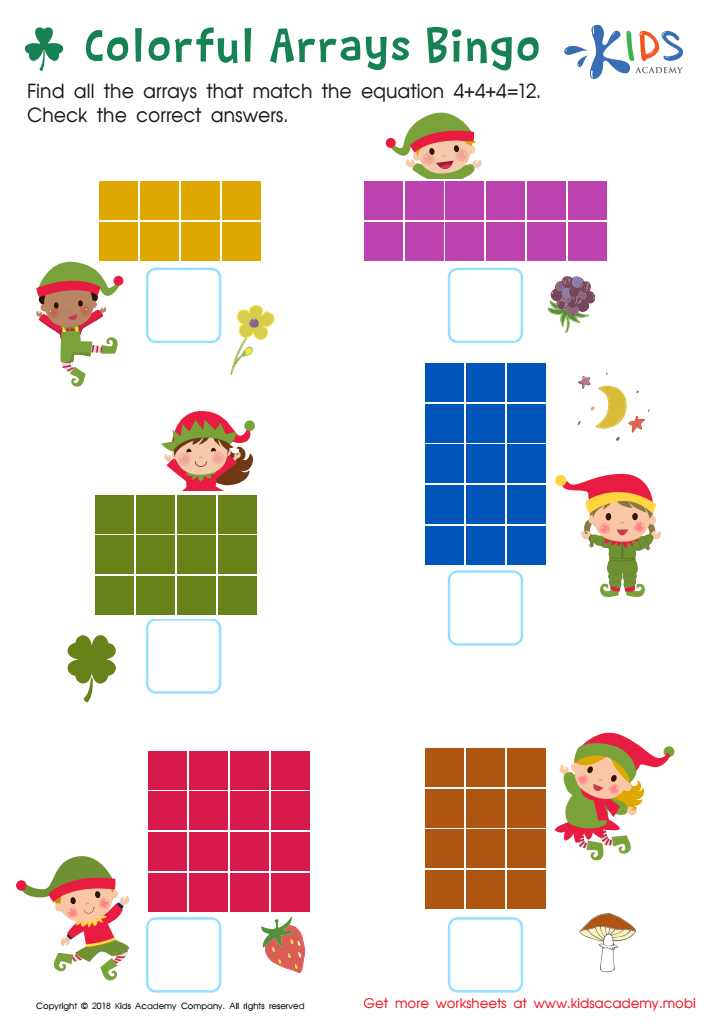
Colorful Arrays Bingo Worksheet








Counting skills are fundamental for young learners aged 3-7, laying the groundwork for future mathematics comprehension. Understanding arrays—the arrangement of objects in rows and columns—enhances spatial awareness and helps children grasp multiplication concepts early on. When parents and teachers focus on these skills, they're not just teaching children to count; they're promoting critical thinking and problem-solving abilities.
Building counting skills through arrays enables children to see the relationships among numbers. For example, arranging objects into two rows of five visually demonstrates that 2 multiplied by 5 equals 10. This tangible representation strengthens number sense and mathematical reasoning. Furthermore, engaging with arrays can foster pattern recognition and help develop fine motor skills through activities like building with blocks or sorting objects.
By nurturing these skills, parents and teachers provide a satisfying and enjoyable learning experience that boosts confidence and curiosity in mathematics. Therefore, attention to counting skills and arrays isn't merely an academic concern; it paves the way for success in more complex mathematical concepts, prepares students for standardized testing, and equips them with life skills necessary for everyday quantitative reasoning. In today’s world, where numeracy is essential, fostering these skills from an early age is vital for overall developmental growth.








