
Analog clock reading Math Worksheets for Ages 3-7
4 filtered results
Difficulty Level
Grade
Age
-
From - To
Subject
Activity
Standards
Introduce young learners to the art of telling time with our Analog Clock Reading Math Worksheets, specially designed for ages 3-7! These engaging, hands-on worksheets simplify time-telling by breaking down clock components and enhancing time reading skills. With vibrant illustrations and age-appropriate exercises, children will master reading hour and minute hands effortlessly while having fun. Perfectly tailored to lay a solid foundation in both math and everyday skills, our worksheets promote confidence, accuracy, and a lifelong love of learning. Whether at home or in the classroom, make time-telling an exciting adventure with our kid-friendly analog clock resources!
Favorites
With answer key
Interactive
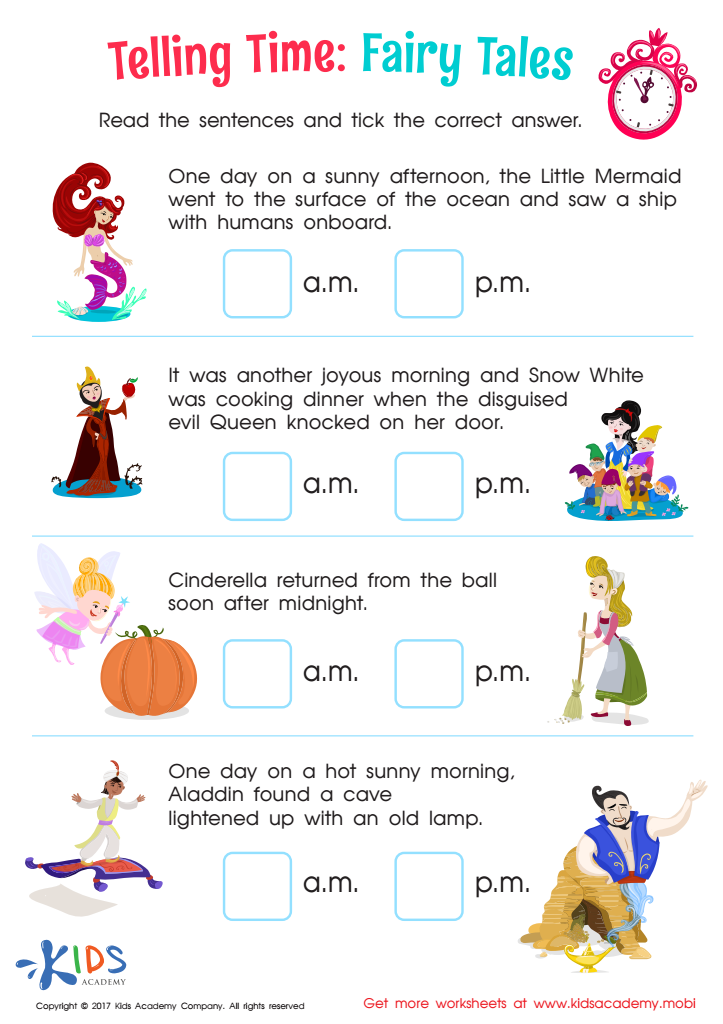
Telling Time: Fairy Tales Worksheet
Bring your child's imagination to life with classic fairy tales! This colorful telling time worksheet has it all: The Little Mermaid, Cinderella, and more! Plus, your child will have fun learning to distinguish a.m. from p.m. with this charming worksheet.
 Assign to My Students
Telling Time: Fairy Tales Worksheet
Worksheet
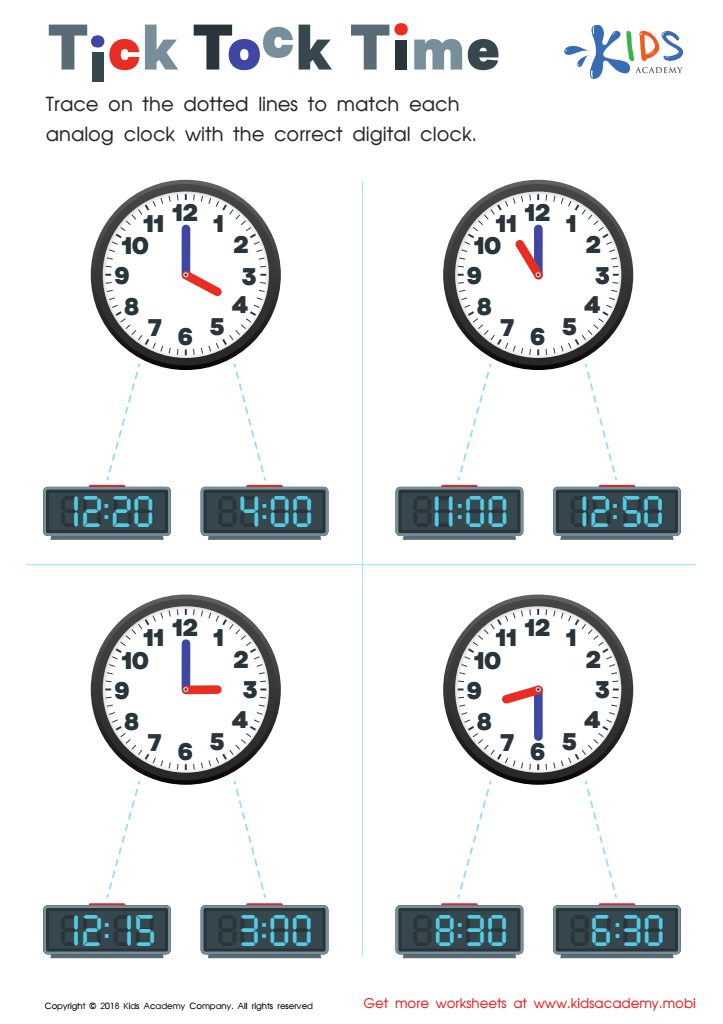
Tick Tock Time Worksheet
Trace the dotted lines on this worksheet to match analog and digital clocks! It's a great way to help your kids learn time-telling. They'll get better at converting analog to digital, and vice versa. Get your children to try it - it's a fun way to practice!
Tick Tock Time Worksheet
Worksheet
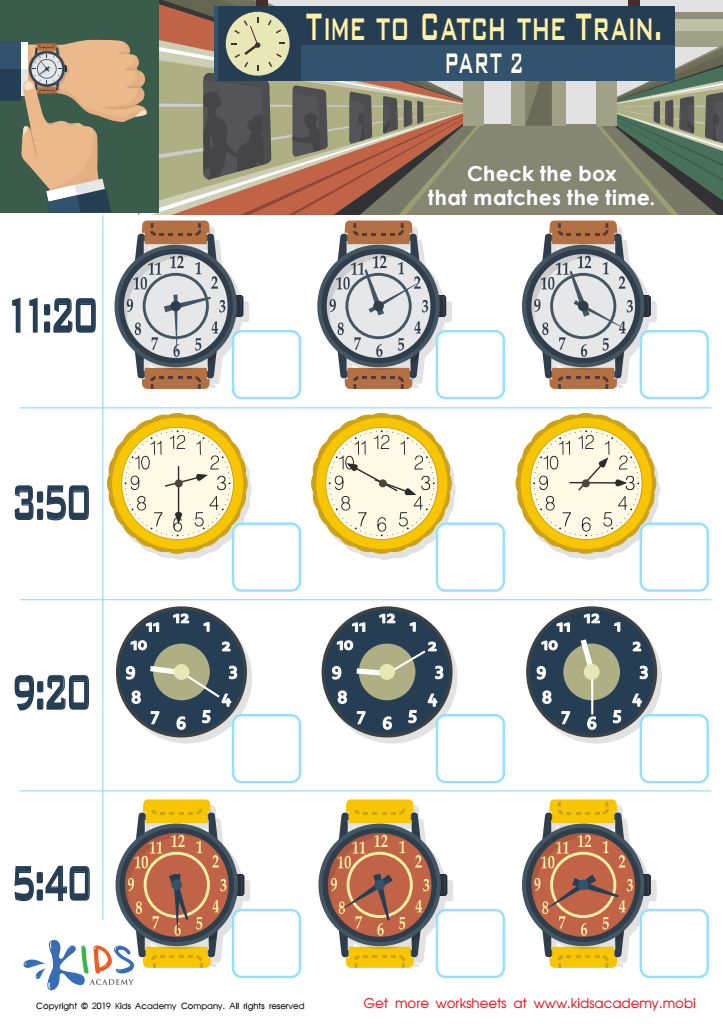
Time to Catch the Train Part 2 Worksheet
Teach your kids the importance of telling time and how to do it. Explain that there are multiple ways to show the time, such as written on the left side or watches in the picture. Guide them to check the box that matches the time. Knowing the time is essential to get things done and create order. Ensure your kids understand this and they will reap the benefits.
Time to Catch the Train Part 2 Worksheet
Worksheet
Join Kids Academy for Free
Who is primarily going to use this learning content?






.jpg)

Analog clock reading is a fundamental skill for young children, aged 3-7, as it not only helps them understand the concept of time but also enhances their overall cognitive and mathematical development. Parents and teachers should prioritize teaching this skill for several reasons.
Firstly, learning to read an analog clock establishes a clear understanding of the passage of time and the structure of the day, which is crucial for developing time management skills. This awareness fosters independence as children learn to anticipate daily events and routines.
Secondly, analog clocks provide an excellent context for practicing and reinforcing key math concepts. As children discern hours and minutes, they enhance their counting skills, understand the concept of partitioning a whole into equal parts, and grasp basic arithmetic concepts like addition and subtraction.
Moreover, telling time requires recognizing and interpreting numerical representations in a circular format, which builds spatial reasoning and problem-solving skills. These skills are foundational for more complex mathematical concepts and operations that children will encounter in later grades.
Additionally, the ability to read analog clocks lays the ground for future academic success and everyday life skills. It bridges the gap between abstract mathematical concepts and tangible real-world applications, thereby making math a relevant and engaging subject for young learners.
Encouraging proficiency in analog clock reading fosters a child’s confidence and competence in navigating both their educational journey and daily life.








