
Comparative analysis Math Worksheets for Ages 3-7
4 filtered results
Difficulty Level
Grade
Age
-
From - To
Subject
Activity
Standards
Explore our engaging Comparative Analysis Math Worksheets designed specifically for children ages 3-7. These interactive resources help young learners develop essential math skills by comparing quantities, sizes, and attributes. Our worksheets are filled with colorful illustrations and age-appropriate activities that encourage critical thinking and problem-solving. By using these worksheets, children will enhance their understanding of comparative concepts while enjoying playful learning experiences. Perfect for both home and classroom settings, our worksheets align with educational standards to support early math development. Start building a strong foundation in mathematics for your little ones today!
Favorites
With answer key
Interactive
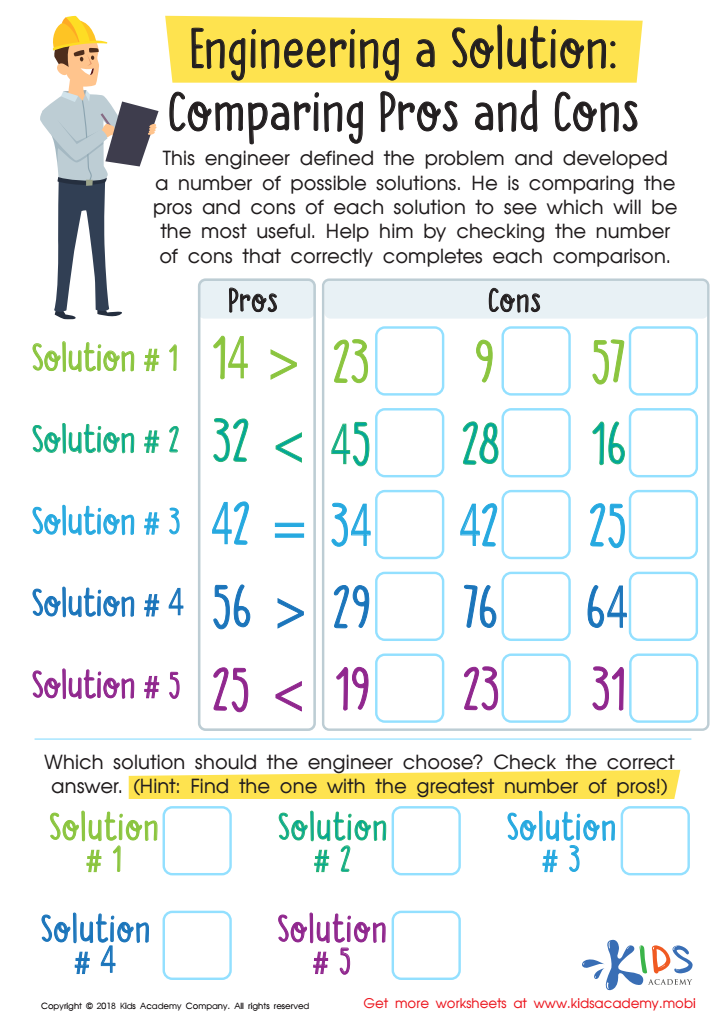
Engineering a Solution: Comparing Pros and Cons Worksheet
Help our little engineers assist the engineer in making a decision! They will solve the equations using greater than, less than, and equal to, and then decide the best solution for the problem using the pros and cons of each.
 Assign to My Students
Engineering a Solution: Comparing Pros and Cons Worksheet
Worksheet
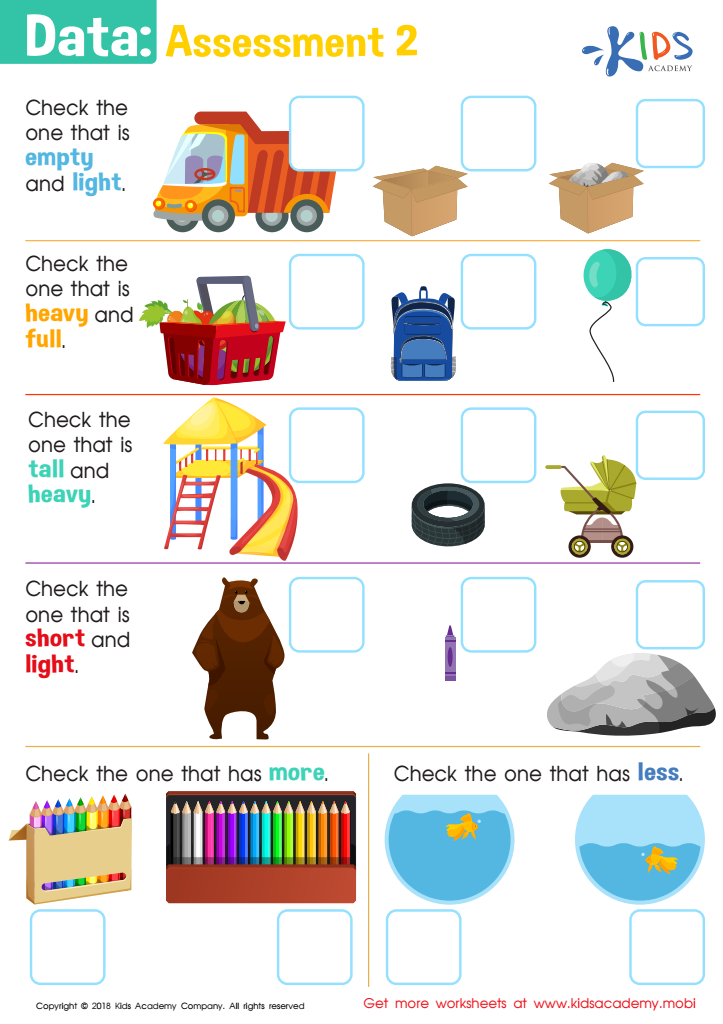
Data: Assessment 2 Worksheet
This PDF helps you assess your students' understanding of concepts like empty/light, full/heavy, tall/short, and more/less. With this worksheet, students use pictures to answer questions and check off the appropriate box. It's a fast, easy way to determine what concepts they have learned and which need more work.
Data: Assessment 2 Worksheet
Worksheet
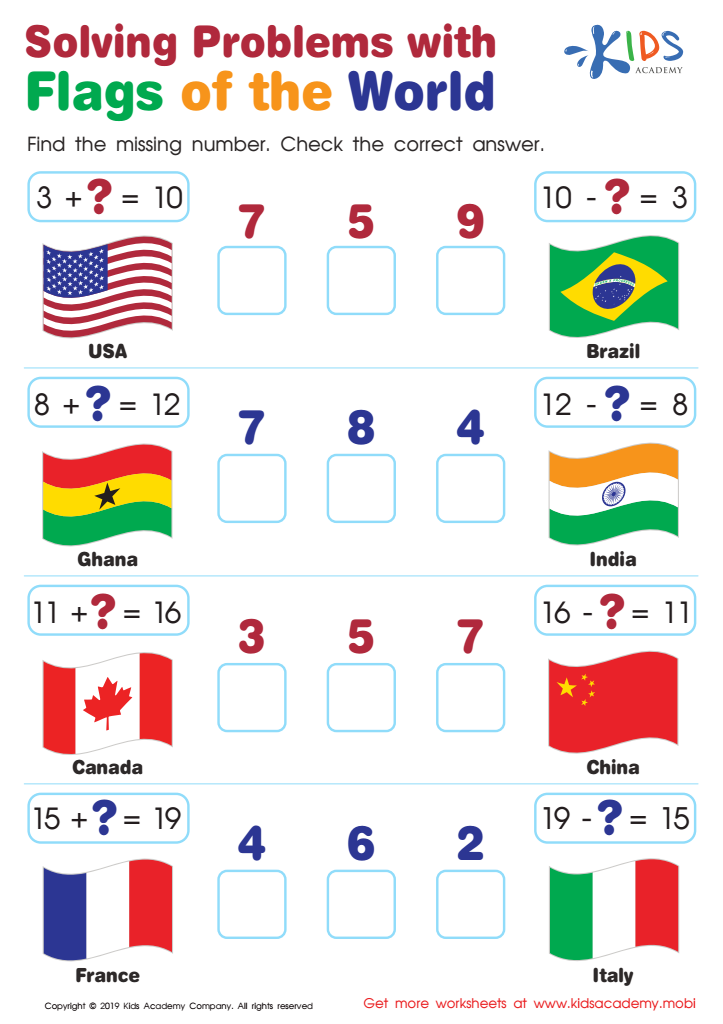
Solving Problems with Flags of the World Worksheet
Name some countries you know with your kids, then introduce their flags with this worksheet. Help them find the missing number in each addition problem, and then check the answer. It's a fun way to learn about different countries near and far.
Solving Problems with Flags of the World Worksheet
Worksheet
Join Kids Academy for Free
Who is primarily going to use this learning content?








Comparative analysis in math for children aged 3-7 is crucial for developing foundational numerical skills and enhancing cognitive abilities. At this stage, children are naturally curious and explore mathematical concepts through their environment. Teachers and parents should care about this approach as it encourages children to understand numbers not just as isolated entities, but through relationships. By comparing quantities, sizes, or other attributes, children learn to think critically and evaluate information, laying the groundwork for problem-solving skills.
Engaging in comparative analysis aids in the development of logical reasoning, as children begin to categorize and make sense of the world around them. This early mathematical literacy fosters a positive mindset towards math, reducing anxiety associated with the subject later in life. Furthermore, comparative analysis supports verbal development; children learn to articulate their thinking, enhancing their communication skills.
Incorporating these analyses in fun, age-appropriate activities doesn't only make math accessible but also enjoyable, strengthening the home-school connection. Ultimately, understanding and supporting comparative analysis in early math leads to a more profound educational experience, equipping children with essential skills for future academic success and everyday problem-solving. Parents and teachers play a vital role in nurturing these early mathematical explorations.








