Understanding measurements Math Worksheets for Ages 3-7 - Page 2
25 filtered results
-
From - To
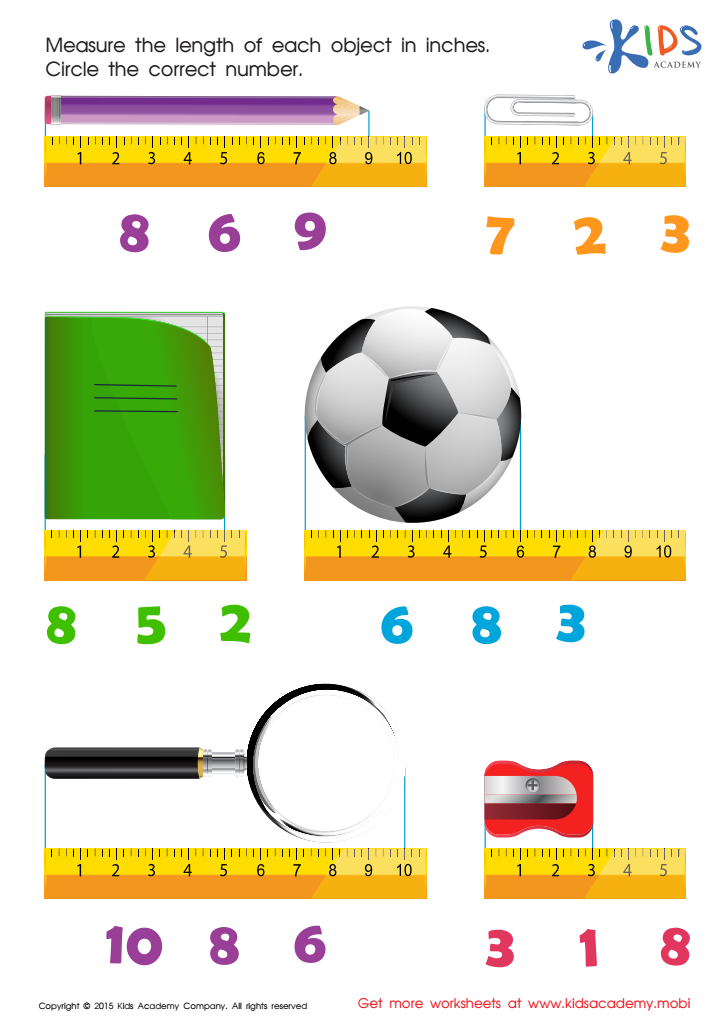
Learning measuring objects in inches Worksheet
 Assign to My Students








Understanding measurements is vital for children aged 3-7 as it lays the foundation for critical thinking, problem-solving, and real-world applications. This early exposure not only fosters mathematical skills but also enhances children's ability to interpret and navigate their environment. Measurements help children make sense of concepts like size, volume, weight, and time, all of which are integral to daily activities, whether it’s cooking, playing, or organizing their toys.
By engaging with measurement, children develop spatial awareness and learn to compare and contrast different objects. Activities such as measuring ingredients for a recipe or determining how tall they are compared to a friend encourage hands-on learning and make abstract ideas tangible. Moreover, these skills will serve them well in future academic pursuits, supporting their progression in math.
Teachers and parents play a crucial role in this learning journey. By incorporating fun, measurement-based activities at home or in the classroom, adults can help cultivate curiosity and a positive attitude toward math. Ultimately, prioritizing understanding of measurements from an early age equips children not just with math skills but also with a framework for logical thinking that will benefit them throughout their educational journey and beyond.








