Comparing objects Measurement Worksheets for Ages 3-7
3 filtered results
-
From - To
Discover engaging and educational Comparing Objects Measurement Worksheets designed for children aged 3-7. These interactive printables introduce young learners to essential measurement concepts such as size, length, weight, and volume through fun activities. Each worksheet challenges kids to compare different objects, promoting critical thinking, observation skills, and foundational math knowledge. Perfect for classrooms or homeschooling, these worksheets cater to various skill levels, ensuring every child can build confidence and proficiency in measurement. Encourage your child’s curiosity and support their learning journey with our expertly crafted worksheets that make measurement both enjoyable and educational.
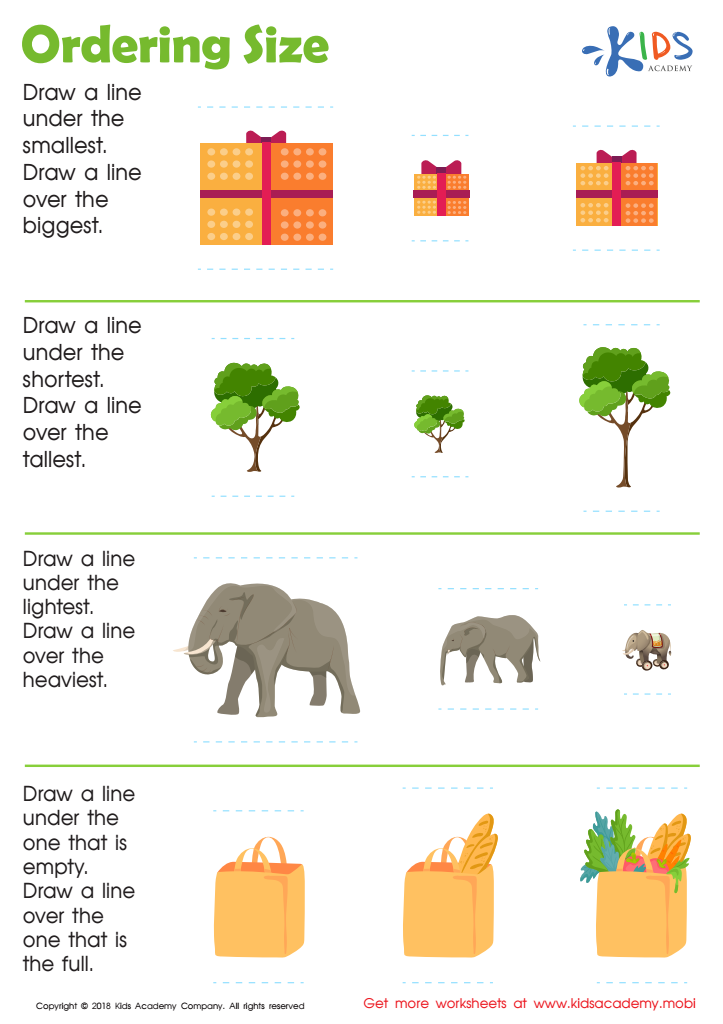
Ordering Size Worksheet
 Assign to My Students
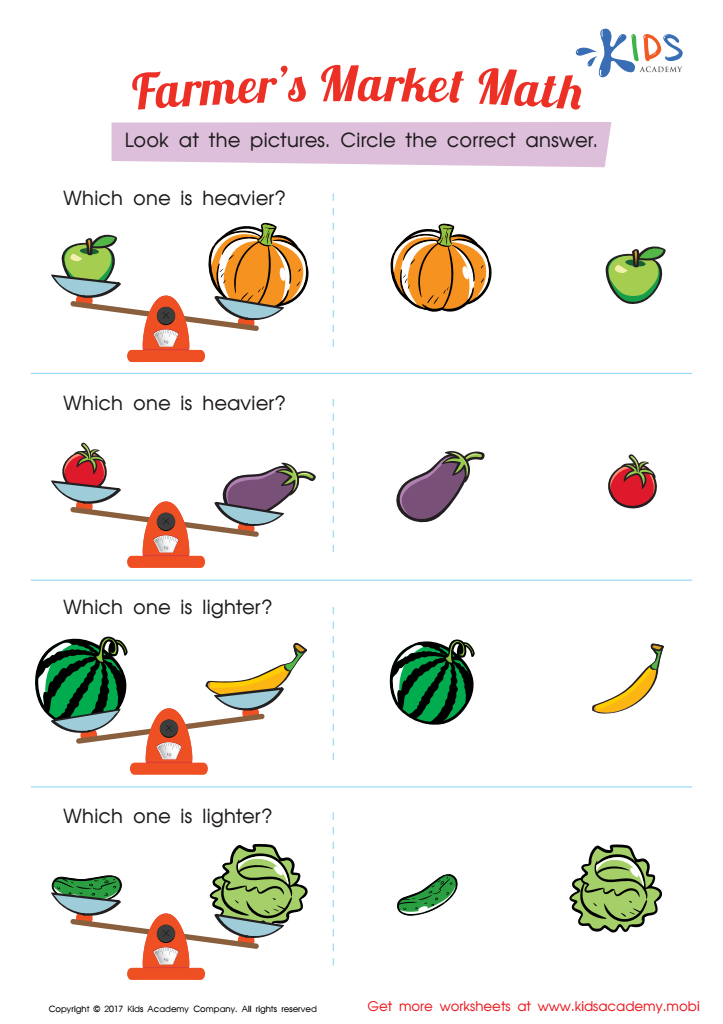
Which One Is Heavier Worksheet
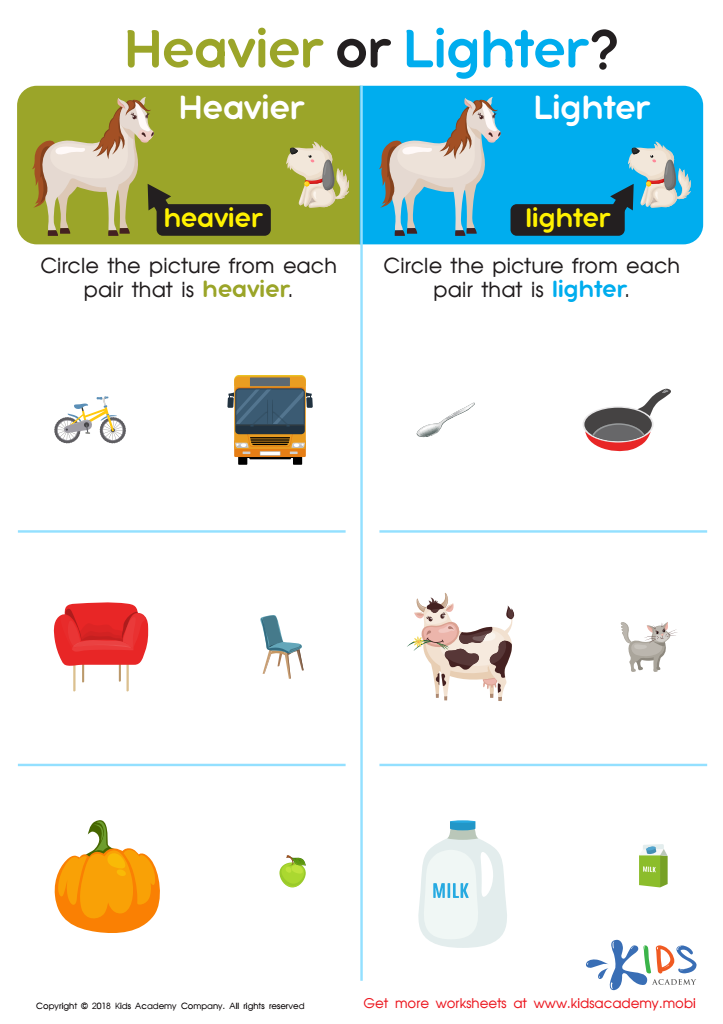
Heavier or Lighter? Worksheet








Comparing objects through measurement is fundamental for young children aged 3-7, laying the groundwork for critical thinking and mathematical understanding. Parents and teachers should prioritize this because it helps kids develop essential cognitive and analytical skills early on. When children compare objects by size, length, weight, and volume, they engage in practical problem-solving and logical reasoning, which are foundational to later mathematical concepts.
Such exercises cultivate observation and description skills, which are the basis of scientific thinking. For instance, when a child determines that a pencil is longer than a crayon, they learn to focus on properties and attributes of objects, fostering attention to detail.
Moreover, comparing objects promotes language development. As children articulate their observations ("This ball is heavier than that one"), they expand their vocabulary and learn to express complex ideas clearly. This form of measurement also involves collaborating and communicating with peers or adults, which enhances social skills.
Lastly, early engagement with measurement provides hands-on learning experiences, making abstract concepts more tangible. This connection to the real world can nurture a lifelong interest in mathematics and science, encouraging children to explore and understand their environment more deeply. In sum, these activities serve as crucial building blocks for varied academic and life skills.








