
Understanding opposites Measurement Worksheets for Ages 3-7
3 filtered results
Difficulty Level
Grade
Age
-
From - To
Subject
Activity
Standards
Explore our "Understanding Opposites Measurement Worksheets" designed for children ages 3-7! These engaging and visually appealing worksheets help young learners grasp the concept of opposites in measurement through fun activities and exercises. Kids will discover pairs like tall/short, heavy/light, and long/short, enhancing their comprehension of comparative terms. By working through these worksheets, children develop critical thinking skills and begin to understand measurement concepts in a playful way. Perfect for homeschooling or classroom settings, these resources make learning enjoyable and interactive. Download our worksheets today and watch your child's confidence grow as they master the world of opposites in measurements!
Favorites
With answer key
Interactive
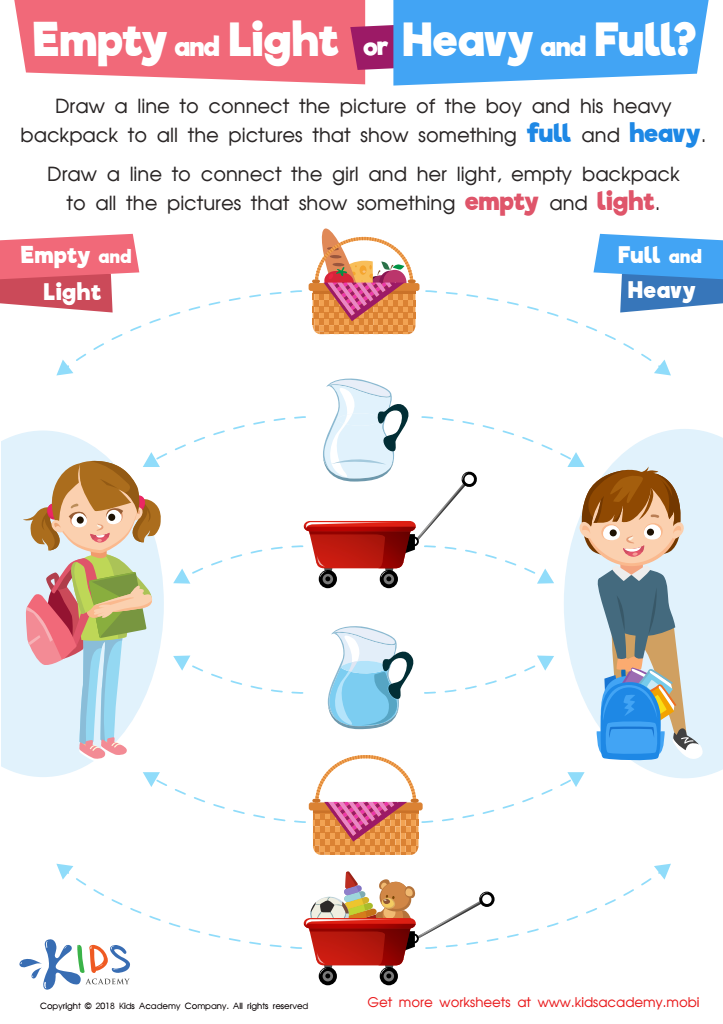
Empty and Light or Heavy and Full? Worksheet
Kids can have trouble understanding measurement, like the differences between heavy and light. This worksheet helps them associate full with heavy and empty with light, using familiar images. Plus, it's a fun way to practice fine motor skills, tracing the lines to connect the pictures.
 Assign to My Students
Empty and Light or Heavy and Full? Worksheet
Worksheet
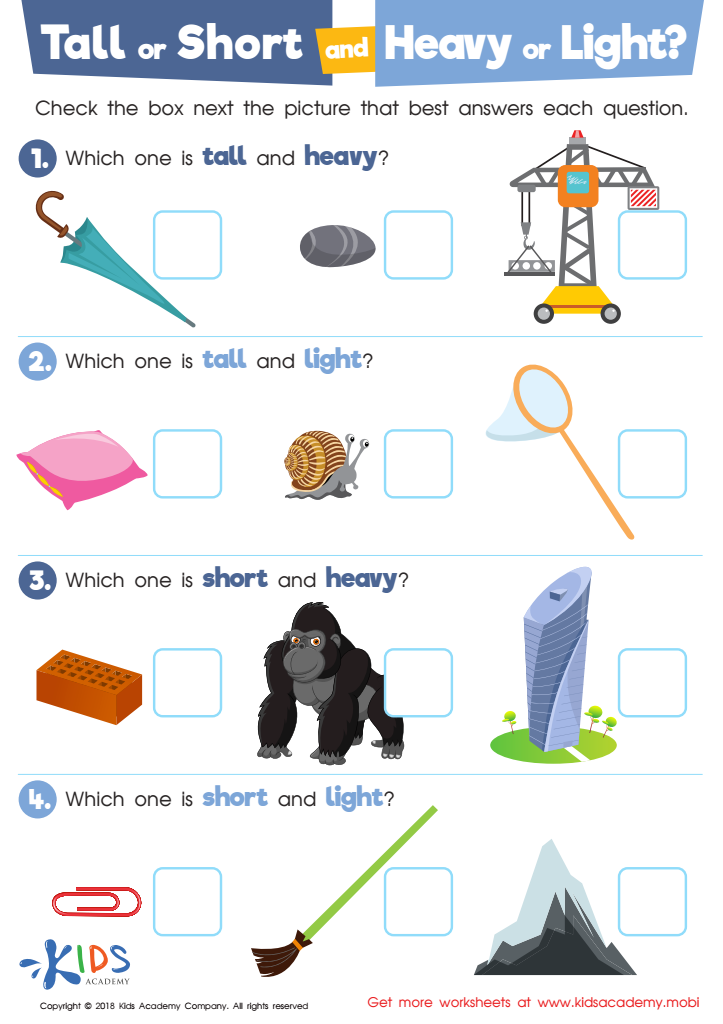
Tall or Short and Heavy or Light? Worksheet
Young children can find basic measurement concepts tricky. This PDF introduces them to the appropriate vocabulary for describing heavy, light, tall and short items, by using familiar pictures. It helps them accurately select which items fit each category.
Tall or Short and Heavy or Light? Worksheet
Worksheet
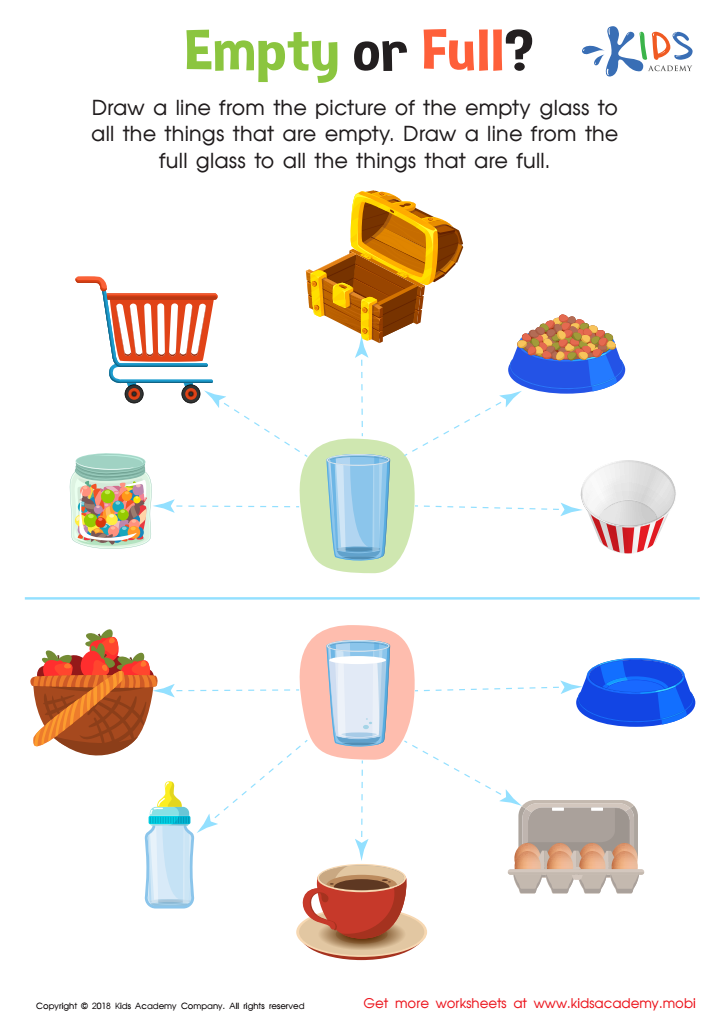
Empty or Full? Worksheet
Let students get to grips with the concepts of empty and full with this PDF worksheet. It uses fun, bright pictures to help them comprehend the difference and also helps develop fine-motor skills with tracing lines. Kids will be proud of themselves as they get answers right!
Empty or Full? Worksheet
Worksheet
Join Kids Academy for Free
Who is primarily going to use this learning content?








Understanding opposites and measurement is fundamental for young children, particularly between the ages of 3 to 7, as it lays the groundwork for critical cognitive and linguistic development. Recognizing opposites enhances vocabulary and helps children articulate their experiences clearly. For instance, knowing the difference between 'hot' and 'cold' or 'big' and 'small' fosters their ability to categorize and make comparisons, vital skills for problem-solving and reasoning.
Measurement concepts, including sizing, weight, and volume, introduce children to basic math and science fundamentals. Activities that involve sorting, comparing, or estimating sizes and quantities promote spatial awareness, which aids in later mathematical understanding. Children learn to express quantity and dimension, linking spatial concepts to eventual understanding of more complex mathematical operations.
Moreover, lessons on measurement and opposites can encourage critical thinking. When children engage in discussions about their findings—like “tall vs. short” or “light vs. heavy”—they develop observational skills and begin drawing conclusions based on evidence. This early education sets the stage for future learning across all subjects. Thus, parents and teachers should prioritize these foundational concepts, ensuring a richer learning experience that promotes mathematical thinking and effective communication from a young age.








