
Time recognition Time Worksheets for Ages 3-7
3 filtered results
Difficulty Level
Grade
Age
-
From - To
Subject
Activity
Standards
Discover our engaging Time Recognition Worksheets designed specifically for children aged 3-7. These worksheets provide interactive and fun activities to help young learners grasp the concept of time. With vibrant illustrations and graded complexity, kids will enjoy recognizing clocks, identifying hours and minutes, and honing their time-telling skills. Our resources cater to various learning styles, making it easier for parents and educators to reinforce concepts at home or in the classroom. Perfect for early mathematics curriculum, these worksheets lay a strong foundation in time recognition, preparing children for future learning. Start your child's journey towards mastering time today!
Favorites
With answer key
Interactive
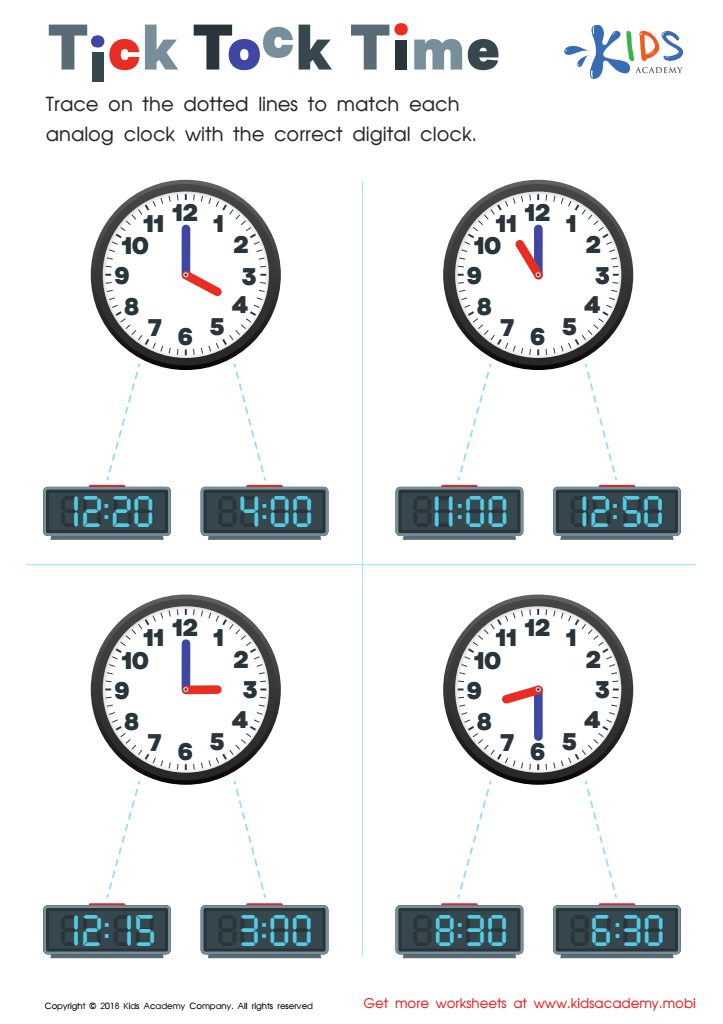
Tick Tock Time Worksheet
Trace the dotted lines on this worksheet to match analog and digital clocks! It's a great way to help your kids learn time-telling. They'll get better at converting analog to digital, and vice versa. Get your children to try it - it's a fun way to practice!
 Assign to My Students
Tick Tock Time Worksheet
Worksheet
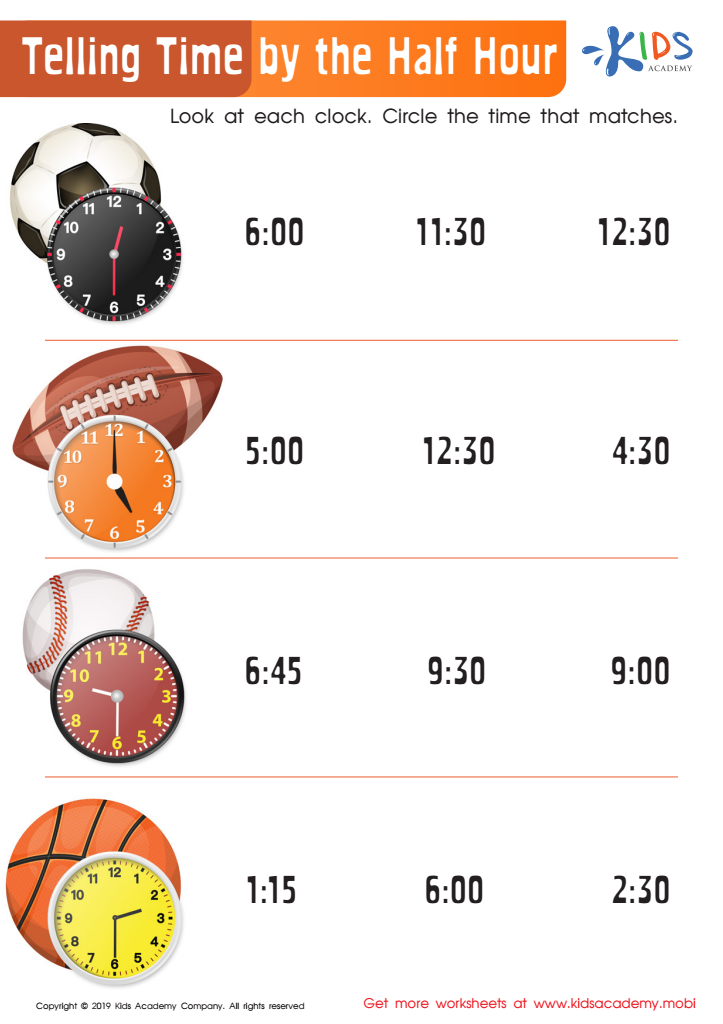
Telling Time by the Half Hour Worksheet
Teach kids to tell time with this worksheet! Four clocks are labeled with different times; help your child circle the right one. It's a great way to teach them to read analog and digital clocks, watches, and written times. Easy and fun learning!
Telling Time by the Half Hour Worksheet
Worksheet
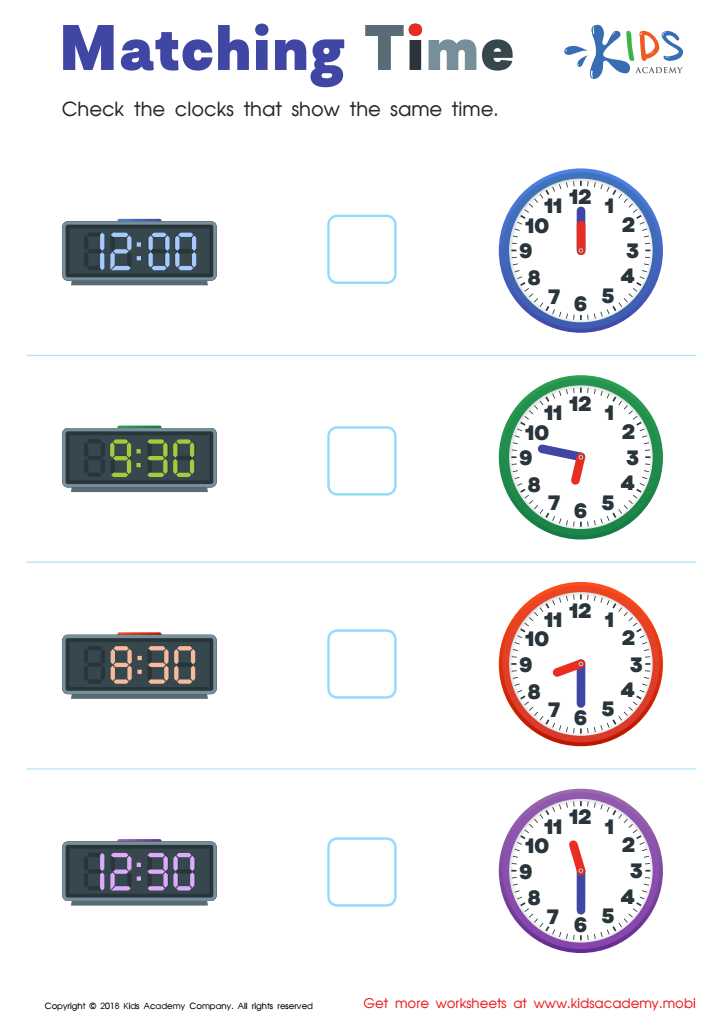
Matching Time Worksheet
Teach your child to read time in both digital and analog formats with this helpful printout. They'll identify clocks that match in both formats and check them off. Colorful and engaging, it's a great way to help your child understand the concept of time-telling.
Matching Time Worksheet
Worksheet
Join Kids Academy for Free
Who is primarily going to use this learning content?







Time recognition is a vital skill for children ages 3-7, laying the foundation for their understanding of routines, scheduling, and ultimately, independence. During these formative years, children begin to build their cognitive and social-emotional skills. Parents and teachers should prioritize time recognition as it aids in the development of these key areas.
Firstly, understanding time helps children manage daily activities and routines. For instance, knowing when it’s time to eat, play, or sleep fosters a sense of security and predictability in their lives. This ability to recognize and adhere to a schedule encourages responsibility and time management skills, which are essential as children progress in their education.
Secondly, time recognition enhances cognitive processing. It introduces children to concepts such as sequencing, which is critical in language and math acquisition. As children learn to read clocks and understand the passage of time, they also improve their attention spans and memory recall.
Lastly, time awareness enriches social interactions. Children can coordinate playdates or group activities more effectively, building friendships and teamwork. Overall, incorporating time recognition into early learning provides children with essential life skills that promote confidence, independence, and social cooperation, making it a crucial focus for parents and teachers alike.








