Understanding number bonds Worksheets for Ages 3-8
3 filtered results
-
From - To
Discover a world of fun and learning with our "Understanding Number Bonds" worksheets, designed specifically for children aged 3-8. Our expertly crafted worksheets help young learners grasp the foundational mathematical concept of number bonds through engaging and interactive activities. By breaking down numbers into easily understandable pairs, children can enhance their addition and subtraction skills, foster problem-solving abilities, and build a strong numerical foundation. Perfect for parents and teachers alike, these printable resources are crafted to suit various learning styles, ensuring that math becomes a delightful and rewarding experience for every child. Explore and download today to enrich your child's early learning journey!
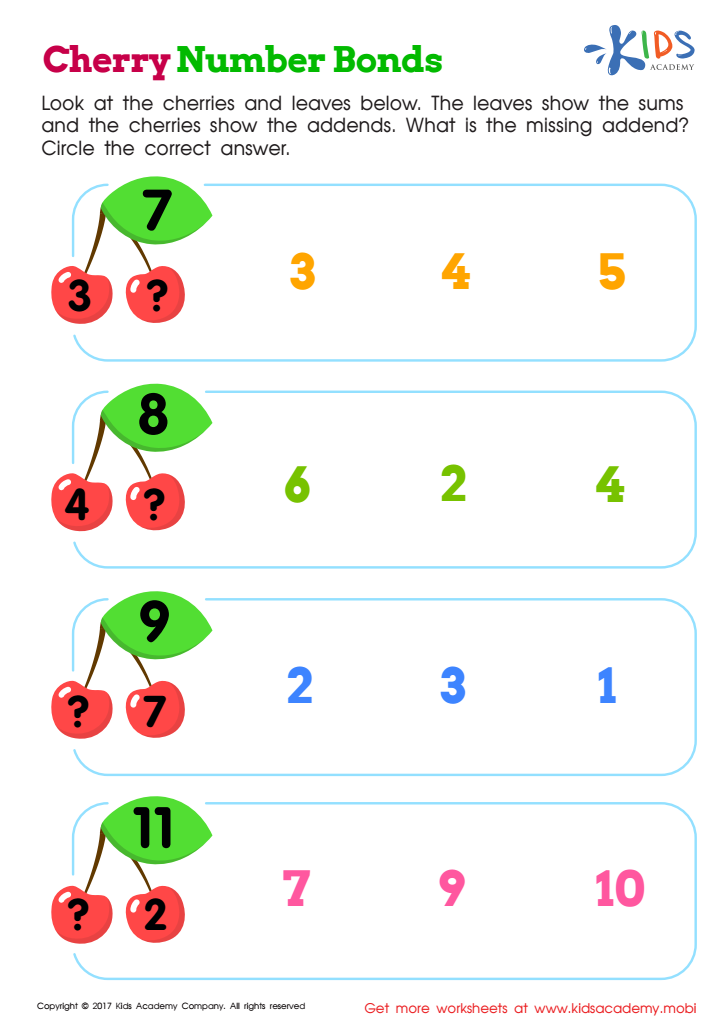
Cherry Number Bonds Worksheet
 Assign to My Students
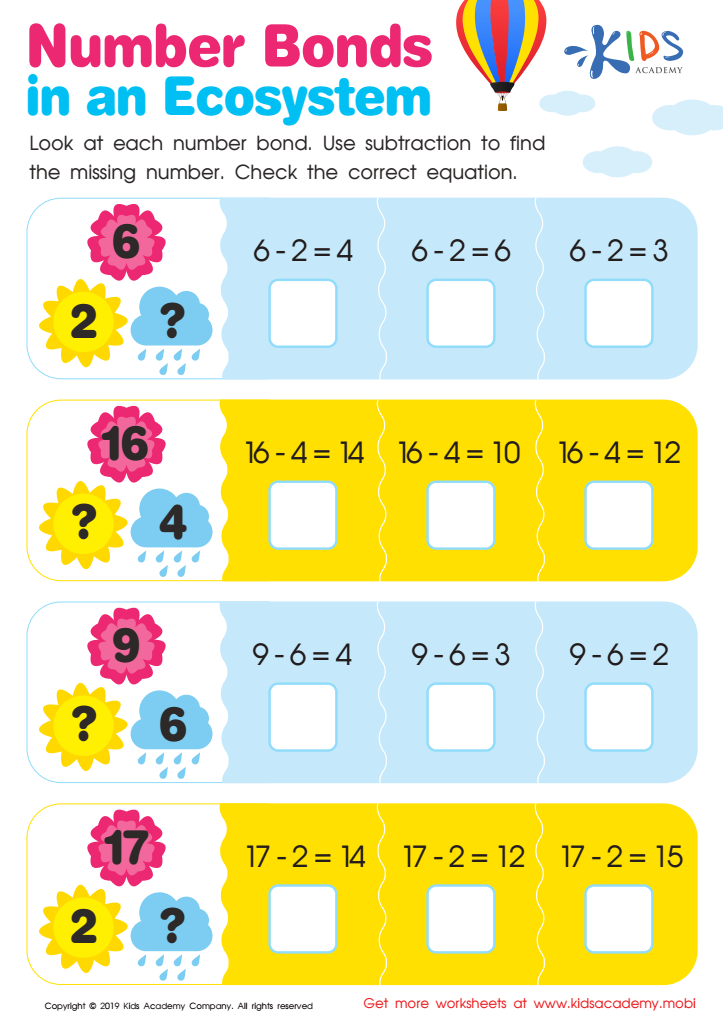
Number Bonds in an Ecosystem Worksheet






Number bonds are a vital mathematical concept that young children ages 3-8 should grasp because they build a strong foundation for future math skills. When parents and teachers prioritize understanding number bonds, they help children see the relationships between numbers, which leads to better arithmetic fluency.
Simply put, number bonds describe how numbers can be split and combined. For example, understanding that 5 can be made from 2 and 3 or 1 and 4 not only aids in basic addition and subtraction but also develops a child's number sense – an intuitive understanding of numbers and their magnitude. This early comprehension makes more complex problems easier as the child progresses in school.
Moreover, recognizing number bonds fosters a child's capacity to approach math problems flexibly, an essential aspect of mathematical thinking. It encourages mental arithmetic, easing the burden of more extensive calculations and paving the way to enjoy and be confident in math.
By actively using tools and strategies like visuals, manipulatives, and engaging activities to teach number bonds, parents and teachers can turn abstract math into tangible concepts for young learners. Ultimately, this solid grounding translates into improved academic performance and a more positive attitude towards math, benefiting children throughout their education and life.








